




Media Campaign Is Key to Lifting Industry’s Image
Expansion of school bus transportation in the 21st century hinges on the industry's efforts to promote its achievements and to erase widespread misconceptions.
As the industry edges into the next millennium, the public image of the school bus has never been more important. That was one of the central themes of the National Association for Pupil Transportation’s 25th annual conference and trade show in Denver. Several of the presentations focused on the need to promote the industry’s accomplishments through public relations on a local, regional and national level. "The way the media reports on school transportation issues has a tremendous influence on the way people think about these issues," said Michael Martin, executive director of the NAPT. Martin discussed the results of a recent survey commissioned by the NAPT and conducted by the research firm Wirthlin Worldwide. The survey was aimed at better understanding the public’s knowledge of school bus safety issues. Survey results from a sampling of approximately 750 Americans showed one-third of respondents believed driving their children to school themselves was the safest form of school transportation. Similarly, they felt that school transportation was of least importance in terms of budget, with textbooks, teacher salaries, enrichment/cultural activities, repair of existing schools and construction of new schools meriting funding priority. According to Martin, these results show that the public is not adequately aware of the safety benefits of the school bus and the importance of supporting its use. A follow-up question, in which respondents were told that the school bus is indeed the safest form of transportation for students, caused a reworking of the funding priorities in which respondents deemed school transportation more important than all other areas. This change in position indicates that people will support school busing if they understand its safety benefits. Martin encouraged the attendees to talk to their local media about this research, in order to get the facts out to the public. In working with the media, he suggested utilizing the safety statistics that appear on the School Bus Information Council web site at www.schoolbusinfo.org. The council was formed by the NAPT and the National Association of State Directors of Pupil Transportation Services (NASDPTS) to provide the media with background information about school transportation. Exposing the facts, Martin explained, is "a way to approach the media in a positive, proactive position and to get them to understand the issue." Charlie Gauthier, executive director of NASDPTS, said the media have begun to use him as a resource for information about the industry. "In the past year, I’ve gotten 400 to 500 calls from the media," Gauthier told a gathering of NASDPTS members. "We’re getting our message out, and the media knows we’re here."
Media Relations 102
Specific information on how to deal with the media was provided by Bill Koch and Barry McCahill in a presentation called "Media Relations 102: Traps and Pitfalls." Koch is vice president of communications at Laidlaw Education Services, and McCahill is senior counselor for Strat@comm in Washington, D.C. They started their presentation with a video segment from the ’70s sitcom The Bob Newhart Show. In the video, Newhart, who played a psychologist, appeared as a guest on a TV news program in which the hostess greeted him with warmth, respect and admiration — until the cameras began rolling. On the air, she attacked him verbally, bombarding him with questions to which there were no good answers, putting words in his mouth and making him look like an idiot. Though Koch and McCahill pointed out that this type of behavior from the media was not the norm, they advised that being aware of techniques used by reporters could circumvent any problems. Possible troublesome techniques reporters might use included putting words in your mouth, building false information into their questions, using hypothetical questions, baiting you or criticizing you or others. Most of these pitfalls can be avoided, they suggested, by thinking about what you are going to say ahead of time, focusing on the positive rather than the negative and taking control of the interview. "Always remember," they advised, "you are the expert. You decide how much to give them." Be honest, focused and to the point. When presented with a potentially damaging question, said Koch and McCahill, eliminate the negative aspects of the question from your answer. Focus on the positive. "They’re rarely going to use his [the reporter’s] questions. They’re going to use your answers," said Koch. The power of the interview, therefore, is in your hands. "Never let them take you down a negative road," added McCahill. "You own the microphone." The pair pointed out, however, that not everyone can and should respond to the media’s questions. If you’re not a spokesperson, they warned, don’t try to be one. Find a person who can speak on the issue. If you are your district’s spokesperson, they advise you to get to know local reporters as much as possible and to seek out media coverage when things are going well, rather than waiting for them to find you when a controversy arises. "Every encounter with the media is an opportunity to say what good things you do in this business," summarized Koch.
Creating a driver surplus
Although media relations is important to the advancement of school transportation, recruiting and retaining drivers will also play a key role in the industry’s success in the next millennium. Methods of alleviating the driver shortage were presented by Michael T. Fleming and Dr. Nancy Blackwelder of Pinellas County Schools in Largo, Fla. Fleming is the transportation director; Blackwelder is program coordinator for the transportation department. Fleming and Blackwelder presented solutions to driver recruitment and retention that enabled their district to not only eliminate its driver shortage, but to create a driver surplus. The changes they made to their program grew from a 1997 bus driver retention report and a 1998 bus driver retention survey, both aimed at better understanding what drivers like and dislike about their jobs. Results indicated that the worst routes, in drivers’ opinions, were those that included the following: highest number of passengers, longest time fully loaded, pick-ups in bad neighborhoods, middle school passengers and low daily total work hours. To take on such routes, drivers wanted an hourly raise, a guaranteed eight-hour workday and 11-month work cycle, a bus assistant and an air-conditioned vehicle. According to Blackwelder, several of these requests were easily fulfilled and the others were worth the investment to lure experienced drivers to the more challenging routes. Before the switchover, the "bad" routes were going to the newcomers, who didn’t know how to handle them and often quit out of exasperation before ever really learning the ropes. With veteran drivers on the more difficult routes, said Blackwelder, the problem routes often turned out to be no problem at all. In addition to this procedural change, the district also implemented other driver suggestions, such as driver uniforms, attendance incentives, an annual driver letter to parents, student bus safety instruction and even behind-the-seat screens to protect drivers from projectiles. These improvements to the quality of the workplace not only helped retain drivers, said Fleming and Blackwelder, but they also helped recruit them. As Blackwelder pointed out, drivers who are happy with their jobs are likely to refer their friends to similar positions.
Special-needs challenges
Meanwhile, the "dynamic duo" of special-needs transportation — Linda Bluth and Peggy Burns — addressed the challenges of the reauthorized IDEA (Individuals with Disabilities Education Act), personnel training, choice transportation and sexual harassment. Bluth is chief of community and interagency services for the Maryland Department of Education; Burns is an attorney for Adams Twelve Five Star Schools in Northglenn, Colo. The presentation was made using specific examples and case studies because, as Burns pointed out, "Everything we do in terms of students with special needs must be looked at case by case." When transportation is on a student’s IEP (Individualized Education Program), for example, and that student is suspended from the bus, he suffers a veritable school suspension as well. Bluth and Burns advised transportation personnel, in such cases, to communicate with parents about transferring the student to another bus temporarily. But, they suggest, if the special-needs student rides the bus solely because of distance, like other students, and does not have transportation included in his/her IEP, administration has no obligation to secure alternate means of transportation for that student. Bluth and Burns further recommended following district policy on the issue of choice transportation, for regular-education students as well as for special-needs students. If the district has a policy that forbids transfer based on choice, they suggest, special-needs students should be treated according to that policy — in the name of fairness, equality and lack of funding. Driver training was pinpointed as key in meeting new IDEA requirements as well as in preparing for and averting possible cases of sexual harassment on the bus. IDEA regulations now require all special- needs bus drivers and monitors to be trained in working with the specific disabilities of the students they will be transporting. In addition, drivers must be aware of their responsibilities with respect to sexual harassment on the bus. The district can be held liable for damages and the Office for Civil Rights will take away funding if the driver "should have known" about a case of sexual harassment that took place on his bus. "The bottom line," said Burns, "is that training has become more and more important."
Specs for special needs
The nuts-and-bolts of special-needs transportation was also discussed. Alexandra Robinson, transportation director at San Diego Unified School District, and Kentin Gearhart, project manager for the Mobile School Bus Project at Riley Hospital for Children in Indianapolis, provided tips on how to spec and equip buses for special-needs service. Robinson pointed out that many school districts, especially smaller ones, don’t know how to properly spec a special-needs bus, leading to poorly conceived modifications and retrofits. These, in turn, create unsafe conditions and liability concerns. She recommended that districts use a special-needs specification checklist that includes categories such as passenger capacity, vehicle size, wheelchair lift door, wheelchair lift, wheelchair/passenger restraint system, seating system, air conditioning, heater, suspension, noise reduction, flooring, miscellaneous equipment and customer service. Each category will present options that need to be examined for the particular application. For example, air conditioning systems need to be sized to the vehicle, environment and operational conditions. If the cooling unit is undersized, temperature-sensitive passengers may be compromised. Robinson added, however, that even the best air conditioning system can cool the interior of a school bus by only 20 degrees. Some students, especially those living in hot climates, might not be able to tolerate an air conditioned bus. "If the student can’t stand the heat, he might be better off not riding the bus," she said. Robinson said school bus operators looking for specifications for special-needs vehicles can consult the 1995 National Standards for School Transportation (which will be updated to the 2000 National Guidelines for School Transportation next year), the state’s department of education or highway patrol and the local district’s policies and procedures. Gearhart provided tips on the purchase and use of equipment for transporting infants and toddlers. Complying with federal safety standards for restraint systems, seat belt assemblies and seat frames is the first objective, Gearhart said. From there, decisions need to be made about which child restraint system is best, depending on the child’s size, weight, age and physical, mental and emotional capacity. Gearhart suggested that infants under 20 pounds and one year of age be transported in an infant-only car seat that is rear-facing and has a detachable base. Because the bench bus seat is flat and the bottom of the base is flat, they complement each other. Snapping the infant seat into the base positions it at the proper angle to transport an infant. It also helps limit driver error on determining the proper angle. Gearhart also recommended that school bus operators buy child safety seats with a vinyl cover rather than cloth upholstery, mainly because it’s easier to clean. Once pre-kindergarten children reach 40 pounds and have outgrown the conventional child restraint, they must use an alternative type of restraint such as a safety vest, he said.
Motivation and humor
Not all of the NAPT program was devoted to specific pupil transportation issues. It also included several motivational presentations. Dave Leedy, Austin Davis, John Powers, Cal LeMon and Craig Zablocki combined humor, wit and wisdom to inspire the attendees. In addition, Lauren Stalnecker, a multimedia artist who travels the country to present anti-drug and anti-violence messages to teenagers, gave an encore performance of his LaurenVision concert. His concert at last year’s NAPT conference in Austin, Texas, was one of its highlights. Zablocki’s presentation, called "Positively Humor," stressed the roles of humor and creativity in the workplace. He warned the audience against taking themselves too seriously and suggested several ways to loosen up:
Keep a humor journal and write down your funny experiences.
Go through the day giving only compliments.
Next time you’re at McDonald’s, treat the person behind you in line to lunch.
Work like you don’t need the money, love like you’ve never been hurt and dance like no one is watching.
Pape takes helm
In official matters, the NAPT elected new board members during the conference. Donald G. Paull, president of Capital Bus Sales and Service in Austin, Texas, was elected president-elect. Meanwhile, Robert C. Pape, transportation director at Lawrence Public Schools in New York, began his duties as NAPT president. His term lasts two years, ending in November 2001. He takes over the duties from Don Carnahan, regional director of business development for Laidlaw Transit.
More Management

EverDriven Launches Route Consolidation Calculator to Estimate Diesel Savings
As diesel prices hit record highs, the largest alternative transportation provider says a 10% route consolidation could save a 120-route district more than $78,000 a year in fuel alone.
Read More →
Zum Secures Continued Financing Support for School Bus Expansion
Generate Private Credit has financed approximately $75 million in school bus deployments across three states, supporting more than 500 buses as Zum expands across the county.
Read More →
Beyond Discipline: A Different Approach to Student Behavior on the Bus
After implementing a dean of students program in Oregon, North Clackamas is seeing positive improvements. Here’s how it worked. The Route is brought to you by IC Bus.
Read More →
A Dean of Transportation's Different Approach to Student Behavior on the School Bus
After implementing a dean of students program in Oregon, North Clackamas is seeing positive improvements on the bus. Here’s how it worked.
Read More →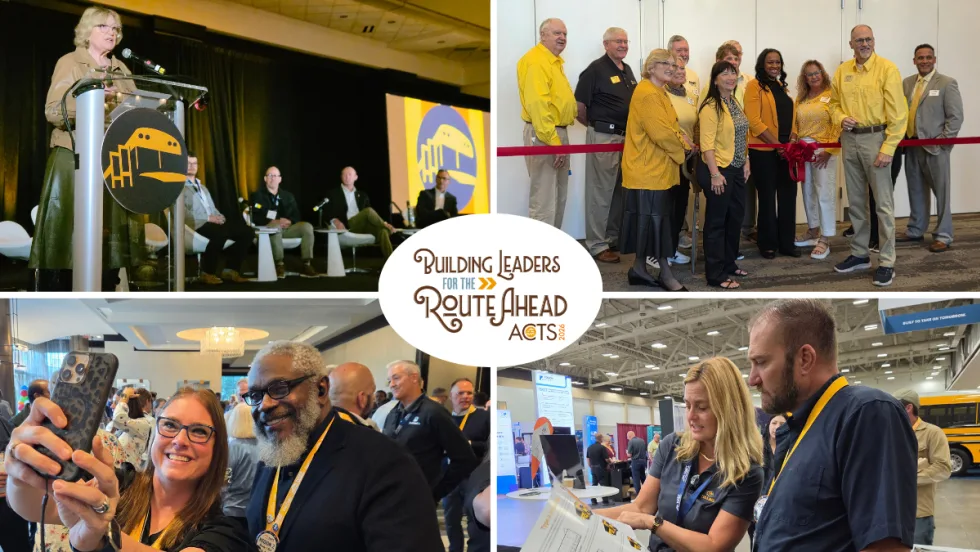
Inside NAPT ACTS 2026: Highlights from Louisville
From federal updates and student behavior strategies to new school bus technology and industry awards, see highlights from NAPT ACTS 2026 in Louisville.
Read More →
Meet the 2025 School Bus Driver Hero Winner: Annette Brown
We caught up with Wa-Nee Community Schools' Annette Brown on site at SBFX, where she was named the 2026 School Bus Driver Hero Award winner. Hear about her reaction, what she loves most about being a school bus driver, and more!
Read More →
Predictability Is Like Ketchup (According to 6-Year-Olds)
To students, a different school bus can feel like a full-blown crisis. One driver reflects on why familiar routines, showing up on time, and being reliably boring matter more than we think.
Read More →
Samsara Launches Free Driver Rewards Program
The new Driver Perks program gives eligible professional drivers access to discounts and offers without adding a cost for participating fleets.
Read More →
How Tax-Exempt Municipal Leases Can Help Finance School Buses
Let’s explore school bus financing options, including municipal leases, vendor payable accounts, and balloon payments, and how they can help stretch fleet budgets.
Read More →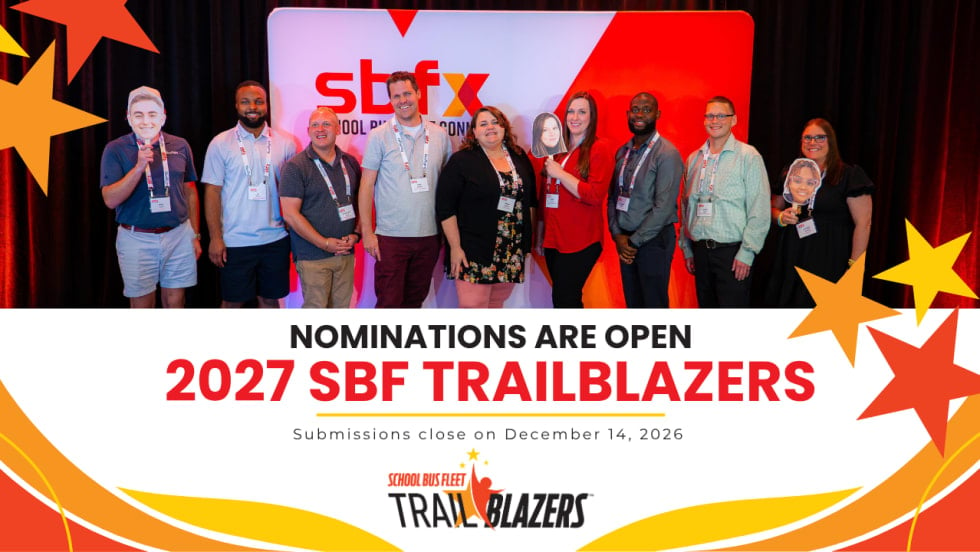
Nominate Rising School Transportation Pros Under 40!
We’re searching for the next generation of leaders making an impact across the K-12 student transportation industry to recognize as SBF’s 2027 Trailblazers. Nominations are open now!
Read More →