




McKinney Sees Longer Bus Life, Diesel Dedication
IC Bus President John McKinney says that school buses now have an average life cycle of nearly 15 years, which means that product durability and customer support are especially critical. He also points to diesel as the “backbone of the industry” and discusses the decision to offer the Cummins ISB engine.

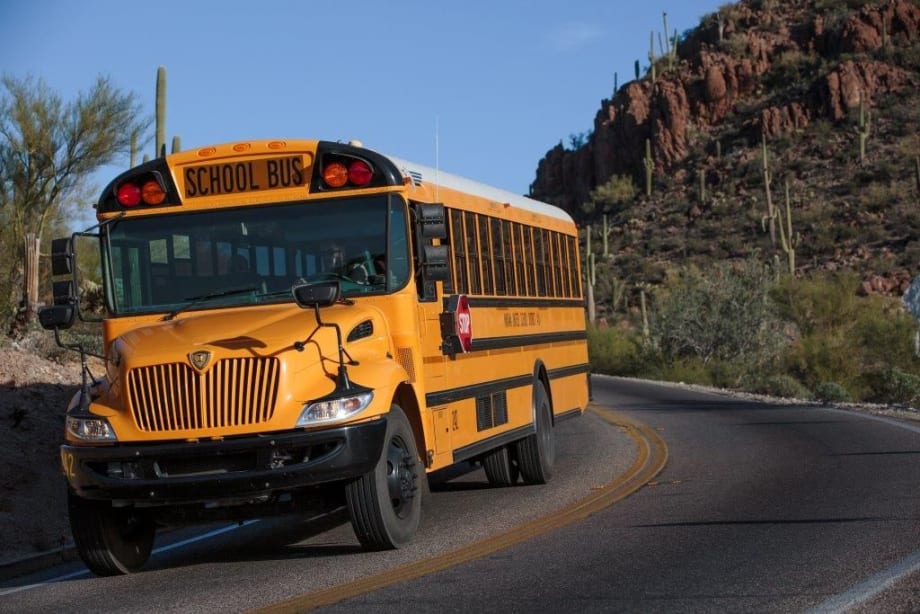
The biggest news from IC Bus over the past year has been the addition of the Cummins ISB6.7 as an engine option for CE Series school buses.
The move ties in with IC Bus’ focus on offering a variety of diesel engines for its school buses, rather than expanding into alternative-fuel options as other school bus manufacturers have done in recent years.
IC Bus President John McKinney calls diesel the “backbone of the industry,” and he says that the mainstay fuel still accounts for 99% of the large school buses on the road. Still, he acknowledges that alt-fuel buses “have a stronger presence in the school bus market than they’ve ever had” and that “some of these technologies long term are very promising.”
In this interview with SBF Executive Editor Thomas McMahon, McKinney discusses these and other trends in the industry, including a shift toward more Type C school buses and fewer Type Ds; growth in the adoption of LED lighting; and an increased focus on driver ergonomics.

IC Bus President John McKinney says that most of the recent growth in school bus sales is from “pent-up demand due to extended replacement cycles.”
SBF: Our research has found that school bus sales increased the past two years, after declining for five years in a row. What does this indicate about conditions in the school bus market?
JOHN MCKINNEY: Your data and our data are the same. Conditions so far in 2014 are fairly positive as well. Demand for buses continues to be strong this year. So we’re anticipating another good year for the industry. We’re still not back to where we would have been in, say, 2007 and 2008, but we’re moving in the right direction. The reality, I think, is that most of this growth is coming from pent-up demand due to extended replacement cycles. Buses have been run longer, and now they’re at a point where some of that pent-up demand has to be satisfied.
What other developments are you seeing in the school bus industry?
One of the biggest developments over, let’s say, four or five years is the ongoing battle for state budgets for school transportation. While conditions in each state differ, today’s new reality is that pupil transportation funding is no longer a given. When funding is cut, then customers aren’t purchasing school buses as frequently. So our products have to last longer. I think our data would show that today the average school bus now has a life cycle of nearly 15 years. It’s hard to find another industry that has a life cycle that long.
So with longer life cycles, what does that mean? Districts and contractors alike are relying on manufacturers and dealers more than ever, as those older buses naturally need more support. For us, we think of that as an opportunity. Our dealer network we believe is our greatest asset, and I know that to be true. Not only do we have more than 290 IC Bus dealer locations, behind that we have over 700 International truck locations that are there to support our school buses and the school bus industry. So this whole idea of longer life cycle, the reliance on more parts and service, and support at a school district and contractor level just really fits in our business model and our go-to-market strategy.
[PAGEBREAK]The other thing I think everybody’s seeing is that alternative fuels have a stronger presence in the school bus market than they’ve ever had. Some of these technologies long term are very promising, but I think it’s still important at this time to keep it in perspective. They still just represent 1% of all the C and D school buses on the road today. So the majority, 99%, are diesel products. Diesel is the backbone of our industry, and that’s not going to change anytime soon.
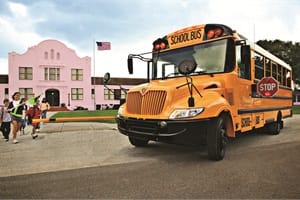
McKinney says that parents are now “thinking about safety in terms of how we manage a student from the time they get picked up in the morning until they get delivered home.”
Are there any big differences in how customers are spec’ing school buses now compared to, say, five years ago?
I think so. We’ve seen a couple things. With the budget constraints and what that entails, people become more efficient. I think that and other things have driven the increase of the Type C bus in relation to the Type D. In 2008, 18% of school buses built were the transit-style, Type D buses. Today, that’s only 13%, and it continues to decline. I think that’s a result of people going to a Type C bus for more commonality in their fleet. We look at that chassis, specifically our Type C chassis, how robust that is, and we talk about longer life cycles — I think that’s all a natural outcome of the industry demands and pressures.
We’ve also seen a shift toward more automotive-like features in our buses. We’ve seen more states embracing seat belts. While we have long been neutral on seat belts — we can build buses with them or without them — in recent years it just seems that more and more districts have adopted them. For those customers with IC Bus, I feel really fortunate that our operational team and engineering team had the foresight to come up with the BTI seats, which includes the ability to retrofit an existing bus to a seat belt application only by replacing the seat back as opposed to replacing the whole seat. So it certainly makes that an easier changeover — and certainly more cost effective and more efficient.
We’ve seen a bigger focus on driver comfort, too. We have done a lot of work on driver ergonomics and driver comfort. Today we are seeing customers taking another step in that by asking for better driver seats, foregoing the static seats for mechanical suspension seats — really thinking about that driver compartment, the amount of time someone’s there, what that means in terms of fatigue, and ultimately what that means in terms of safety for the children and the driver.
That could also be related to the issue of driver shortage, because if drivers aren’t comfortable, districts are going to have a harder time retaining them.
Exactly. The other thing we’re seeing is a lot more customers embracing LED lighting packages. With LED lights, customers see lower maintenance costs and decreased stop reaction time for buses making stops. We’ve seen some of our largest customers introduce all-LED lights into their fleets this year. That’s a relatively new change.
The other thing that we continue to see is school bus customers integrating new aftermarket technologies on their buses, from cameras to GPS-enabled tracking systems. There’s a number of new technologies that weren’t here five years ago, and I really think it’s where the industry has moved and is moving.
I’ve been in the industry for a while. Initially we used to always think about safety in terms of the product, and I don’t want to minimize that. The way the school bus is structured, the rollover technology and testing, the side intrusion — all of that is incredibly important. But I think we’ve done that so well that now it’s a given. Parents, communities and, as a result, school boards and districts are thinking about safety in terms of how we manage a student from the time they get picked up in the morning until they get delivered home. Where are they in that route, and what happens on the bus?
So there are all these technologies about when a student gets on the bus and when they get off and how to track that. There are video cameras inside the bus and on the exterior of the bus to be comfortable about the environment that our kids are being transported in. I think we’re going to continue to see that evolve.
[PAGEBREAK]

On offering the Cummins ISB engine for CE Series buses (pictured), McKinney says that “we had a number of customers that were Cummins loyalists that prefer that engine. And then there’s our ability to be able to say, ‘We’re going to give you options.’”
Last year, IC Bus added the Cummins ISB6.7 as an engine option for CE Series school buses. Tell us about what drove the decision to add that option.
Ultimately, it came down to a simple decision. We had a number of customers that were Cummins loyalists that prefer that engine. And then there’s our ability to say, “We’re going to give you options.” So it really made sense. Now as we look at our lineup, we’ve got a MaxxForce 7 V8. We’ve got a DT in-line 6, and now we’ve got the ISB. So when we’re talking to a customer, we’re able to give them the full gamut. All of those are packaged in what we believe is the best chassis in the industry. It makes a lot of sense to us. We’ve had a great relationship with Cummins over the years, so that fits like a glove with us. You’ve got a lot of technicians that are trained on the ISB; they don’t want to switch — they have that technology. So it’s been a good fit, and we’ve been very pleased with how it’s been received.
About how many orders have you gotten for CE school buses with the ISB engine?
We’ve gotten 4,000 orders for school buses with the Cummins ISB. We’ve built 2,000 of those since this past January. Feedback from our customers has been terrific, so that’s been great. It’s been overwhelmingly positive. The products are performing well in service, and, again, why wouldn’t they? That’s a great engine, and we believe it’s packaged in a great chassis and a great product. So our expectation is that it ought to do the job.
In 2012, Navistar formed an agreement with Chinese truck maker JAC to develop and distribute school buses in China. What have been the results of that project so far?
I personally spent a lot of time in China as part of that. A couple of things: First of all, I was really excited that as a company, we spent a lot of time on our own with the Chinese government, with the technical people, just educating them on our mode of school buses. As you go to countries like China, the big deal is that the school bus controls traffic. When I think about where the U.S. market is at and the evolution of the industry in China, I think it’s going to take some time for their market to develop.
JAC is a partner of Navistar now. We have a joint venture on the engine side there. We continue to explore the market and see where we can play. We continue to look at the opportunities and offer our technical expertise where it makes sense. We do think potentially, someday, there’s something there.
In addition to China, we’ve been hearing about other foreign nations, such as the United Arab Emirates, taking steps to improve their school transportation systems. Are you seeing other opportunities for IC Bus abroad?
Certainly we saw the opportunity in China, and we’re able to play a role there. But we’ve seen strong interest in the Middle East as well. What we’re seeing is that region is looking to the school bus market in North America for guidance, similar to in China, and how to provide safe transportation for their students. So we started having some of those conversations a few years ago, and now we’re starting to see some of that take hold. In fact, recently, we just won a tender offer in Saudi Arabia for 200 school buses. These buses will be used to transport students. Just a few years ago, that was nothing more than an idea.
In most of the rest of the world, the school bus market that we know, an industry rooted in strict safety standards and a commitment to our children, that has a vehicle that controls traffic, is still an idea.
In North America, we know that controlling traffic and what happens around the bus is critical. That’s just an incredible amount for a country to get their heads around. I think in some form or fashion, it’s going to get there. It just takes some time.
More Management

STA Acquires Sunrise Transportation
Student Transportation of America expands in Illinois and Connecticut through Sunrise's fleet of nearly 1,000 vehicles.
Read More →
EPA Opens $180M DERA Funding Round for Diesel Upgrades
The 2026 Diesel Emissions Reduction Act program seeks applications from eligible organizations to accelerate the retirement of legacy diesel vehicles.
Read More →
HopSkipDrive’s CareEngine Targets the ‘Exceptions’ in Student Transportation
The new platform works alongside districts’ existing transportation management systems to coordinate specialized rides, automate last-minute changes, and turn ride data into operational improvements.
Read More →


The Right Ride for Every Student: Navigating the New Student Transportation Ecosystem
How should districts blend school buses with small-vehicle transportation and other options? EverDriven CEO Mitch Bowling discusses safety, costs, partnerships, and strategy.
Read More →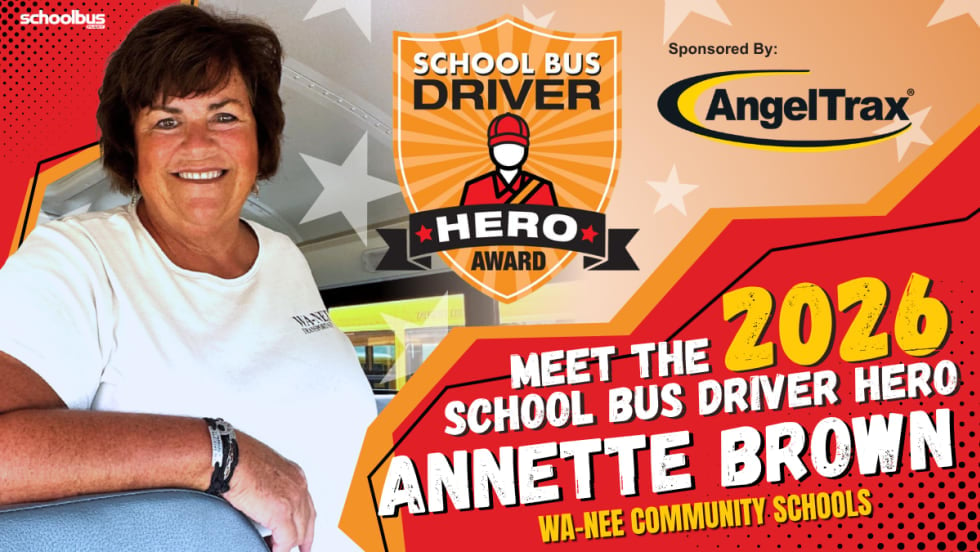
Annette Brown Always Takes the Extra Time: Meet Our 2026 School Bus Driver Hero
For more than 30 years, the Wa-Nee Community Schools driver has treated students like family, combining safety, compassion, and servant leadership to make a lasting difference on and beyond the school bus.
Read More →
How to Build a Better Driver Training Program
Ready to boost up your school bus instructor training? Here’s how to pick the right talent and improve recruitment, retention, and safety.
Read More →
CALSTART and Forth Combine to Form Catalyst Mobility
The new name represents a renewed vision for the nonprofit focused on advancing clean, equitable, and affordable transportation solutions that move people and goods.
Read More →
What Makes a Great School Bus Driver Trainer?
Choosing the right school bus driver trainer takes more than experience. Learn six keys to selecting and developing trainers and evaluating program effectiveness.
Read More →
School Bus Contractors Expand Through New Deals, Acquisitions & Partnerships
STA's Canadian division acquires Ontario-based G&L Stevenson Transport; Durham School Services adds a new district in California; First Student expands in New Jersey; and Minnesota Coaches rebrands and acquires Halo Transportation.
Read More →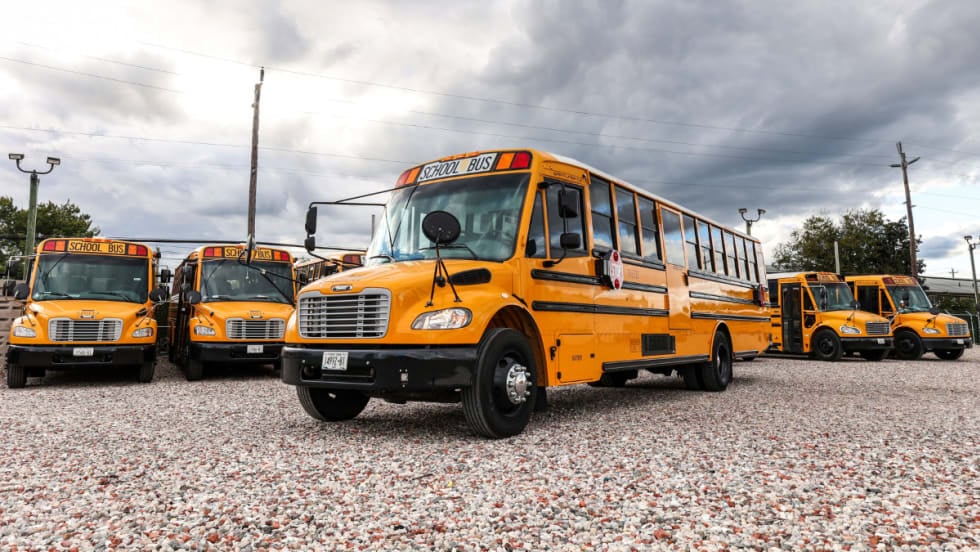
Logan Bus Company Rolls Out AI Phone System for NYC School Bus Families
A summer pilot found that AI agents could handle most routine calls, freeing up time for customer service staff to focus on emergencies and complex family concerns.
Read More →