




Get Involved: Getting School Bus Drivers, Aides Involved in the IEP Process
Making the School Bus Ride Easier for Students With Autism in 7 Steps
Students with autism can become overwhelmed by the noise and crowded space on a school bus. Drivers and aides can help by accessing transportation plan information to minimize triggers, establishing consistent routines, and giving calm, clear direction.
by Lynda Van Kuren
January 24, 2020
Students with autism should be drilled repeatedly on emergency procedures and include as many details as possible: sirens, evacuations, other students, and emergency personnel.
Photo: SDI Productions via Getty Images
5 min to read
Autism and riding the school bus can be a challenging combination, creating a high-risk environment where noise, crowded and enclosed space, and other factors can make students who require special-needs transportation so uncomfortable that they become agitated and lash out.
Fortunately, with planning and adequate autism training for school bus drivers and aides, these students can be more comfortable on a school bus.
In fact, school transportation staff are pivotal members of the team supporting a child with autism, says Cheryl Wolf, an expert on transporting students with special needs - including transportation for an autistic child - from Lafayette, Indiana.
1. Form an Individualized Transportation Plan for Students with Autism
Having an Individualized Transportation Plan (ITP) for each student with autism who may have problems on a school bus is crucial, according to Sue Shutrump, supervisor of occupational and physical therapy for the Trumbull County Educational Service Center in Niles, Ohio.
Often, the ITP is part of a child’s Individualized Education Program. If not, school transportation personnel and the child’s IEP team can develop one.
The ITP should include the child’s disorder, sensitivities and triggers, how they are likely to react to triggers, and techniques that calm them down. If the child has a behavior management plan, that should be in the ITP too, as well as the names and contact information for the child’s teachers, intervention specialists, and parents.
If school bus staff do not get an ITP for their students with autism, they should ask to see the part of the child’s IEP pertaining to transportation, or for tips from the child’s teachers and parents.
2. Stick to a Consistent Routine.
One of the best ways to help a child with autism is to consistently follow the same routine. The child should be picked up at the same time in the same place, and the bus should follow the same route. If there is any change, the child should be told as soon as possible, Wolf recommends.
Children with autism should also be assigned a seat that works for them. A seat near the driver may be perfect for one child on the spectrum while the sound of the door opening may disqualify it for another who is sensitive to noise. Another child may prefer a seat over the wheel well, because the vibration soothes them and their feet reach the floor.
3. Identify & Minimize Triggers.
Another strategy that helps these students is to minimize the triggers that cause a reaction.
For example, noise cancelling headphones or music-playing headsets can help those with noise sensitivities (some districts or states don’t allow them as they can prevent children from hearing directions in an emergency); child safety seats or vests can help those with light touch sensitivity; and tape placed on stair edges can help those with sight impairment or who have difficulty directing their visual focus in visually busy environments.
Sometimes triggers can be difficult to identify. In such cases, bus drivers can invite the child’s IEP team to join a test drive, advises Shutrump. A team member may notice things like a child who is gravitationally insecure and made anxious by moving or being moved, sitting with their feet off the ground or that the car seat’s loose strap aggravates their light touch sensitivity.
Cameras also can be used to identify triggers, says Marsha Tripp, special education professor at East Carolina University. The bus driver, aide, or the child’s teacher or behavior specialist can review the video to learn what set the child off.

Another tip from Marsha Tripp, special education professor at East Carolina University: bus drivers can keep a bag of goodies on board based on what they know soothes their students with autism. Photo courtesy Marsha Tripp
4. Calmly Give Clear Direction to Students with Autism
When approaching a child with autism who is upset, the bus driver or aide should speak in a calm, modulated voice and give clear, concise directions devoid of options or rationalizations. They also should not tell the student what not to do, advises Shutrump.
If the student is engaging in dangerous behavior, school bus staff should try to redirect them with something they like, Tripp adds. Some techniques that often work include specific phrases (provided by the teacher); weighted blankets, vests, or wrist weights; stickers; and sensory balls. If the student has a behavior management plan, that should be followed.
If none of these tactics work, school bus drivers should call the school or transportation supervisor for help, Wolf adds.
5. Use Special Tools to Communicate with Nonverbal Students.
Communicating with students who are nonverbal requires the right tools. Some children respond to specific phrases or hand-signals, which school bus staff can learn from teachers and parents. Others respond to story cards or picture strips.
These cards show students how to respond in different situations, ranging from covering one’s ears when it gets too noisy to the steps to take in an emergency. Rather than asking the child to make eye contact, when using these cards, the school bus driver or aide should place them where the student is looking, Shutrump recommends.
6. Cover Details for School Bus Emergencies.
Students with autism should be drilled repeatedly on emergency procedures and include as many details as possible: sirens, evacuations, other students, and emergency personnel. Otherwise, the missing element can throw the students off, as Wolf affirmed when firefighters boarded a school bus in her district.
“They were in full gear and the kids freaked out,” she says. “They [thought they] were looking at Darth Vader.”
7. Communicate with Teachers and Parents.
School bus drivers and aides should communicate regularly with the parents and teachers of these students. Asking the parents how the child is in the morning and sending a note to the teacher when an incident occurs should be common practice.
Also, whenever there is a recurring problem, the school bus driver should ask to meet with the child’s education team.
“School bus drivers are related service providers. They can — and should — request an IEP meeting to discuss a problem,” Shutrump says. “When we come up with a plan for these students, it keeps them comfortable and makes them feel like they’re in control.”
Subscribe to Our Newsletter
More Special Needs Transportation
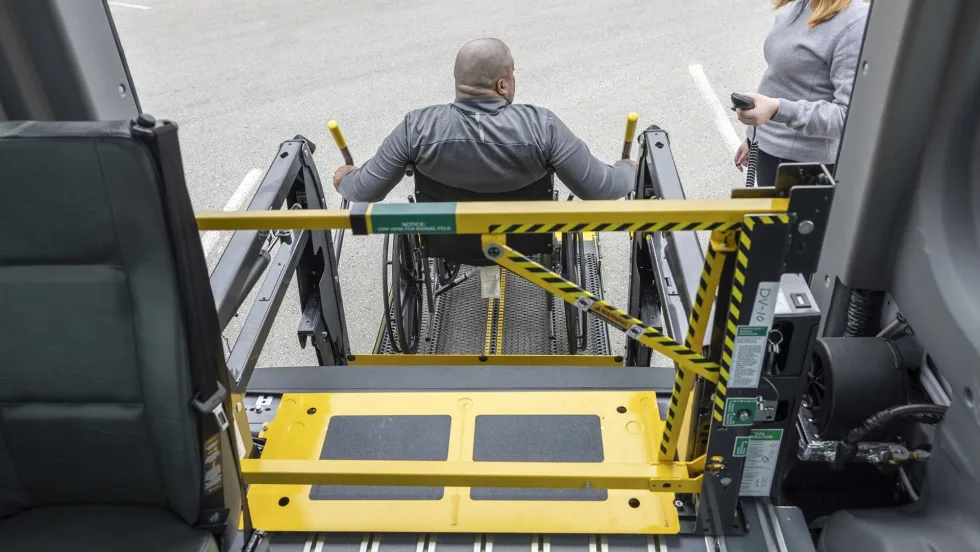
BraunAbility Introduces New Safety Barrier for Wheelchair Lifts
LiftSentinel is designed to add another layer of protection during wheelchair loading and unloading and can be retrofitted to many existing commercial lift installations.
Read More →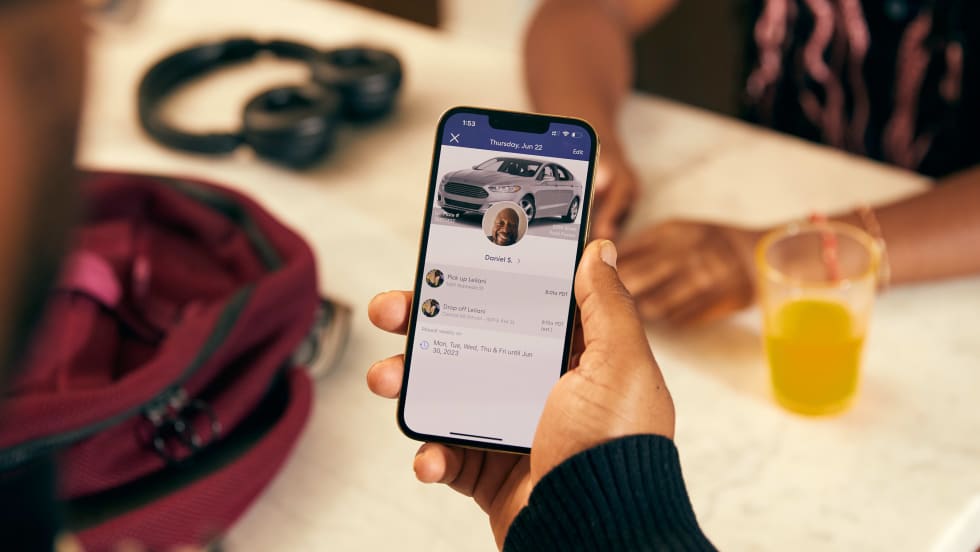
HopSkipDrive Launches New Safety, Driver Consistency Features for 2026-27 School Year
The company’s free ride recording, live ride tracking, and consistent driver assignments aim to improve safety and continuity for diverse student transportation needs.
Read More →
The Most Common Wheelchair Securement Mistakes on School Buses (and How to Fix Them)
Small missteps in wheelchair securement can have serious consequences. Here are 32 tips from experts to reduce risk and increase student safety on the bus.
Read More →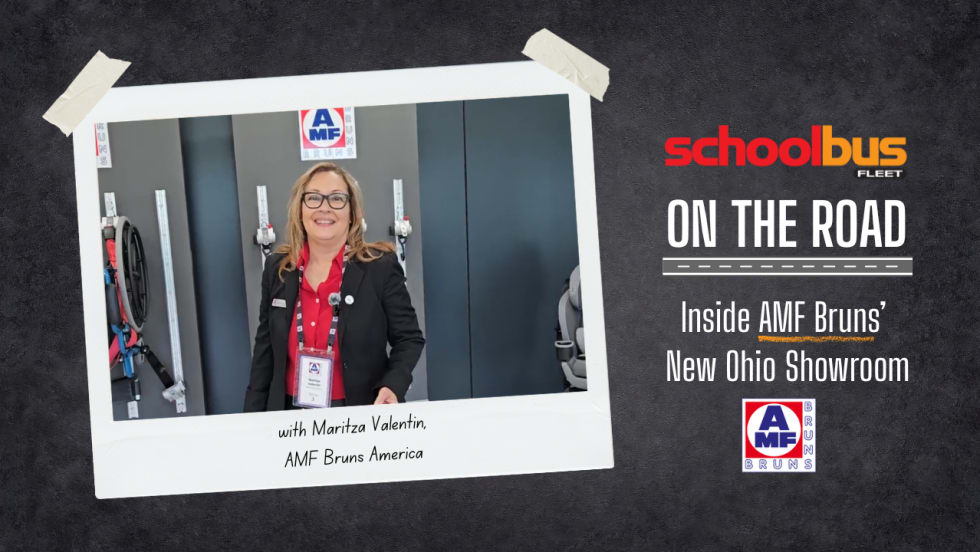
Inside AMF Bruns’ New Showroom: School Bus Securement Solutions Explained
Go inside AMF Bruns America’s new Ohio showroom with Maritza Valentin to see its FutureSafe technology, driver training tools, securement systems, and seating innovations.
Read More →
What AMF Bruns’ New Facility Means for Customers [Video]
Inside AMF Bruns’ new Stow, Ohio, operations: See how expanded space and innovation will enhance customer support and operations.
Read More →
AMF Bruns Expands in Ohio, Investing in Growth and Community
With expanded production space, local investment, and a growing workforce, AMF Bruns is scaling its U.S. presence. Here’s an exclusive first look inside the new Stow, Ohio, HQ.
Read More →
Inside AMF Bruns of America’s New Ohio Manufacturing Facility [Photos]
Take a behind-the-scenes look at AMF Bruns of America’s new 41,000-square-foot Stow, Ohio, headquarters, featuring advanced manufacturing, expanded space, and future-ready mobility solutions.
Read More →
First Student Boosts Student Support in Wichita & Texas
First Student and Wichita Public Schools are using behavioral support strategies to improve student ride experiences, while a separate initiative expands access to after-school programs through a bus donation.
Read More →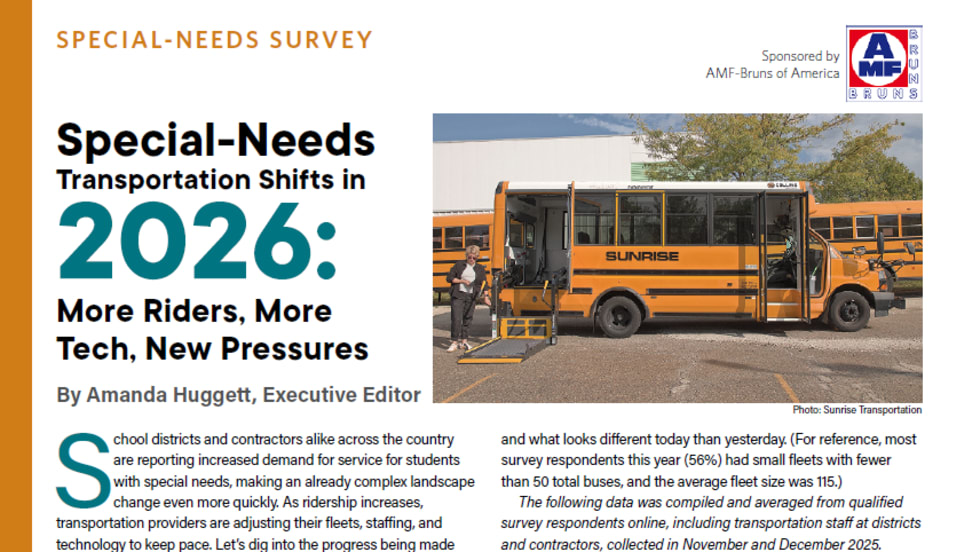
2026 Special-Needs Transportation Survey
What’s changing in special-needs transportation? This year, student transportation operators report a rising need, easing driver shortages, growing tech adoption, and evolving challenges. Sponsored by AMF Bruns of America.
Read More →
The Lived-Experience Gap in Mobility Tech: An Expert Take on Safe Student Transportation
Brianna Pauwee, a product application specialist at AMF Bruns of America and a wheelchair user, drops in to The Route to share practical securement and training insights, plus the story behind the new “Beyond Mobility” podcast. The Route is sponsored by IC Bus.
Read More →