




Keeping Warm in the Dead of Winter
The winter season ushers in some extreme weather conditions that can take a toll on transportation operations. A school bus contractor in Alaska discusses what it takes to keep passengers, staff and equipment safe and warm.
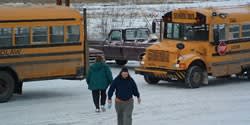
Zero-degree temperatures have the uncanny ability to keep many Americans indoors where it’s warm and cozy. But in some parts of the country, Alaska for instance, this convenience isn’t always an option. Laidlaw Education Services of Fairbanks, Alaska, keeps going despite the cold.
Tricky territory
The Fairbanks branch of Laidlaw launched in 1995 with the acquisition of Mayflower Contract Services. The company has a fleet of 156 buses, mostly Blue Bird TC/2000s or rear-engine Internationals. About 43 of the buses are dedicated to transporting special-needs students. In all, approximately 5,500 students are transported daily to 30 schools in a district that encompasses 7,361 square miles, roughly the size of Rhode Island, Delaware and Connecticut combined.
Setting up camp in an area where close to 60 percent of the roads are unpaved created immediate challenges for the operation. Not only do drivers contend with temperatures that go up to 95 degrees and drop to 60 below, they also deal with hilly areas that have seven- to eight-percent inclines. Add snow and ice to this formula and it’s easy to imagine the trials of navigating buses through such adverse climates and terrain.
The heat is off
Although Alaska has an average of 75 inches of snowfall each year, more than 15 inches have fallen at once. At press time, it was 20 degrees, and the region was behind in snowfall.
There have been no below-zero temperatures as yet, but Edward Graff, branch manager at Laidlaw, is vigilant.
Graff and some of his drivers have identified advantages to frigid temperatures. “We like it when it’s cold,” he says, explaining that the ground is sticky and the buses, especially when they are warmed up, grip the roads better.
Laidlaw uses Onspot’s automatic tire chains to handle the icy roads. Similar to Rud Chain’s Rotogrip automatic snow chain system, Onspot’s chains fasten to the bus’ suspension and allow traction enhancement for both forward and reverse movement of the bus, all at the flip of a dashboard switch. The driver never leaves the cockpit to activate these chain systems.
The automatic chains are used in conjunction with hard irons, however. These chains — used for the outer dual tires — require the driver to exit the bus to install them. The combined traction is ideal for stops and starts, especially on slick roads and routes in the Alaskan mountains where there is more snow.
Comfort zones
Laidlaw requires early check-ins on days when a storm is imminent or if hazardous road conditions exist. Drivers are brought in 20 minutes early to install their chains.
The Alaska branch employs 11 mechanics: nine at the Fairbanks terminal and two at Moose Creek.
District ordinances require all buses to be stored indoors at a minimum of 45 degrees. Laidlaw buses are stored in two heated barns that use oil furnaces to keep the equipment, as well as the personnel, warm.
The two bus barns total 75,000 square feet. The Moose Creek terminal is 21,000 square feet while the Fairbanks terminal is 54,000 square feet.
Keeping the buses warm cuts down on maintenance problems and makes for an easier start on cold mornings.
Safe and warm
When spec’ing buses, Alaskan transportation operations must include what is commonly known as the Alaskan package. The Alaskan package is essentially a heating and insulation combination that includes an auxiliary heating system made by Espar and insulation throughout the body of the bus.
The Espar heating system is a backup heater that runs independently from the rest of the bus. The system runs on diesel fuel at approximately three-quarters of a gallon per hour and can be angled to blow heat at step wells to keep the steps dry. Espar puts extra heat into the bus at about 250,000 Btu.
[PAGEBREAK]
The buses are also equipped with a solid defrost system to keep the windows frost-free. Door windows are double-paned to prevent fogging and both west-coast mirrors and crossover mirrors are heated. Each of these items come spec’d on Laidlaw buses. Strobe lights, stop-arm strobes and reflective tape are also mandatory equipment.
Another safety item found on the vehicles is the pedestrian lights. These lights shine out from the driver and pedestrian sides of the bus to spot children when it’s dark out.
“We also use a microphone to cross the kids,” Graff says. “The outdoor P.A. system is a requirement here. It’s for the children, to let them know when it’s OK to cross and when it’s not OK to cross.”
Replacement and maintenance
Laidlaw recently received delivery of 25 new 23-passenger Thomas/Ford vehicles with Ricon wheelchair lifts. The order was part of the company’s bus replacement schedule, which requires 60 percent of buses to be less than 12 years old.
The branch’s preventive maintenance program is 3,000 miles or 45 days for oil, lube and filter inspections. The schedule is the same for transmission servicing. There’s also a 12-month or 12,000 mile brake inspection. The branch gets inspected twice a year by state inspectors.
Hazard alert
Alaskan operations have challenges that differ from those at operations in the rest of the United States. For instance, not in many other places does a driver come across a 1,500-pound moose lingering around a bus stop.
“We have moose, black bears and grizzlies,” Graff says. “We’ve had to keep children on the bus and not let them off because of moose.” Drivers call the parents and have them meet their children at the bus. In the past, Laidlaw buses have hit two moose. The creatures, which are often 6 or 7 feet tall, can be aggressive and sometimes charge at people.
Darkness is another challenge for the contractor in the way it affects drivers. With the shortest day clocking in at only two hours and 46 minutes, it’s no wonder that drivers fall into periods of depression. But Laidlaw finds ways to combat the psychological effects of the long nights.
“We’re like a family around here,” Graff says. “If there’s a problem, we ask how we can help.”
Transporting special-needs students when the weather is harsh presents a set of problems for drivers as well. Entering and exiting driveways that haven’t been plowed or well kept is a hazard not only for the monitor and driver but for the special-needs student as well.
“If a driver complains about a driveway, we go out and investigate to see what kind of condition it’s in,” Graff says. Laidlaw then makes clear to the property owner the risks involved in keeping the property in such condition.
Laidlaw drivers use Motorola two-way radios to communicate with other drivers and dispatch. The radios work off a company-owned repeater perched atop Murphy Dome. A common problem is the dead spots experienced when drivers traverse some of the region’s more hilly areas. These spots can spell trouble when there are breakdowns or emergencies.
Then there is the fuel situation. No. 2 diesel is currently $2.77 per gallon. During the winter, Laidlaw runs No. 1, which is about 11 cents more per gallon. The Alaska branch, like many other operations, has taken a huge hit with the inflated fuel costs.
“Nobody saw this coming,” Graff says. “We were hit pretty hard, so it comes off our bottom line.”
The bright side
Graff considers the drivers at his branch to be the best special equipment he could spec on his buses. The starting wage for drivers is $12.25, and the top wage is $16.15. Drivers are guaranteed five hours a day if a route is less than five hours. They receive 50 cents more per hour for difficult routes, meaning those with unruly passengers or rough terrain.
Forty hours of training — 20 classroom and 20 behind-the-wheel — is mandatory for all drivers. Those who must traverse the hilly areas receive special instruction.
Training occasionally includes a game of safety bingo. Participants can win a T-shirt or coat with the company colors and logo. The game can get quite competitive, which highlights the drivers’ pride in their work and their employer.
More Management

How to Build a Better Driver Training Program
Ready to boost up your school bus instructor training? Here’s how to pick the right talent and improve recruitment, retention, and safety.
Read More →
CALSTART and Forth Combine to Form Catalyst Mobility
The new name represents a renewed vision for the nonprofit focused on advancing clean, equitable, and affordable transportation solutions that move people and goods.
Read More →
What Makes a Great School Bus Driver Trainer?
Choosing the right school bus driver trainer takes more than experience. Learn six keys to selecting and developing trainers and evaluating program effectiveness.
Read More →


School Bus Contractors Expand Through New Deals, Acquisitions & Partnerships
STA's Canadian division acquires Ontario-based G&L Stevenson Transport while Durham School Services adds a new district contract in California, First Student adds a New Jersey contract, and Minnesota Coaches acquires Halo Transportation.
Read More →
Logan Bus Company Rolls Out AI Phone System for NYC School Bus Families
A summer pilot found that AI agents could handle most routine calls, freeing up time for customer service staff to focus on emergencies and complex family concerns.
Read More →
From Intent to Impact: What I Learned About Leadership from TAPT
A Texas transportation supervisor shares lessons on self-awareness, accountability, managing stress and building trust — and why investing in leadership development matters at every stage of your career.
Read More →
NAPT Names 2026 Award Recipients, Hall of Fame Inductee
Who earned national recognition for their work in student transportation? This year, NAPT named five recipients of its 2026 awards for service, safety, and leadership, plus its newest Hall of Famer.
Read More →
2026 State of Student Transportation Report
Driver shortages. Rising costs. Growing safety expectations. More data, but not enough time to act on it. The 2026 State of Student Transportation Report reveals what transportation leaders say is putting the most pressure on their operations—and where they’re investing next. See how your priorities compare.
Read More →
How to De-Escalate an Angry Person: 5 Steps for Handling Workplace Conflict
What makes emotions run high, and how should you handle an angry colleague or parent? Follow these steps for staying calm, listening, showing empathy, and resolving conflict.
Read More →
What Readiness Looks Like This School Year
Learn about the challenges shaping the 2026–2027 school year, from persistent driver shortages and budget pressure to technology and readiness gaps. See how school districts are responding and adapting in Zonar’s 2026 Back-to-School Readiness Report.
Read More →