




Island Time Crunch: How Ground Transport Got Up and Running on Maui
With limited time to acquire buses and recruit drivers, Louis Gomes and his team worked quickly to launch service for Maui students before a new school year began.

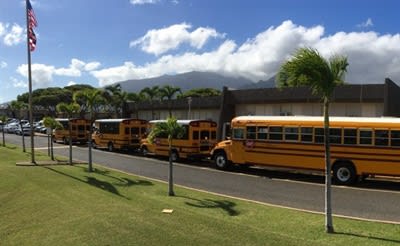
It’s no small feat to get a school bus operation up and running. It’s even more difficult when you’re starting from scratch — no buses, no drivers or other employees, and no place to park or service the buses. Add in the fact that the operation is on an island, and the task seems nearly impossible.
But Louis Gomes, president of Oahu, Hawaii-based Ground Transport Inc., achieved the nearly impossible when he recently built a new school bus operation on Maui. And, he did it in just six months.
“Ground Transport Inc. did a phenomenal job,” says Mark Lindstrom, a general manager for TransPar Group who helps the Hawaii Department of Education (DOE) oversee contractors. “They started from ground zero and worked their way up to providing transport for 71 bus routes on Maui for the beginning of school.”
Gomes says the Maui school bus operation is one of the most difficult he has set up. Because the contract he was awarded to provide bus service to three Maui school complexes (high schools and their feeder schools) was challenged, Gomes didn’t get the green light from the Hawaii DOE until late February 2017 — a date that gave him limited time to start up the service for the 2017-18 school year.
However, by consistently working toward his goal, implementing a comprehensive school bus driver recruitment campaign, training the drivers, smoothing the way for licensure, and creatively using new and existing employees, Gomes provided transportation service to all but two of his 19 Maui schools on time — and those two had bus service within the month. But Gomes is quick to say it wasn’t a one-man job. He credits his staff with the operation’s success.
“We were very concerned about getting students to and from school and minimizing any inconvenience for the parents and community,” he says. “Everyone pulled together and did what needed to be done.”
Rush for New Buses
Once the Hawaii DOE gave Ground Transport the all-clear, Gomes’ first task was obtaining 81 new school buses by Aug. 7, Maui’s first day of school. Knowing this is normally a six-month process, Gomes had no time for delay. He immediately ordered the buses — which included safety devices such as video surveillance cameras, GPS, and two-way communications systems — from A-Z Bus Sales. Then Georgia-based manufacturer Blue Bird swung into production. As the new buses came off the factory floor, they were driven across the country to San Diego, California, and were loaded onto ships for the voyage across the Pacific Ocean to Hawaii.
Ground Transport also ordered smaller special-needs buses from Collins. Similarly, those vehicles left the Type A manufacturer’s Kansas plant and were driven to port and put on a waiting ship.
It took four shiploads, but by the end of June 2017, Ground Transport had 48 regular school buses, 23 special-needs buses, and 10 spare units on the island of Maui.
Recruiting Drivers and Aides
Gomes’ second — and perhaps most challenging — hurdle was finding 71 school bus drivers, 48 of whom would need a commercial driver’s license (CDL) with passenger and school bus endorsements.
The remaining 23, who would drive the special-needs vehicles, needed only a regular driver’s license. (Lindstrom explains that in Hawaii, drivers do not need a CDL to operate 14-passenger school buses.)
With Maui’s low unemployment rate, Gomes’ search was even more difficult, Lindstrom notes. To find drivers, Gomes launched a no-holds-barred recruitment campaign: He attended every job fair, advertised daily in top newspapers and on radio stations, and offered $3,000 hiring bonuses for CDL school bus drivers, $1,000 bonuses for non-CDL drivers, and $500 bonuses for bus aides. As further enticement, Gomes offered competitive salaries and benefits.
Gomes’ campaign successfully brought in applicants, but most of them had only regular licenses, so he developed a plan to help them become CDL drivers.
First, Gomes provided extensive training. He started by preparing the driver candidates for the written license tests, which covered both general and specialized knowledge.
When the drivers passed those exams, Gomes provided the hands-on training they needed, including everything from pre-trip inspections to driving and road skills. To ensure they got this training as quickly as possible, he hired another company to help.
Gomes also assisted the new drivers with the myriad hurdles that accompany CDL licensure. He paid all the associated fees and even set up appointments with the city licensing department for their road tests.
Though Gomes worked to get the drivers up to speed quickly, he ensured they met his stringent standards for highly qualified, safe drivers.
“We trained aggressively and did thorough background checks,” Gomes says. “The bus is an extension of the classroom, and safety is very important.”
While Gomes was preparing regular bus drivers to take the wheel, he also hired and trained the special-needs drivers and attendants on how to work with children with disabilities and how to handle their equipment.
Despite his best efforts, Gomes was 18 drivers short when school started. To provide bus service to as many schools as possible, he deployed management, maintenance, and training personnel, all of whom were qualified, to drive buses and brought in drivers from his Oahu office. He also consolidated some of the routes.
“Even the new employees helped with doubling up on the routes,” Gomes says. “They normally have two routes in the morning and two in the afternoon. Some had to do three routes just to pick up the kids and take them to school.”
Gomes kept recruiting and training, and by mid-September he had a full staff of qualified bus drivers.
Overcoming Staff Shortages
Gomes also needed to build management, administrative, and maintenance teams, which he did by hiring new employees, contracting with other businesses, and reassigning Oahu personnel. His new hires included trainers, the outside company he contracted with for training, and managers.
To pick up the administrative and maintenance slack, Gomes’ Oahu staff pulled double duty. Gomes flew administrative personnel back and forth from his Oahu office, and he relocated two of his maintenance staff members to Maui until he could hire more technicians.
Gomes also lived on Maui for weeks on end. That way, his staff could easily contact him to prevent and solve problems.
“I’m hands-on,” he says. “I went out and visited my team members, and people could come up to me in the base yard and ask questions.”

For its new Maui operation, Ground Transport had to recruit dozens of school bus drivers and other staff members.
Far-Flung Fleet
Gomes had another issue to overcome: Ground Transport’s Maui school bus operation was spread throughout the island. The office was located in central Maui; the maintenance facility was in another part of central Maui; and the buses were parked in two base yards, one in a third Maui site and the other in Lahaina, on the western end of the island.
Gomes and his team worked around the problem. Management and dispatch were conducted from the main office, supervisors and trainers worked from office trailers that he placed on the base yards, and buses were relocated when they needed service.
“We were running from one location to another,” Gomes says. “To service a bus, we had to take it from one yard to another. We did what we had to do.”
From the time he got the all-clear, Gomes was determined to provide school bus service on time to the Maui schools he was responsible for. Given the odds against him, he could have easily become overwhelmed. But Gomes said that he and his team stayed focused and committed to the job, and that made all the difference.
“We kept moving forward and doing what we do best,” he says. “We tried to stay positive, and it worked out.”
Fine-Tuning the Operation
Ground Transport’s Maui operation is now running smoothly, although Gomes keeps working to improve it. Knowing that the school bus driver shortage is an ongoing problem, he recruits and trains drivers nonstop.
Gomes is also buying property on Maui, where a new central facility will house all facets of the operation.
And, as always, Gomes will keep his can-do attitude front and center.
“I try to get my drivers and my team to be very positive,” he says. “I have a lot of good employees, and I try to support them as best I can. I know what’s involved. I used to drive a bus.”
More Management

How to Build a Better Driver Training Program
Ready to boost up your school bus instructor training? Here’s how to pick the right talent and improve recruitment, retention, and safety.
Read More →
CALSTART and Forth Combine to Form Catalyst Mobility
The new name represents a renewed vision for the nonprofit focused on advancing clean, equitable, and affordable transportation solutions that move people and goods.
Read More →
What Makes a Great School Bus Driver Trainer?
Choosing the right school bus driver trainer takes more than experience. Learn six keys to selecting and developing trainers and evaluating program effectiveness.
Read More →


School Bus Contractors Expand Through New Deals, Acquisitions & Partnerships
STA's Canadian division acquires Ontario-based G&L Stevenson Transport while Durham School Services adds a new district contract in California, First Student adds a New Jersey contract, and Minnesota Coaches acquires Halo Transportation.
Read More →
Logan Bus Company Rolls Out AI Phone System for NYC School Bus Families
A summer pilot found that AI agents could handle most routine calls, freeing up time for customer service staff to focus on emergencies and complex family concerns.
Read More →
From Intent to Impact: What I Learned About Leadership from TAPT
A Texas transportation supervisor shares lessons on self-awareness, accountability, managing stress and building trust — and why investing in leadership development matters at every stage of your career.
Read More →
NAPT Names 2026 Award Recipients, Hall of Fame Inductee
Who earned national recognition for their work in student transportation? This year, NAPT named five recipients of its 2026 awards for service, safety, and leadership, plus its newest Hall of Famer.
Read More →
2026 State of Student Transportation Report
Driver shortages. Rising costs. Growing safety expectations. More data, but not enough time to act on it. The 2026 State of Student Transportation Report reveals what transportation leaders say is putting the most pressure on their operations—and where they’re investing next. See how your priorities compare.
Read More →
How to De-Escalate an Angry Person: 5 Steps for Handling Workplace Conflict
What makes emotions run high, and how should you handle an angry colleague or parent? Follow these steps for staying calm, listening, showing empathy, and resolving conflict.
Read More →
What Readiness Looks Like This School Year
Learn about the challenges shaping the 2026–2027 school year, from persistent driver shortages and budget pressure to technology and readiness gaps. See how school districts are responding and adapting in Zonar’s 2026 Back-to-School Readiness Report.
Read More →