




How to Optimize the Use of Transportation Tiers
With proper planning and design, tiered school bus service can yield significant efficiencies and cost savings. It can also create longer shifts for drivers.
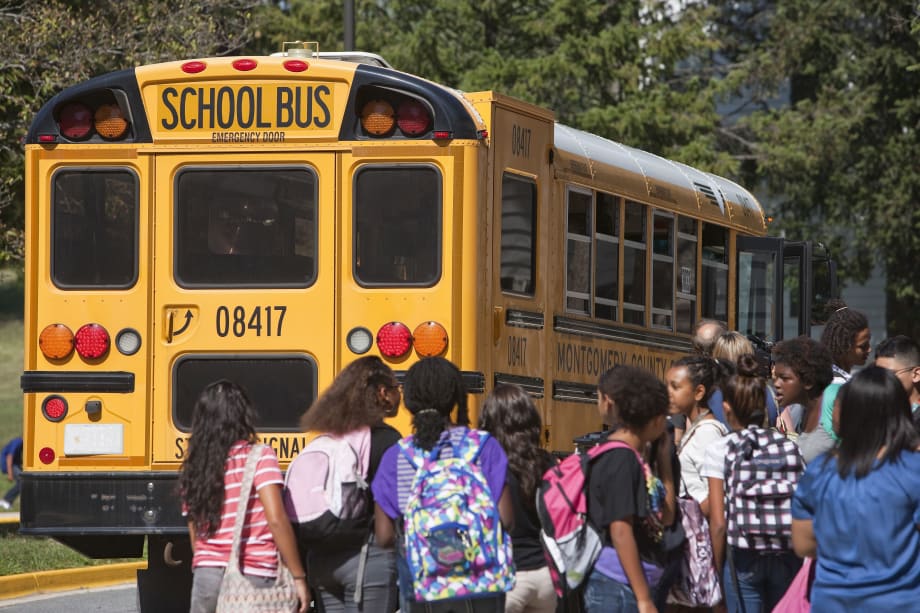
Photo courtesy NHTSA
This is part 3 in the series "Cutting Costs By Mastering Time and Space." Read Part 1 here and Part 2 here.
Decades ago, pupil transportation services began increasingly using the clever approach of serving the three basic levels of schools — high school, middle school and elementary school — with essentially the same vehicles, operating three “tiers” of service.
This development was made possible by the recognition that the length of the school day for each type of school is different, and as a result, the staggered start and end times could enable one school bus to transport a bus-load of students from each school tier.
This approach works largely because elementary school hours are shorter than middle school hours, and middle school hours are shorter than high school hours. So, for example, if elementary school hours ran from 9 a.m. to 2 p.m., middle school from 8 a.m. to 3 p.m., and high school from 7 a.m. to 4 p.m., a bus would have an entire hour between each school’s start or end times to transport a load of its students to or from school, and then deadhead back to the start of the next run.
Of course, the duration of each type of school, the distance between them, the size of the service area, trip lengths and other factors make this approach more complex, and in turn, it generally yields results that are less than perfect.

Ned Einstein, a consultant and forensics expert in various transportation fields, suggests using the summer to plan and design tiered school bus service for cost savings and longer driver shifts.
But even with these challenges, such an approach offers enormous benefits. Most importantly, it yields significant efficiencies and cost savings. But it also creates longer shifts for what is normally a part-time driving job. And under ideal circumstances, it can create a full day’s work for those drivers involved, albeit on a split-shift basis.
Constraints and conundrums
The ideal model layout of tiers identified above, which could keep one’s entire fleet busy throughout the day, would almost never exist, for numerous reasons:
No high school would, for example, hold classes for nine hours — although actual middle and elementary school hours might be somewhat closer to those identified in the model above.
In most service areas, not every student rides the bus. Instead, in most cases, only those outside a minimum walking distance would do so. Yet because these distances vary for students of various ages, the number of students to be transported from each type of school can vary greatly. So to fully utilize the vehicles in each run of the tiers, this number must be offset by longer riding distances for middle and high schools. This perfect balance will rarely work out. So optimum efficiency must be achieved by making adjustments — for example, not using some buses for all three tiers. But when the middle tier is thinner than the others (in terms of ridership and trip lengths), inefficiencies are generally unavoidable — although one way to soften them is to pay attention to the various sizes of buses in one’s fleet. Coordinating this component of the effort with the number of students and distances they must travel is challenging.
The decision to locate a school — often made decades before any thought was given to transporting students in tiers — almost never takes into account transportation opportunities and constraints. Thus schools’ positioning rarely is optimal for a high utilization rate for all or most buses operated in all three tiers. There is no way to improvise with this piece of the equation. It simply becomes a constraint around which other options must revolve.
As a safety and security matter — particularly where special-education students are integrated with general-education students on the same buses — the mixing of students from these three types of schools is usually discouraged. Thus all the students from one tier must be picked up and dropped off before those in the next tier are transported, as opposed to a situation where some overlaps might otherwise increase vehicle utilization rates. However, this problem can largely be addressed by adding an attendant to the bus, assigning seats and enforcing these assignments.
Because only those students residing beyond a minimum walking distance are usually transported by school bus, each tier of service is constrained by the fact that the bus would be transporting only those students who reside the farthest distance from their respective schools. This reality poses a challenge because it requires the consideration of almost countless choices for assigning each bus to the most efficient tier of runs.
In low-density areas, where both schools and students are spread over a considerable distance, the ride times would usually be too long for a bus to drop off many students (or sometimes even a handful of them) and then have enough time to deadhead back to the next tier’s starting point. Here, the co-mingling of students of all ages is likely the most powerful tool in terms of efficiency. However, it creates other challenges, such as bullying and the need for attendants to prevent it. At the same time, technologies like video cameras can help minimize the risks.
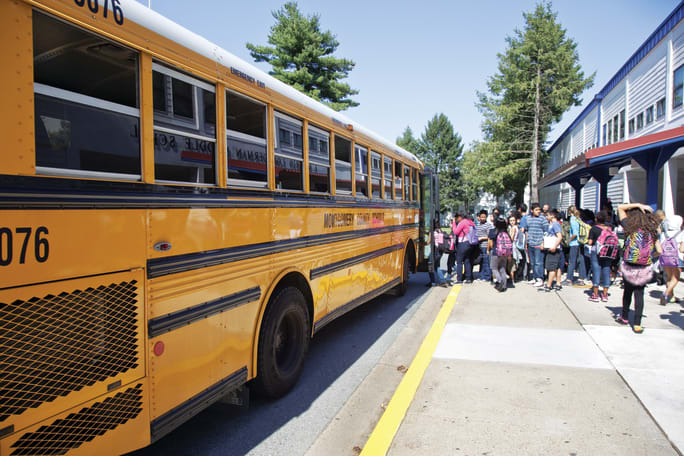
The duration of different types of schools, the distance between them, the size of the service area and other factors make the tiered transportation approach more complex.Photo courtesy NHTSA
Options and opportunities
As a result of these constraints, and a few others that may be unique to certain communities, not every school bus in the system will be able to serve three full tiers of students, much less with most vehicles’ seating capacities fully utilized.
At the same time, the spectrum of schools, school locations and school hours that exist can overcome, to a considerable extent, the basic limitation of the ideal situation noted above — if one is creative enough to factor them in.
Citing only a handful of factors that can increase utilization and decrease costs, one can begin to see how far a given system can go toward optimizing its tier structure, even if not every bus is deployed for three or more tiers, and/or not every bus is filled to capacity during its provision of service in each tier.
This is where one’s imagination, creativity and/or outside help can be invaluable. Here’s a sample of some things that can be done to “grease” the opportunities to optimize efficiency:
1. As Part 2 of this series pointed out, the bell times of schools can be modified, even while the durations of their school days need not be. So even minor modifications of these times can not only enable service to be provided in tiers altogether, but can also greatly compensate for the otherwise impossibility of perfectly coordinating service so that every one of the tiers, on most vehicles, is efficient.
2. As also noted in Part 2 of this series, many (if not most) fleets contain many buses that are larger than needed. To the degree that the mix of vehicle sizes is optimized, the utilization of existing capacity in tier-oriented transportation will necessarily increase since it would be almost impossible to fully utilize the seating capacity of every bus in every tier.
Even minor modifications of school bell times can greatly compensate for the otherwise impossibility of perfectly coordinating service so that every one of the tiers, on most vehicles, is efficient.
3. As noted above, co-mingling students in the three different types of schools holds enormous promise — particularly since a school bus bench seat can hold three elementary-age students or two middle- or high-school-age students. Optimizing the seating capacity and integrating it into the many other components of tier transportation is a daunting challenge, and for large school districts, it could not likely be done without some twist of scheduling software. Of course, the upside of this challenge is that once you optimize the solution, it will work for the entire school year.
4. Over time, every desk, much less every classroom in every school, is not always filled. While moving small quadrants of students from one school to another could involve a considerable number of hardships (including longer ride times), this approach could add much to balancing out the capacity utilization of each tier of service. At the same time, those students transported to schools out of their neighborhoods — a personal hardship by itself — also depends on the excess capacity to add more students to some schools, which may not have enough classrooms to accommodate them. But this movement — often not involving a massive number of students — could do much in optimizing tier efficiency. Also, it integrates well with other educational goals, like allowing certain students to attend schools with special programs that the schools close to them do not have.
5. Also, if the transportation of many special-education students is integrated with that of general-education students, the flexibility to mix and match tiers of service can be increased greatly by increasing the percentage of vehicles that are lift-equipped. This flexibility will also make the utilization of more capacity per bus easier with a mix of buses that includes more that are not full size. The downside, of course, is paying more for a few additional buses to be lift-equipped — although bus-trading among school districts in a sub-regional area could minimize these costs, and in fact, adjustments could be made annually to optimize most districts’ fleets to accommodate their tier efficiency.
6. Finally, in addition to the three basic tiers of service, we must not forget that transportation is often provided in (a) early buses to accommodate, for example, breakfast programs, (b) late buses to accommodate after-school activities and sports teams, and (c) buses for preschool and kindergarten, which are often only a half-day of school, typically in either the a.m. or p.m. period. The positioning of half-day kindergarten and preschool programs within the school day can be a handy tool to enable the school system to optimize its use of tiers — particularly in those cases where the distances the students must travel serves as a constraint to operating tiers of service in the first place.
Optimum efficiency must be achieved by making adjustments — for example, not using some buses for all three tiers.
Complexity or simplicity
By now, the reader’s head may be swimming from the complexity of achieving what these opportunities tantalizingly suggest. Yet at the same time, one can see that there are numerous tools and approaches available to make it work, and that making it work can save a considerable amount of money.
As a general rule, time spent in planning represents a fraction of the cost savings at the operating level — especially since every solution will be used roughly 180 times a year.
One thing that must obviously change — and that also causes a considerable number of incidents and accidents, as well as several weeks of chaos at the beginning of the school year — is the practice that many school districts employ by beginning service each fall with the same routes as they ended the previous year’s service with — and making often radical adjustments to them during what is commonly referred to as a “shake-out period.”
I understand how attractive this approach is, and why: It requires practically no work in the summer. And instead of identifying and assigning every new and carry-over student to the optimum route, the school simply sends the same sheet of paper identifying last year’s routes and stops (the starting points for the current year’s service), and instructing or implying that parents direct their children to the stop nearest their homes.
As a safety consultant and expert witness, I have always been horrified by this approach, largely because while the walking distance to the nearest bus stop may be the shortest, it may not be the safest. Employing this approach completely ignores streets that are dangerous for students to cross to reach their bus stop.
So one enormous benefit to spending the summer actually planning which students will ride on which buses at which pickup and drop-off times is that, in the process, these decisions can also include an analysis of the street and intersection complexities that each student must negotiate to reach the stop, and each student can be directed to the safest stop to reach, not merely the one closest to his or her home. This is particularly critical for elementary-age students who, as a factor of their age and development, may not possess the ability to safely cross a simple street.
Conclusions
In summary, to achieve the considerable gains from the approach presented above — even compared to a simplistic use of tiers that already provides significant benefits — system design and planning efforts will have to be undertaken during at least part of the summer months. But this should not involve a large number of employees, particularly if an outside expert with a “feel” for how these pieces fit together is brought in to help get the project started, and to examine and tweak the results when it has been concluded.
As noted in Part 2 of this series, were a school district willing to employ the full range of changes available to solve the problem, my firm would provide this assistance at no cost other than receiving a percentage of the cost savings. So the planning costs would be incurred only for those in-house officials and management involved in the project, and a lot of drivers could be employed in much of the lower-level tedium this requires (e.g., “plotting” dots of every student on a base map so that one could literally design the concepts and routes with a grease pencil). The costs of this effort would be covered by the savings from optimizing the use of vehicles.
Ned Einstein is a consultant and forensics expert in various transportation fields, including school bus, transit, paratransit and motorcoach. He welcomes comments, criticism and feedback. He can be reached at einstein@transalt.com.
More Management

How to Build a Better Driver Training Program
Ready to boost up your school bus instructor training? Here’s how to pick the right talent and improve recruitment, retention, and safety.
Read More →
CALSTART and Forth Combine to Form Catalyst Mobility
The new name represents a renewed vision for the nonprofit focused on advancing clean, equitable, and affordable transportation solutions that move people and goods.
Read More →
What Makes a Great School Bus Driver Trainer?
Choosing the right school bus driver trainer takes more than experience. Learn six keys to selecting and developing trainers and evaluating program effectiveness.
Read More →


School Bus Contractors Expand Through New Deals, Acquisitions & Partnerships
STA's Canadian division acquires Ontario-based G&L Stevenson Transport while Durham School Services adds a new district contract in California, First Student adds a New Jersey contract, and Minnesota Coaches acquires Halo Transportation.
Read More →
Logan Bus Company Rolls Out AI Phone System for NYC School Bus Families
A summer pilot found that AI agents could handle most routine calls, freeing up time for customer service staff to focus on emergencies and complex family concerns.
Read More →
From Intent to Impact: What I Learned About Leadership from TAPT
A Texas transportation supervisor shares lessons on self-awareness, accountability, managing stress and building trust — and why investing in leadership development matters at every stage of your career.
Read More →
NAPT Names 2026 Award Recipients, Hall of Fame Inductee
Who earned national recognition for their work in student transportation? This year, NAPT named five recipients of its 2026 awards for service, safety, and leadership, plus its newest Hall of Famer.
Read More →
2026 State of Student Transportation Report
Driver shortages. Rising costs. Growing safety expectations. More data, but not enough time to act on it. The 2026 State of Student Transportation Report reveals what transportation leaders say is putting the most pressure on their operations—and where they’re investing next. See how your priorities compare.
Read More →
How to De-Escalate an Angry Person: 5 Steps for Handling Workplace Conflict
What makes emotions run high, and how should you handle an angry colleague or parent? Follow these steps for staying calm, listening, showing empathy, and resolving conflict.
Read More →
What Readiness Looks Like This School Year
Learn about the challenges shaping the 2026–2027 school year, from persistent driver shortages and budget pressure to technology and readiness gaps. See how school districts are responding and adapting in Zonar’s 2026 Back-to-School Readiness Report.
Read More →