




Going Beyond Alt-Fuel Buses to Go Green
Minimizing idling, maximizing tires and fuel, and recycling some shop supplies are inexpensive green strategies that transportation departments can easily implement at their operations.
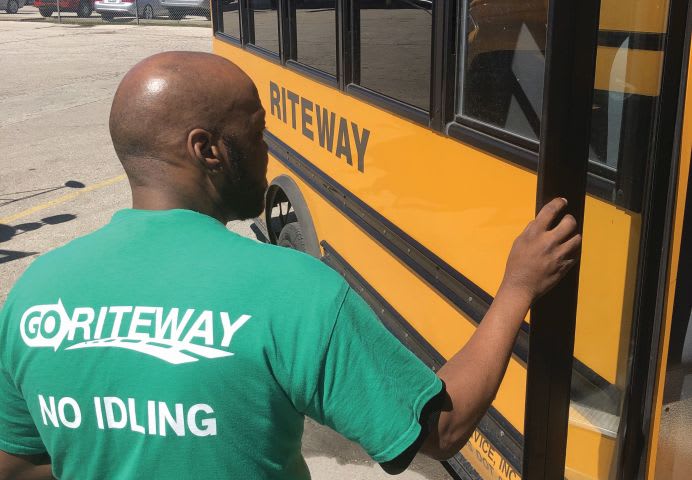
As part of an initiative to cut down on idling time, GO Riteway had T-shirts made for its drivers with a safety message on the front and “No Idling” on the back as a reminder.
As part of an initiative to cut down on idling time, GO Riteway had T-shirts made for its drivers with a safety message on the front and “No Idling” on the back as a reminder.
Going green: it’s a challenge school transportation departments across the country face. Although school buses already offer a lighter carbon footprint by taking dozens of cars off the road, and many school districts have invested in alternative-fuel buses, that’s not the answer for every operator, especially given today’s tight budgets.
Fortunately, there are a number of low-cost green strategies that pupil transportation departments can adopt. And, going green may save money over the long term.
However, the importance of going green exceeds budgetary considerations.
“Some green measures may save money, but when it comes to [going] green, the goal isn’t always about saving money,” says Keith Henry, director of transportation for Lee’s Summit (Mo.) R-7 School District. “We want to maintain the environment and make sure it’s safe for the next generation. That’s our goal: to be a responsible partner to our community.”
SBF spoke with three school bus operators who have found ways to lighten their carbon footprint beyond running alternative-fuel buses in their fleets. Here, we share some inexpensive green strategies pupil transportation departments can easily implement at their operations.
Minimizing Idling Time
Reducing school bus idling times is one of the most effective ways to conserve fuel and reduce fuel emissions, according to Henry. That’s why he, as well as Nathan Graf, senior executive director for the San Antonio (Texas) Independent School District, and Paul Kolo, vice president of operations for Wisconsin-based GO Riteway Transportation Group, have policies limiting bus idling times. Their school buses can idle no longer than five minutes unless they are carrying special-needs students or the weather is excessively hot or cold.
To help his drivers reduce idling time, Henry ensures his bus routes avoid dead-end roads, cul-de-sacs, and entries to subdivisions via main thoroughfares whenever possible.
“The more you stop, the more you idle,” he says. “Even though you’re picking up kids, you’re still idling.”
Graf, too, streamlined his routes. He asked about 10 of his drivers who knew San Antonio “inside and out” to adjust the routes. They moved stops and rearranged the routes so there was no downtime between bus stops.
Graf’s work paid off. He cut the number of bus routes and increased the number of students served.
“In our first year, we brought our [route] count down from 181 to 154,” Graf says. “We were transporting about 7,500 kids. Now we’re transporting about 8,200 kids, so we’re actually transporting about 700 to 800 more kids on fewer routes. … It lowers the amount of fuel we need. It lowers the amount of toxins in the air.”
Graf continues to revamp bus routes based on GPS, which his routers review daily, to see if stops are used consistently or should be moved.
To reduce idling time, Henry also pared down the time it takes his diesel buses to warm up on cold winter days. By using block heaters, his buses warm up in 30 minutes instead of one to two hours. Then one-liter, diesel-fired heaters continue warming the buses. Those heaters also produce radiant heat, which defrosts the front windshields — all before the drivers arrive.
“Between block heaters and the diesel-fire heaters, we’re saving emissions and fuel,” he says.
GO Riteway’s Kolo tackled another situation where excessive idling often occurs — when drivers load and unload students at school.
In addition to instructing drivers and posting signs reminding them not to idle, he sends managers to schools to ensure drivers shut off their buses. The school bus company also had T-shirts made for drivers with a safety message on the front and “No Idling” on the back.
Finally, all three pupil transportation professionals regularly monitor GPS reports to learn when a bus idles too long — 10 minutes or more — and coach drivers who habitually exceed idling limits.
Ending Fast Starts, Hard Stops
For Kolo and San Antonio’s Graf, avoiding fast accelerations and hard braking is another key to reducing their environmental footprint.
“At any given time during the day, we’ve got 160 folks on the road, and if they’re doing a fast start or hard stop, it creates wear and tear on the engine, toxins in the air, and wastes fuel,” Graf says.
Therefore, safe, conservative driving is part of Graf’s and Kolo’s driver training courses. Then, they use technology to ensure drivers continue to avoid jerky driving habits. Graf regularly monitors GPS reports of driver actions, and both review live feed videos and camera footage to determine whether a fast acceleration or hard stop was warranted.
In an intensive conservation program, simply reducing idling and encouraging conservative driving habits can save 5% to 8% on fuel costs, according to Kolo.
Engine Oil, Fuel Go the Distance
Changing the oil every 3,000 miles is a thing of the past for Lee’s Summit’s Henry, who has his oil analyzed to determine when it should be changed. With this method, Henry says his oil lasts up to 10,000 miles, and he often needs to change it only once a year.
“[With] a diesel bus that may take 30 quarts of oil, you don’t want to change it every three months,” he says. “When you’re using oil analysis and changing it at a better interval, you’re saving oil, and oil is a contaminant. You’re also saving money, but you’re not sacrificing your engine’s performance.”
Kolo’s fuel-saving tactics include using No. 2 instead of No. 1 diesel blends except in the coldest weather. No. 2 diesel fuel burns more efficiently and now has additives that prevent gelling, he says.
To conserve fuel, Graf sets his buses’ GPS speed governor at 50 mph. Additionally, when it makes sense, Kolo’s drivers keep their buses at home mid-day instead of returning them to the terminal.

A San Antonio (Texas) ISD mechanic sets the governor, also known as a speed limiter, on a school bus. The district keeps it set at 50 mph to ensure fuel isn’t being wasted.
Optimizing Tires
Henry puts different tires on rear engine and front engine buses — a green tactic that enables him to get more wear from his tires.
“Rear engine buses need different tires than front engine buses,” he says. “There are different weights, dynamics, and driving stress on the buses. We reduce our costs, but this also addresses environmental issues.”
Creating a Green Facility
Graf’s commitment to going green includes his department’s facility, which features motion-sensor, LED lighting; energy management air-conditioning control that maintains a set temperature; and sheetrock that is made of recycled materials and is chemical-free.
Graf says making his new digs environmentally friendly didn’t cost more than using traditional materials, and the automatic lighting and energy management air conditioning will save money in the long run.
Henry’s facility includes motion-sensor LED lighting, a compressed natural gas heating system, and an air filter that keeps chemical odors from leaking into the environment.
Recycling to Lower Costs
Recycling is a fact of life for Graf, who says his department “recycles just about everything.” That includes the buses’ fluids, batteries, oil filters, antifreeze, and other disposable products. Even the tires are recycled; they are shredded for mulch-like materials for playgrounds.
Graf implemented the program, which lowered his trash costs, by contacting community vendors. However, when possible, he includes the district’s schools in his recycling efforts.
Going Paperless
Henry also uses email instead of paper whenever possible.
“We used to print bus passes and mail them,” he says. “Now the bus passes are emailed to the parents. When you’re serving 18,000-plus kids, it’s a nice way to save a lot of postage.”
More Management

How to Build a Better Driver Training Program
Ready to boost up your school bus instructor training? Here’s how to pick the right talent and improve recruitment, retention, and safety.
Read More →
CALSTART and Forth Combine to Form Catalyst Mobility
The new name represents a renewed vision for the nonprofit focused on advancing clean, equitable, and affordable transportation solutions that move people and goods.
Read More →
What Makes a Great School Bus Driver Trainer?
Choosing the right school bus driver trainer takes more than experience. Learn six keys to selecting and developing trainers and evaluating program effectiveness.
Read More →


School Bus Contractors Expand Through New Deals, Acquisitions & Partnerships
STA's Canadian division acquires Ontario-based G&L Stevenson Transport while Durham School Services adds a new district contract in California, First Student adds a New Jersey contract, and Minnesota Coaches acquires Halo Transportation.
Read More →
Logan Bus Company Rolls Out AI Phone System for NYC School Bus Families
A summer pilot found that AI agents could handle most routine calls, freeing up time for customer service staff to focus on emergencies and complex family concerns.
Read More →
From Intent to Impact: What I Learned About Leadership from TAPT
A Texas transportation supervisor shares lessons on self-awareness, accountability, managing stress and building trust — and why investing in leadership development matters at every stage of your career.
Read More →
NAPT Names 2026 Award Recipients, Hall of Fame Inductee
Who earned national recognition for their work in student transportation? This year, NAPT named five recipients of its 2026 awards for service, safety, and leadership, plus its newest Hall of Famer.
Read More →
2026 State of Student Transportation Report
Driver shortages. Rising costs. Growing safety expectations. More data, but not enough time to act on it. The 2026 State of Student Transportation Report reveals what transportation leaders say is putting the most pressure on their operations—and where they’re investing next. See how your priorities compare.
Read More →
How to De-Escalate an Angry Person: 5 Steps for Handling Workplace Conflict
What makes emotions run high, and how should you handle an angry colleague or parent? Follow these steps for staying calm, listening, showing empathy, and resolving conflict.
Read More →
What Readiness Looks Like This School Year
Learn about the challenges shaping the 2026–2027 school year, from persistent driver shortages and budget pressure to technology and readiness gaps. See how school districts are responding and adapting in Zonar’s 2026 Back-to-School Readiness Report.
Read More →