




Feds show school bus support
At the annual conference of state pupil transportation directors, NHTSA Administrator David Strickland touts the safety and environmental benefits of the “humble yellow school bus,” as he calls it. NTSB Chairman Deborah Hersman credits state directors and others in the industry for their work to prevent school bus-train crashes.

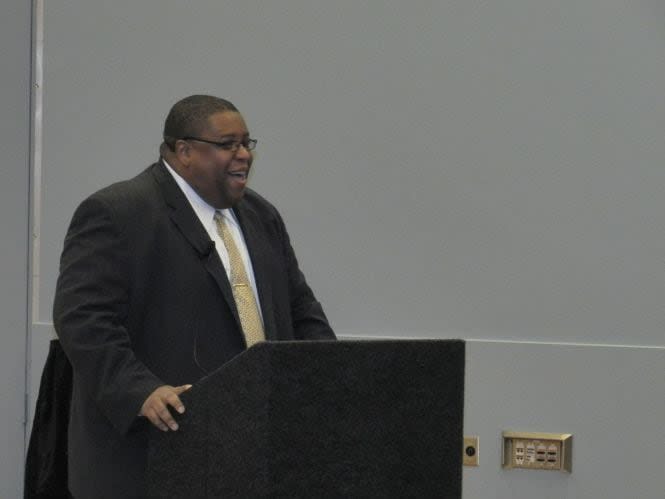
During the NASDPTS conference in Cincinnati, NHTSA Administrator David Strickland touted the safety and environmental benefits of yellow school buses.
The annual conference of state pupil transportation directors this fall drew some high-profile speakers from the federal government, and those officials had some encouraging words for the school bus community.
David Strickland, administrator of the National Highway Traffic Safety Administration (NHTSA), touted the safety and environmental benefits of the “humble yellow school bus,” as he called it. He also expressed support for increasing school bus ridership.
“We need to think about how we can expand busing — how we get more kids on buses,” Strickland said.
He noted that parents who prefer to drive their kids to school rather than putting them on the school bus have to be informed of their choice’s increased safety risk and contribution to traffic congestion.
Also during the National Association of State Directors of Pupil Transportation Services (NASDPTS) conference, which ran Oct. 21-24 in Cincinnati, NHTSA presented its new materials that promote school bus transportation.
The set of three posters can be downloaded for free at www.nhtsa.gov/School-Buses by clicking on the links under “Facts.”
High praise
In another session, National Transportation Safety Board (NTSB) Chairman Deborah Hersman reviewed several of her agency’s recent highway accident investigations and its ensuing recommendations. She also noted the lack of fatal school bus-train crashes in recent years, and she credited state directors and others in the industry for their work in preventing them.
In reviewing NTSB’s recommendations to enhance motorcoach safety, Hersman cited the superior occupant protection of school buses.
“You all have had real compartmentalization since the 1970s,” Hersman said of the school bus industry. Motorcoaches, with features like large windows through which passengers are ejected in some crashes, “are not designed with safety in mind,” she said.
[PAGEBREAK]
Flammability issue
An alarming development discussed during the NASDPTS conference was that chemical companies are reportedly funding a nonprofit group that is lobbying state legislatures to adopt additional flammability standards for school buses.
Accordingly, NASDPTS unveiled a new position paper explaining that the standards being proposed aren’t suited for pupil transportation — and the industry’s own national specifications are actually more stringent.
The paper, developed by NASDPTS’ School Bus Manufacturers Technical Council, details the fire-related federal standards that apply to school buses, including FMVSS 302 — Flammability of Interior Materials.
The paper notes that flammability standards are also included in the industry’s National School Transportation Specifications and Procedures. A maximum burn rate is specified for floor covering, and passenger seats are to meet the criteria of the School Bus Seat Upholstery Fire Block Test.
One of the standards being proposed in the lobbying efforts is to require that school bus seats meet ASTM International Standard E1537, “Standard Test Method for Fire Testing of Upholstered Furniture.” But the School Bus Seat Upholstery Fire Block Test is more stringent and more reliable, the NASDPTS paper points out.
Another of the lobbyists’ proposed standards, the paper explains, is to require that each plastic component in school bus engine compartments meets a V-0 classification when tested in accordance with the Underwriters Laboratories (UL) Inc. Standard 94, “Standard for Safety of Flammability of Plastic Materials for Parts in Devices and Appliances Testing.” But the chemicals that would be used to meet that standard could be problematic.
“In addition to major concerns regarding durability and performance of plastic components made to meet the UL 94 V-0 classification, there are also concerns with the chemicals that could be required to treat the plastics,” the paper says. “Brominated Flame Retardant (BFR) chemicals are typically used to meet UL 94 V-0 classification, and it is unknown what effect these BFR chemicals could have on plastic components in the engine compartment environment.”
The position paper is available at www.nasdpts.org/Papers.
Compelling speakers
Other highlights of the conference included a keynote speech by former NBA All-Star Mark Eaton and a welcome address by Ohio state director Pete Japikse, in which he discussed changes in school transportation and the need to come up with new solutions to old problems.
Kim Koenigs, executive director of the Worth County (Iowa) Development Authority, gave a passionate presentation about her campaign to pass Kadyn’s Law, which is named after a local girl who was killed in May 2011 when a motorist illegally passed her school bus.
The 2012 NASDPTS conference is scheduled for Oct. 19-22 in Memphis, Tenn.
More Management

How to Build a Better Driver Training Program
Ready to boost up your school bus instructor training? Here’s how to pick the right talent and improve recruitment, retention, and safety.
Read More →
CALSTART and Forth Combine to Form Catalyst Mobility
The new name represents a renewed vision for the nonprofit focused on advancing clean, equitable, and affordable transportation solutions that move people and goods.
Read More →
What Makes a Great School Bus Driver Trainer?
Choosing the right school bus driver trainer takes more than experience. Learn six keys to selecting and developing trainers and evaluating program effectiveness.
Read More →

School Bus Contractors Expand Through New Deals, Acquisitions & Partnerships
STA's Canadian division acquires Ontario-based G&L Stevenson Transport while Durham School Services adds a new district contract in California, First Student adds a New Jersey contract, and Minnesota Coaches acquires Halo Transportation.
Read More →
Logan Bus Company Rolls Out AI Phone System for NYC School Bus Families
A summer pilot found that AI agents could handle most routine calls, freeing up time for customer service staff to focus on emergencies and complex family concerns.
Read More →
From Intent to Impact: What I Learned About Leadership from TAPT
A Texas transportation supervisor shares lessons on self-awareness, accountability, managing stress and building trust — and why investing in leadership development matters at every stage of your career.
Read More →
NAPT Names 2026 Award Recipients, Hall of Fame Inductee
Who earned national recognition for their work in student transportation? This year, NAPT named five recipients of its 2026 awards for service, safety, and leadership, plus its newest Hall of Famer.
Read More →
2026 State of Student Transportation Report
Driver shortages. Rising costs. Growing safety expectations. More data, but not enough time to act on it. The 2026 State of Student Transportation Report reveals what transportation leaders say is putting the most pressure on their operations—and where they’re investing next. See how your priorities compare.
Read More →
How to De-Escalate an Angry Person: 5 Steps for Handling Workplace Conflict
What makes emotions run high, and how should you handle an angry colleague or parent? Follow these steps for staying calm, listening, showing empathy, and resolving conflict.
Read More →
What Readiness Looks Like This School Year
Learn about the challenges shaping the 2026–2027 school year, from persistent driver shortages and budget pressure to technology and readiness gaps. See how school districts are responding and adapting in Zonar’s 2026 Back-to-School Readiness Report.
Read More →