




Enhanced Ergonomics Highlighted in New Conventional Bus Designs
Unlike automobiles, which can undergo drastic design changes from year to year, school buses tend to look the same, at least to the general public, no...
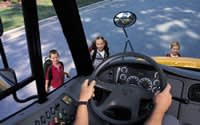
Unlike automobiles, which can undergo drastic design changes from year to year, school buses tend to look the same, at least to the general public, not only from year to year but from decade to decade.
But subtle enhancements to the driver's area, in the way of improved ergonomics, are regularly made by school bus manufacturers. These improvements are critical to the comfort and well being of the driver and to the safety of the passengers. They’re also critical to the ability of school districts and contractors to keep their turnover rates to a minimum. A driver who is comfortable behind the wheel is a lot less likely to leave the job than one who is constantly complaining about the driver’s compartment. Even something as subtle as a lack of storage space for a purse or other personal items can lead to overall discontent.
Driver input collected
When IC Corp. in Conway, Ark., was designing its 2005 CE conventional bus series, it received input from nearly 1,500 bus drivers from around the country. These drivers provided 34 measurements, including height, weight and length of arms and legs. From these measurements, a group of 28 "virtual" drivers of all shapes and sizes was generated for use in computerized ergonomic simulations. "Your average bus driver is not your average American," says Randall Ray, platform marketing manager for Warrenville, Ill.-based International Truck and Engine Corp., parent of IC Corp. "We measured real bus drivers; that was the key thing."
In addition to physically measuring the drivers, engineers at IC Corp. assessed their strength, movement capabilities and emotional reactions using video of them under actual driving conditions. Several different angles were monitored to document the movements and timing of drivers' feet, arms, hands and eyes. This data was analyzed to help design an environment that reduces the stresses that drivers face. "Our goal was to eliminate the driver’s need to lean, reach or make awkward movements," says Ray.
John Mellberg, creative vehicle stylist in the Research Design Development department at Thomas Built Buses in High Point, N.C., says the company collected and analyzed the input of 25 to 30 bus drivers from North and South Carolina while designing the drivers’ work space for the Saf-T-Liner C2, the new conventional school bus.
"We interviewed small groups of five or six at a time for about half a day each," Mellberg says. The drivers were weighed and measured for height and asked their ages and years of school bus driving experience. Then they were seated in a bus and asked to adjust the seat and steering column to a comfortable position. "We took photos of each driver in the adjusted position, explained the features of the interior surroundings they were in and interviewed them regarding their likes and dislikes of these features," he adds. "Interestingly, one of their biggest requests was for a place to put trash or to store their personal items," Mellberg says, adding that this request was addressed in the C2.
Visibility tops list
Because the ability of the drivers to see as much of the road as possible is critical to safety and comfort, bus manufacturers have been modifying the design of windshields, hoods, side windows and other elements that affect visibility. In its Vision conventional bus, engineers at Blue Bird Corp. in Fort Valley, Ga., say they were able to increase with a highly angled hood the driver’s range of sight by up to 20 inches compared to competitors' buses. The Vision also features a laminated glass panel with a wide-angle lens positioned slightly ahead of the service doors. This innovation allows the driver to see into a critical safety area near the right front wheel.
In addition, the Vision has an outward-opening tempered-glass service door that enhances the driver’s view of the loading and unloading area. The two-panel door is 27 inches wide and 78 inches high.
Other bus manufacturers also have been focusing on improved visibility. In the CE series, IC Corp. eliminated the center bar in the windshield by using one flat sheet of glass. "We also changed the wiper pattern to add significantly more wiped area," says Ray. "This enhances the driver’s ability to see across the entire road during inclement weather."
With its C2, Thomas has improved the visibility footprint found on a typical Type C school bus. Engineers reduced the forward hood height, allowing a typical driver to see the ground over the center of the hood at approximately 10 feet from the front bumper. The large, curved windshield allows more upward visibility, and loading zone visibility left and right of hood center is improved thanks to innovative “A” pillar windows and a window forward of the entrance door below the right “A” pillar window.
Mellberg says Thomas engineers reduced the dashboard instrument panel brow to minimize its visual presence. "The driver sees what we call the fence line of the window at the cowling, which also has been lowered," he explains. "In addition, the interior “A” pillar areas are painted black instead of school bus yellow to reduce glare/reflective light, and the dash and surrounding gray-colored areas are coated with a low-gloss paint to minimize driver eye fatigue from glaring objects."
There's also enhanced visibility for the passengers. Mellberg says the C2 has larger passenger windows, allowing more light into the bus. He says the increased interior illumination could help to improve the mood of students and reduce the likelihood of behavioral problems. Along those lines, Mellberg says the two color choices for the interior — gray and beige — also help to create a more positive atmosphere. "Both are on the light side of the color spectrum and, here again, help to brighten the interior surroundings," he says.
{+PAGEBREAK+} Hands-on improvements
Drivers often refer to their operating area as the cockpit of the vehicle. It's an apt description, given the number and variety of controls that they command. Bus manufacturers constantly tinker with the layout of these instruments, hoping to find a formula that will satisfy the most hard-to-please drivers. The key to winning over these critics is placing the controls in easily accessible places and ensuring that gauges are properly positioned and easy to read.
In the Vision, Blue Bird created a wrap-around dash that puts switches within easy reach. The gauges are back-lit with lighted needles, helping drivers read the instrumentation in dim lighting.
Thomas' C2 also features instrument panel gauges that are easy to read. The operator controls' placement is standard, but end users can customize the placement of the left-side controls console switches, depending on their individual functional needs. "It gives them flexibility to accommodate their specific user requirements," says Mellberg.
IC Corp.’s CE series has what’s being called a “one-button stop” feature. It puts frequently performed tasks such as door and warning-light controls at the driver’s fingertips on the steering wheel. “So there should never be a situation where the driver has to take both hands off the steering wheel,” Ray says. In addition, all of the exterior lights can be controlled with a single button, making the pre-trip light check simple for one person to perform.
Pedals, seats, steering
Ray says the CE series embraces a more "automotive" environment for the driver. For example, the accelerator and brake pedals are now aligned in a more "car-like" rather than "truck-like" position. He concedes that earlier conventional bus models have brake and accelerator pedals that are awkward in their shape and placement.
Thomas' C2 offers adjustable foot pedals as an option. This is especially helpful for short or heavyset drivers. "This enhances pedal reach for shorter drivers, and heavy drivers can increase the distance between the steering wheel and seat for maximum belly room, but still maintain good leg reach to the pedals if they are adjusted rearward," says Mellberg.
Much consideration is also given to the position of the steering column and the flexibility of the seating adjustment. "The design philosophy was to accommodate drivers of statures ranging from 5th percentile females to 95th percentile males," Mellberg says. Three-dimensional human modeling helped engineers determine proper seating positions and back angles.
Mirrors play key role
Another ergonomic consideration is the use of mirrors. Drivers who have to strain to use their mirror systems not only add to their fatigue factor but also undermine the safety of the vehicle and its passengers.
"Remote-control mirrors can be adjusted by the driver without the help of a mechanic," says Chris Albers, general manager of Zomir LLC in Cincinnati. "This is an important consideration, because drivers — especially when they're in a hurry — don't take the time that they should to adjust their mirrors if they can't do it themselves."
Albers says low-mount mirrors on the driver's side can help to improve the field of view. “When they can see over the top of the mirror, it can help to prevent left-turn accidents,” he says.
Another visibility issue is the glare from driving mirrors created by headlights from approaching motorists. Reduced-reflectivity glass in these mirrors can cut the glare, Albers says. Heated mirrors are another ergonomic consideration. The severe winter that hit the East Coast this year points at the importance of being able to clear mirrors in icy temperatures.
Room for improvement
And the future of ergonomics in a school bus? It's a work in progress. “We never stop learning,” says Mellberg. “We are continually looking at better ways to improve driver functional performance, comfort and visibility.”
More Management

EverDriven Launches Route Consolidation Calculator to Estimate Diesel Savings
As diesel prices hit record highs, the largest alternative transportation provider says a 10% route consolidation could save a 120-route district more than $78,000 a year in fuel alone.
Read More →
Zum Secures Continued Financing Support for School Bus Expansion
Generate Private Credit has financed approximately $75 million in school bus deployments across three states, supporting more than 500 buses as Zum expands across the county.
Read More →
Beyond Discipline: A Different Approach to Student Behavior on the Bus
After implementing a dean of students program in Oregon, North Clackamas is seeing positive improvements. Here’s how it worked. The Route is brought to you by IC Bus.
Read More →
A Dean of Transportation's Different Approach to Student Behavior on the School Bus
After implementing a dean of students program in Oregon, North Clackamas is seeing positive improvements on the bus. Here’s how it worked.
Read More →
Inside NAPT ACTS 2026: Highlights from Louisville
From federal updates and student behavior strategies to new school bus technology and industry awards, see highlights from NAPT ACTS 2026 in Louisville.
Read More →
Meet the 2025 School Bus Driver Hero Winner: Annette Brown
We caught up with Wa-Nee Community Schools' Annette Brown on site at SBFX, where she was named the 2026 School Bus Driver Hero Award winner. Hear about her reaction, what she loves most about being a school bus driver, and more!
Read More →
Predictability Is Like Ketchup (According to 6-Year-Olds)
To students, a different school bus can feel like a full-blown crisis. One driver reflects on why familiar routines, showing up on time, and being reliably boring matter more than we think.
Read More →
Samsara Launches Free Driver Rewards Program
The new Driver Perks program gives eligible professional drivers access to discounts and offers without adding a cost for participating fleets.
Read More →
How Tax-Exempt Municipal Leases Can Help Finance School Buses
Let’s explore school bus financing options, including municipal leases, vendor payable accounts, and balloon payments, and how they can help stretch fleet budgets.
Read More →
Nominate Rising School Transportation Pros Under 40!
We’re searching for the next generation of leaders making an impact across the K-12 student transportation industry to recognize as SBF’s 2027 Trailblazers. Nominations are open now!
Read More →