A growing demand for propane buses in recent years has sparked an influx of training programs for maintenance technicians. Here, industry experts share top tips and best practices for maintaining propane school buses.
Sadiah Thompson・Assistant Editor
March 5, 2019
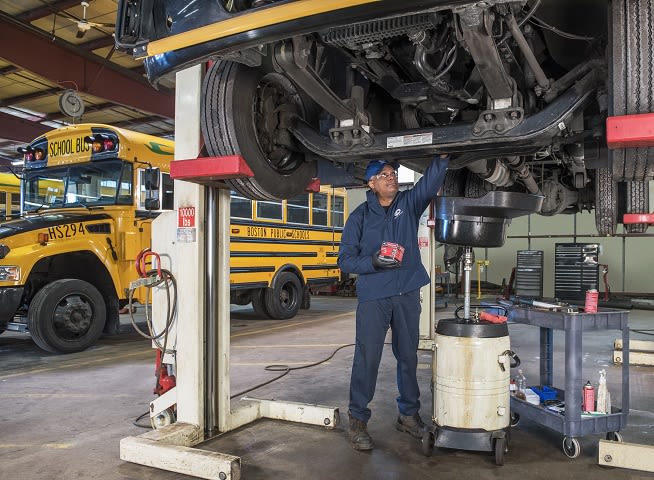
Maintenance for propane school buses includes consistent oil and filter changes, and fueling at routine service intervals.
Photo by Erwin Harrison
6 min to read
From low-cost operation to reduced downtime and emissions, propane school buses provide a variety of immediate and long-term benefits for school transportation, and as the demand to adopt the alternative fuel intensifies, the more technician training becomes a priority.
In recent years, the industry has seen a growing demand for propane buses. In response, school bus manufacturers and propane autogas suppliers are ensuring they provide maintenance personnel with the necessary tips, as well as in-person and online training programs.
Ad Loading...
“Technicians are constantly reaching out for more training and we are actively listening,” says Carol Dietrich, the director of corporate training and technical publications for Blue Bird. “Possessing the ability to properly maintain the buses ultimately cuts down on mechanical breakdowns and saves money.”
SBF spoke with a number of industry experts, including some vehicle maintenance technicians to discuss best practices for propane maintenance and the various factors to consider before, during, and after the purchase of a propane school bus.
Diesel Versus Propane
Before even thinking about conducting any maintenance procedures, Ryan Zic, the school bus sales director for propane systems supplier Roush CleanTech, says technicians should note key differences in maintenance requirements for diesel and propane engines.
“For example, the propane engines require less oil by volume than diesel, and no additional diesel emission fluids,” he explains. “There are no aftertreatment items to service, such as maintenance parts and fluids, because propane’s chemical properties allow it to power an engine.”
In addition to that, Zic advises technicians to follow manufacturer-recommended procedures when de-pressurizing fuel lines in propane systems, as they typically maintain some amount of pressure after the vehicle shuts down.
Ad Loading...
Aside from the fact that there are fewer components to maintain, one of the more important distinctions between propane and diesel school buses is the use of spark ignition systems in propane engines, as opposed to compression ignition systems in diesel engines.
“Typically, after a propane bus hits about 50,000 miles, you’re going to be changing spark plugs,” says Brian Lowe, the vehicle maintenance manager for Pinellas (Fla.) County Schools.
He adds that it’s important for fleets to incorporate changing and inspecting spark plugs into their regular maintenance schedules.
Fuel Savings and Infrastructure
Propane can often be delivered on site to fleets, where the pricing is typically based on the volume of propane used. One way that fleets can avoid these additional fuel costs is by building or purchasing individualized fueling stations.
In Tennessee, Clarksville-Montgomery County School System operates two propane fueling stations so drivers can quickly and efficiently fill their buses, says Ricky Phillips, the district’s vehicle maintenance manager.
Ad Loading...
Each year, the district puts out a bid to contract fueling stations with local gas companies, he explains, and the two companies that propose the lowest price for propane receive fueling contracts with the district for the year.
“The [fueling stations] really helped drive our fuel costs down,” Phillips says, “and we plan on opening up a third station in the summer of 2019.”
While propane fueling stations may be useful and easy to adopt for some fleets, others, particularly larger fleets, may need to consider using propane fueling tanks.
Peter Crossan, fleet and compliance manager for Boston (Mass.) Public Schools, says the district uses a vendor to fuel its propane buses with a dual-hose fueling truck.
“The idea of moving our 248 propane buses to the fuel queue and parking them is inefficient,” he says. “Instead, [the vendor] can go down an aisle in the bus yard with buses on both sides, and they can fuel our buses without moving or starting a single bus.”
Ad Loading...
Despite leasing the district’s bus garages, Crossan says Boston Public Schools operates with zero infrastructure costs.
According to Michael Taylor, the director of autogas business development for the Propane Education and Resource Council (PERC), in most cases, existing maintenance and garage facilities will not require costly modifications during a fleet’s transition to propane.
“If existing buildings are code compliant for diesel and gasoline, typically there are no infrastructure changes required for propane autogas,” he explains.
For specifics on fueling facility requirements, Taylor recommends transportation professionals check with their local authority having jurisdiction (AHJ), as additional requirements may exceed the standards established by the National Fire Protection Association (NFPA), International Building Code, and National Electric Code.
Curbing Maintenance Costs, Emissions
The biggest difference school bus manufacturers and propane systems suppliers note for propane maintenance is the reduced maintenance costs on oil and filter changes and emissions.
Ad Loading...
Pinellas County Schools recently ordered 30 Blue Bird propane school buses to add to its existing fleet of 642 buses, with 98 now being propane. Since implementing the alternative-fuel buses, Lowe says the district went from using 34 quarts of oil for oil changes on diesel buses to using 8 quarts of oil on propane buses. In addition, the cost of oil filters has dropped by almost a quarter, with propane oil filters costing about $4 compared to $18 for diesel oil filters.
Crossan notes that most propane engine manufacturers and suppliers will give districts an estimate for how long they can operate buses between filter and oil changes, which can be helpful when determining preventive maintenance intervals.
“Unlike most fleets, we do a complete preventive maintenance inspection and filter change every 91 calendar days,” he explains.
The district does this for two reasons. The first, Crossan says, is that the district often hits the limit for operating hours before miles. The second reason is that if the district conducts propane service intervals by miles, they could have 50 buses that need preventive maintenance one week and then three buses the next, due to differences in length of bus routes.
In terms of emissions, PERC’s Taylor says propane school buses provide substantial reductions without the additional maintenance costs of diesel engines that require diesel particulate filters (DPFs) and diesel emissions fluid (DEFs).
Ad Loading...
Importance of Training
For districts looking to improve their propane maintenance procedures, Blue Bird’s Dietrich encourages them to take advantage of training programs.
This year, Blue Bird is hosting three factory-based, hands-on training events for maintenance technicians. Topics for the trainings include Roush CleanTech propane systems, multiplex and body control diagnostics, and tire wear analysis.
The manufacturer is also launching a three-tiered technician certification program through Blue Bird Academy, in which users will be able to take advantage of online and factory-based training when servicing Blue Bird buses.
In addition, Roush CleanTech, which is the autogas systems supplier for Blue Bird’s propane buses, is expanding its web-based training offerings with hands-on vehicle troubleshooting, diagnostic software training, and classroom learning.
Through 2019, PERC will be continuing its sponsorship of free technician training opportunities across the U.S., in partnership with the National Alternative Fuels Training Consortium (NAFTC).
Ad Loading...
“Investing in training may seem like an investment with little in return,” Dietrich says. “However, it is vital to make investments in training and development to successfully keep those buses running at the optimal level.”
Top Tips for Propane Maintenance
Propane systems may require less maintenance, but technicians are still encouraged to stay up to date with the latest propane service practices and procedures. Jamie Allison, the manager of service education for Thomas Built Buses, pinpoints five key services to ensure school districts uphold consistent, cost-effective maintenance.
1. Ensure your station fuel pump is being maintained at regular service intervals. A liquid propane fuel system is susceptible to contamination. Station pumps that leak oil into the propane when filling units is a common source of contamination.
2. Make consistent oil checks and change intervals based on mileage. Propane engines can use more oil than diesel engines while having a lower oil volume. This can lead to low oil operation if not checked regularly.
3. Spark plug changes. Since propane buses have a spark ignition engine, the spark plugs need to be changed at regular service intervals, usually every four oil changes. Diesel shop staff will need to make sure these are added to their maintenance schedule.
4. Fuel filter change. Some propane systems have two fuel filters. A fuel filter prevents contaminants from entering the fuel tank. A fuel supply inline filter keeps contaminants from reaching the injectors. Both should be changed at standard service intervals to prevent system contamination.
5. Frosted fuel line requires leak inspection. Frost on a fuel line of a properly operating system is usually a sign of a fuel leak. If you see frost, conduct a leak inspection and repair any issues found to maintain bus safety and save on fuel cost.
Your district's buses carry students to school every day. This guide shows how predictive maintenance powered by fleet data helps keep buses reliable, drivers accountable and students safer from the first bell to the last stop.
The acquisition of Downriver Truck and Bus expands Kerry Brothers’ school bus maintenance footprint across southeast Michigan, adding repair capacity, diagnostic resources, and state inspection support.
CAN Mentor and the latest JPRO update aim to simplify vehicle network diagnostics and improve repair efficiency for technicians of all experience levels.
Cummins discusses its first-ever gasoline engine for school buses, EPA 2027, and why bus fleets still want durable, simpler internal combustion options.
Vampire Tools introduced the VAMPLIERS Caiman 7.5-inch multi-purpose pliers, combining screw extraction, cutting, crimping, and gripping functions into a single tool designed for fleet maintenance professionals.
Chat with Noregon’s Kevin Smallhorn at ACT Expo about bus diagnostic tools, telematics integration, CNG maintenance support, and strategies to help reduce downtime and improve uptime.
Don’t let bus downtime wear you down. Here’s how bus operators are shifting from manual processes to AI-powered, data-driven maintenance systems for improved reliability and safety.
Covering 38 routes on a Friday afternoon. Buses idling while routes overlap. Parents calling nonstop about late arrivals. Sound familiar? This whitepaper explores how district transportation leaders solved these exact problems — and what measurable results followed.