




Maintenance staff: 148 (shop, parts, and office/support positions)
Service bays: 64 over six sites
School buses: 1,848
Annual route mileage: 27 million
Other vehicles: 1,200
Efficiency Efforts Pay Off for Growing Fleet
Clark County School District has found new ways to optimize its maintenance program. The shop team is seeing success with laptops and mobile Wi-Fi, a dedicated white fleet service center, and a new DEF filling system, among other initiatives.
by Thomas McMahon
March 1, 2019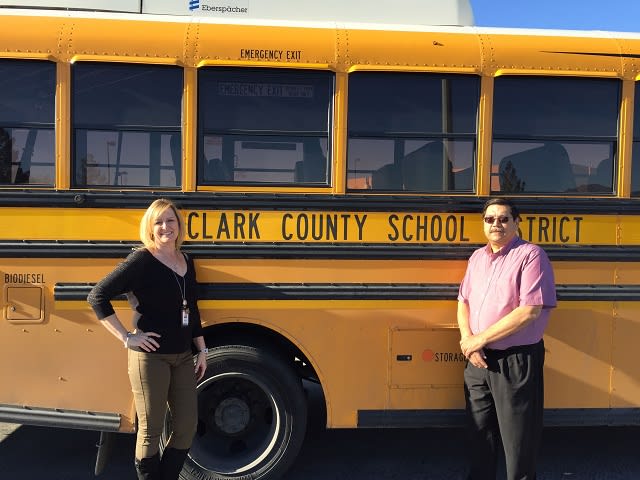
Shannon Evans, executive director of transportation, and Paul Shelley, director of fleet services, oversee the biggest public school bus operation in the nation.
8 min to read
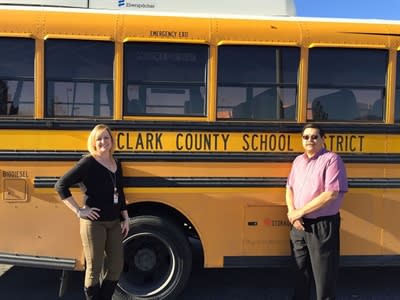
Shannon Evans, executive director of transportation, and Paul Shelley, director of fleet services, oversee the biggest public school bus operation in the nation.
With more than 1,800 school buses covering an area of about 5,000 square miles, efforts to boost efficiency go a long way at Clark County (Nev.) School District.
The Las Vegas-based district, which operates the biggest publicly owned school bus fleet in the nation, has found new ways to optimize its maintenance program, from equipping technicians with laptops to streamlining the white fleet and parts inventory.
These steps help the district operation as it keeps pace with an increasing demand for transportation, fed by rising student enrollment, new school construction, and other changes in Clark County.
“We grow the fleet by about 75 to 100 buses per year,” says Shannon Evans, executive director of transportation for Clark County School District.
As the fleet grows, so does the need for personnel in the transportation department. Along with experiencing the widespread school bus driver shortage, Clark County is struggling to recruit enough mechanics and mechanic assistants.
“People are not as eager to go into the repair field,” says Paul Shelley, director of fleet services. “Luckily, our turnover [of shop staff] is less than on the driver side.”
Connecting Technicians
Helping in both staff retention and operational efficiency, Clark County School District is making efforts to ensure that its maintenance technicians are well-equipped for the job. Most notably, the district has been outfitting techs with laptops and Wi-Fi hotspots.
Shelley says that having a laptop in the bus bay gives technicians data at their fingertips, which saves time and enables them to better document the work that they perform on vehicles. When techs go out on service calls, having a laptop and mobile Wi-Fi is especially beneficial.
“They can access diagnostic information in the field so we don’t have to pay an outside contractor,” Shelley says.
Evans notes that the laptop-equipped technician taps into a new dynamic that can streamline the repair process.
“You can connect to a diagnostic troubleshooting document and narrow down [the issue] much more quickly than you could before, when you’re trying to guess,” Evans says.
Testing New Technology
Expanding on the laptop initiative, the Clark County transportation department is working on plans to equip its buses with mobile data terminals (also known as tablets). Evans says she expects the devices to provide multiple benefits, such as allowing drivers to clock in and out on board the bus and to report mechanical issues via an app. The district hopes to have tablets up and running on some of its buses next year.
Another new school transportation technology that Clark County will soon start testing is 360-degree-view surveillance systems, which show the driver video camera footage from around the bus. This year, the district is equipping 24 buses with the 360-view systems. Evans says they will gather feedback from drivers to evaluate how helpful the systems are and “whether they have a true safety impact.”
Bolstering DEF Setup
Clark County School District has also made changes to its fueling infrastructure that have enhanced efficiency and data collection.
With the addition of diesel exhaust fluid (DEF) to the emissions systems of diesel school buses, Clark County’s garage attendants have had to spend more time in the fueling process. First, they would drive a bus to a fuel island to fill it with diesel, and then they would drive it around to the garage to fill it with DEF.
To consolidate the process, Shelley had a DEF tank and dispenser installed at one of the district’s fuel islands, enabling the garage attendants to tackle two tasks in one place.
“We’re seeing a lot more efficient use of time by not having that second [step],” Evans says. “We’re getting ready to roll that out at more locations. … We look at the little efficiencies as well as the big efficiencies.”
Another advantage of adding DEF equipment to the fuel island is that it is now integrated with the district’s recently upgraded fuel monitoring system, which in turn is integrated with the district’s RTA fleet management software. Now, instead of having to manually measure and record DEF use, the fuel monitoring system keeps an accurate record “so we know exactly how much we put in each vehicle,” Shelley says.
Also programmed into the fleet management software is Clark County’s preventive maintenance schedule. Every 4,000 miles, buses go through a visual check, and any issues that are discovered are addressed. At 12,000-mile intervals, the maintenance team conducts oil changes and other services that are required by the manufacturer.
The district’s current fleet roster includes 1,848 school buses, 100 food service vehicles, and about 1,100 other vehicles, known as the white fleet. To help technicians focus their efforts and skills, the transportation department has dedicated one of its facilities to servicing the white fleet.
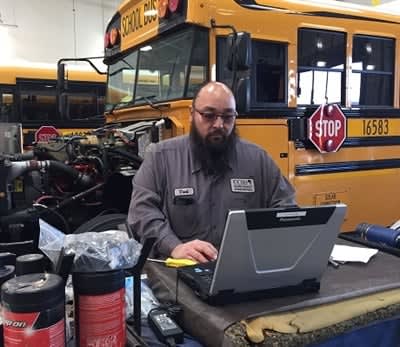
Outfitting mechanics with laptops has helped them save time and better document the work they perform on vehicles.
Fleet Service Restructuring
With such a large mixed fleet, Clark County’s technicians work on a wide variety of vehicles. Beyond the yellow buses, there are sedans, district police cars and SUVs, pickup trucks, dump trucks, and other types of vehicles.
With the goal of better organizing the shop structure, over the past few years Evans and Shelley have separated the white fleet maintenance from the school bus maintenance. To facilitate this effort, they took one of the district’s smaller transportation satellite facilities — which “wasn’t highly supportive for school bus operations,” Evans notes — and developed it into a white fleet service center.
“All of our non-school bus work goes over to the white fleet service center,” Evans says. The result of this segmentation, she adds, is that “mechanics can be more focused … [and] training and support can be customized to the type of work the mechanics are doing.”
Meanwhile, the Clark County transportation department now has five school bus facilities, which also support outlying areas. For preventive maintenance and major repairs, buses from those remote locations are brought to one of the in-town facilities. For some repairs, a mobile technician is dispatched to the site.
Motor Pool Furthers Efficiencies
The white fleet has been the subject of another efficiency initiative at Clark County: a district-wide motor pool.
As Shelley analyzed the district’s non-school bus fleet, he found that there was a significant number of underutilized vehicles at various district sites — essentially sitting in a parking lot most of the time.
The transportation department saw an opportunity to streamline the fleet while still having vehicles available for when district staff members need them.
“We created a motor pool at the white fleet service center,” Evans explains. “If employees need a vehicle for district business, they can pick it up and return it. This has been very successful.”
Establishing the centralized motor pool allowed Clark County to cut its white fleet by about 10%, or 130 vehicles. This, in turn, has reduced the need for maintenance work, smog checks, and other costs associated with the vehicles. Also, Evans notes, “It allowed us to repurpose some mechanics.”
“We need to be looking at the younger workforce to find those students that have drive and initiative, and we’ll teach them and guide them.”
Shannon Evans, executive director of transportation
Clark County (Nev.) School District
Optimizing Surplus Sales
When it comes to selling vehicles, Clark County School District previously relied on a local auction, which had its shortcomings. For example, the first and second buses sold in an auction might fetch a decent price, but after that the demand would dwindle.
“It’s a limited market,” Shelley says. “We were not getting what we thought was the value of the vehicles.”
On that front, Clark County decided to try selling its vehicles online, primarily on the website PublicSurplus.com. The change has brought in significantly more revenue, which goes back into the district’s general fund.
“Paul has been able to get more consistent pricing — $5,000 or $6,000 [per] bus throughout the whole process,” Evans says. “We’re reaching more buyers through online access. … We’ve had people from the East Coast buying our buses.”
Clark County has also used the Public Surplus site to sell unneeded parts. This ties in with an effort to keep the district’s parts inventory in check.
Clark County’s school bus fleet is on a 14-year replacement cycle. So when, for instance, the 2005 model year buses are replaced, the parts manager will search the inventory for any parts that are specific to the 2005 model year buses. Those parts can then be sold off rather than taking up space and collecting dust on the shelf.
“This whole auction process allowed us to get rid of parts and make sure our whole parts inventory is viable, usable parts,” Evans said.
In some cases, Shelley notes, an unused part that isn’t too old can be returned to the dealer for a credit.
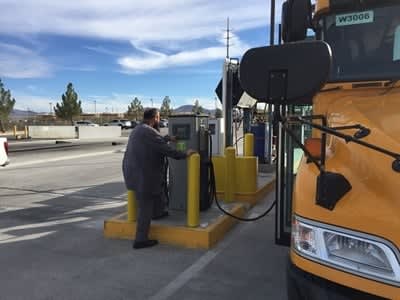
Clark County School District installed a diesel exhaust fluid tank and dispenser at one of its fuel islands, enabling staff to tackle two tasks in one place.
Biodiesel and Beyond
The majority of Clark County School District’s buses run on a biodiesel blend. Those that operate around the city are fueled with B20 (20% biodiesel, 80% petroleum diesel), while those in the outlying areas are fueled with B5.
Clark County is also investigating other alternative-fuel options. So far, that has included acquiring six propane buses to test out. The district has found that the propane buses need to be refueled mid-day, which limits where they can be operated.
“We’re having to keep them centrally located because they don’t have the range we’d like to see,” Evans says.
Meanwhile, Clark County is interested in electric school buses but wary of their high purchase price. To buy electric buses, Evans says, they would have to be sure that lower operating costs would yield savings over the course of the district’s 14-year replacement cycle.
“We need to get a return on investment in that 14 years,” Evans says. “We’re hoping that the cost [of electric school buses] continues to improve.”
Investing in Future Techs
Another new initiative at Clark County School District is a student worker program, which aims to provide career training for students while investing in the future of the shop workforce.
The district plans to launch the program this spring with two or three students from local high schools or trade schools who might not be college-bound. They will initially work on non-school bus vehicles at the white fleet service center. The goal is to get the students on a track to becoming school bus technicians once they reach the district’s age requirement for the position, 21.
“We need to be looking at the younger workforce,” Evans says, “to find those students that have drive and initiative, and we’ll teach them and guide them.”
Thomas McMahon is a contributing writer who has been covering pupil transportation for more than 16 years. He previously served as an editor at School Bus Fleet.
Subscribe to Our Newsletter
More Maintenance
Sponsored•September 8, 2026
The Essential Guide to School Bus Maintenance and Student Safety
Your district's buses carry students to school every day. This guide shows how predictive maintenance powered by fleet data helps keep buses reliable, drivers accountable and students safer from the first bell to the last stop.
Read More →
Kerry Brothers Grows Michigan School Bus Repair Network
The acquisition of Downriver Truck and Bus expands Kerry Brothers’ school bus maintenance footprint across southeast Michigan, adding repair capacity, diagnostic resources, and state inspection support.
Read More →
Noregon Introduces CAN Bus Diagnostic Tool, Expands JPRO Features
CAN Mentor and the latest JPRO update aim to simplify vehicle network diagnostics and improve repair efficiency for technicians of all experience levels.
Read More →
Cummins on Smarter, Simpler Engine Innovation
Cummins discusses its first-ever gasoline engine for school buses, EPA 2027, and why bus fleets still want durable, simpler internal combustion options.
Read More →
Report: 72% of Diesel School Buses Now Use Advanced Low-Emission Engines
New data shows advanced low-emission diesel technology continues expanding across school bus fleets, even as electric bus adoption gains momentum.
Read More →
Vampire Tools' CAIMAN 7.5-Inch Multi-Purpose Screw Extractor Long-Nose Pliers with Crimper
Vampire Tools introduced the VAMPLIERS Caiman 7.5-inch multi-purpose pliers, combining screw extraction, cutting, crimping, and gripping functions into a single tool designed for fleet maintenance professionals.
Read More →
How Advanced Diagnostics Helps Bus Fleets Stay Ahead of Repairs
Chat with Noregon’s Kevin Smallhorn at ACT Expo about bus diagnostic tools, telematics integration, CNG maintenance support, and strategies to help reduce downtime and improve uptime.
Read More →
How School Bus Fleets are Getting Ahead of Breakdowns
Don’t let bus downtime wear you down. Here’s how bus operators are shifting from manual processes to AI-powered, data-driven maintenance systems for improved reliability and safety.
Read More →
Pennsylvania School Bus Maintenance Team Praised for Dedication to Safety
Matthews Bus Company’s West Jefferson received a letter of commendation from the Pennsylvania State Police for their fleet inspections.
Read More →
Sponsored•April 16, 2026
From Chaos to Clarity: How School Districts Are Running Leaner Transportation Operations
Covering 38 routes on a Friday afternoon. Buses idling while routes overlap. Parents calling nonstop about late arrivals. Sound familiar? This whitepaper explores how district transportation leaders solved these exact problems — and what measurable results followed.
Read More →