




Don't Leave Money on the Table: Using Software for Medicaid Reimbursement
Software programs automate reporting, making it easier, faster and less costly, suppliers say. Districts have been able to save days’ worth of staff time and have more, reliable data with which to recoup much-needed funds.

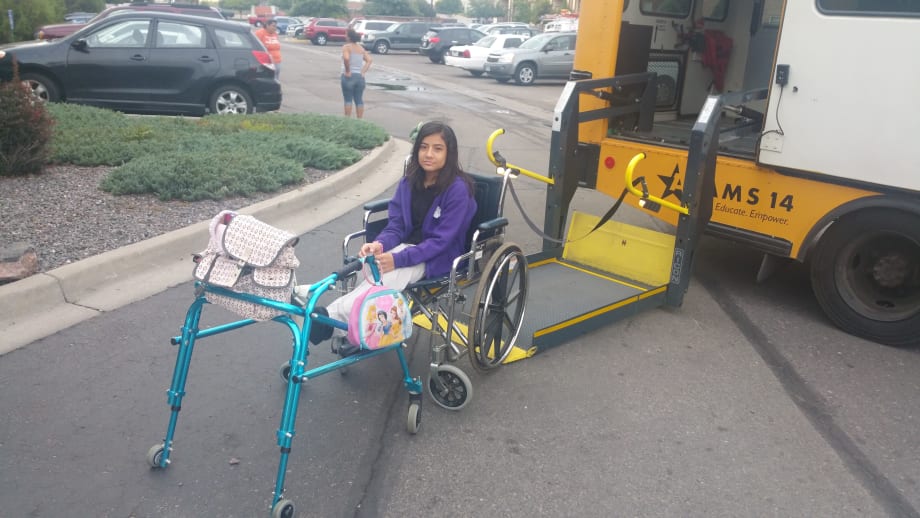
School districts such as Adams County (Colo.) School District 14 have adopted software programs with routing and ridership tracking to streamline Medicaid reimbursement reporting. Shown here is one of the district’s special-needs students with her school bus. Photo by Billy Salaz, Adams County (Colo.) School District 14
Although Medicaid provides reimbursement to school districts for transporting qualified special-needs students, some have chosen not to file reports to get the money back, finding that the challenges outweighed the benefits when done by hand.
Many districts have also been concerned about getting audited for unknowingly submitting inaccurate information. This meant they were forgoing much-needed funds that can be used to help pay for special-needs vehicles; vehicle maintenance, equipment and depreciation; and to train staff members.
Among districts surveyed by TMAnderson Consulting a few years ago, only 10% filed claims for Medicaid reimbursement, and though that has recently increased to nearly 20%, only 7% claim the vehicles they use for qualified special-needs students, says Theresa Anderson, owner and principal of TMAnderson Consulting. That is unfortunate, because some Colorado districts, such as Aurora Public Schools and Cherry Creek School District, have recouped $400,000 to $1 million annually, she adds.
“It used to be that going after these claims cost school districts money,” says Ted Thien, senior vice president and general manager, Versatrans product group at Tyler Technologies. “There’s labor involved, but transportation departments need every ounce of funding they can get. More [of them] are dedicating staff and [investing in] technology so they can get those reimbursements. Five years ago, it wasn’t very common.”
The many eligibility and data requirements for reimbursement may seem intimidating, but several software options that track and store data can help create reports efficiently and reliably.
Districts have created the reports on paper in the past, which could take days. For some, implementing software programs has cut that time down to a few hours. Using the programs is also more convenient for bus drivers, because they no longer have to keep an attendance record, since that is automated through student ridership tracking programs.
Still, another concern many districts have is about penalties and audits in response to unintentionally providing incorrect data. However, that may be more likely to happen when keeping records by hand, which can produce less reliable information.
Frank Gazeley Jr., vice president of client relations at Transfinder, says that instead of estimating, knowing the exact number of miles a student rode on the bus provides the opportunity, especially for fleet maintenance, to track the cost related to special-needs requirements, which can be difficult for schools to measure without software tracking tools. He adds that districts sometimes think the reimbursements aren’t going to be worth it, but with the right tools, tracking the data is simple.
“It can be part of the normal process,” he explains. “It does take work. You may have to merge data [from different sources, like] a fleet maintenance product, but the numbers can be very significant, even for a small district.”
However, some districts may still see student tracking implementation as an operational challenge because of card management and the adjustments that may be needed to district policies and communications (what to do when a student does not have a card, for example), media involvement and driver training, says Jason Corbally, president of EDULOG.
Understanding eligibility requirements
One of the most important factors to note in creating a report for Medicaid reimbursement is that not all special-needs students transported by a district are eligible to be counted. In many states, only students who are transported to services addressing their special needs, such as physical therapy or audiology, can be included, and only the days they received services can be counted.
Additionally, districts must get consent from parents for billing to be done on behalf of their child, which is typically done when creating the individualized education program (IEP) or healthcare plan, Anderson says.
The student also must require adaptive equipment, such as a safety vest or a wheelchair. An aide or nurse can only be claimed if they are exclusively assigned to the child per their IEP while being transported. California and New York also require districts to have a lift-equipped bus.
Required data can vary from state to state, but usually also includes the student’s information from the IEP or health plan, stop location, stop time, the mileage and amount of time spent on the bus, and driver ID number and signature. Some states accept an electronic signature, but most require a manual signature from the driver, Anderson says.
Districts also need to double-check their local service plan to ensure that transportation is included. Many are surprised to find transportation missing from that list, she adds.
Software streamlines process
Software programs from suppliers, such as EDULOG, SchoolSource, Secured Mobility, Seon, Synovia Solutions, Transfinder, TripSpark Education, Tyler Technologies and Zonar, which many transportation departments already use for GPS, routing and ridership tracking, can help track the required data and quickly create a report.
Transportation departments use the programs to track eligibility data and then export it to a spreadsheet, have the bus drivers sign manually or via electronic signature, and send it to the special-needs or Medicaid department, which runs a match on when the student received special-needs services and submits a paper or PDF copy to Medicaid for reimbursement.
Typically, IEP data is defined in school bus routing software, which integrates GPS and radio frequency identification (RFID), tying bus drivers to bus numbers and routes when they clock in. Student trip data is captured in ridership tracking software when they scan their card on a card reader inside the bus as they enter and exit. In many systems, the routing software and ridership tracking software data can be pulled for the report.
For example, Seon’s vMax Compass features Transportation Action Request, a system that lets staff outside the transportation department make a change request to a student’s transportation plan. Reports can then be customized and exported as a CSV file or Excel spreadsheet, says Kerry Somerville, director of business development for the fleet division at Seon.
SMART tag’s report section includes a special-education reimbursement button for monthly reports for all qualified students who rode in a one-sheet calendar format, says Brett Taylor, product manager, SMART tag, for Secured Mobility. It also lists students eligible for Medicaid reimbursement in its Admin Portal. If a district doesn’t have routing software, staff members can log in to the portal and note that a student is eligible for reimbursement.
Three Transfinder products work together to create report data: the Routefinder Pro routing system, which tracks routes with vehicles that include special-needs equipment, such as restraints or wheelchair lifts; Infofinder Mobile, which tracks student ridership; and Servicefinder, its fleet maintenance tracking program.
Transfinder now also offers an app that enables users to track the location of special-needs equipment.
Similarly, through Tyler’s Versatrans product line, a combination of data, from Versatrans Routing and Planning; Versatrans Onscreen; and Tyler Telematic GPS for vehicle and driver tracking, is integrated to create one comprehensive report. Versatrans Onscreen can create a report that shows student ridership activity. Special-needs accommodations can be noted in the scheduling portion of Versatrans Routing and Planning, which also can track only the days the student was transported to special services.
Tyler’s Thien notes that both special-needs transportation and regular-education transportation are tracked, which works well for students receiving special services who are able to ride a regular school bus.
For more convenience, TripSpark’s routing software is calendar-based, allowing districts to track changing transportation requirements for students, particularly those who travel from school to other locations to receive special services.
SchoolSource, which is piloting its software with a school bus contractor in New York, features RFID equipment that can track any device a student carries, such as a fob or ID card, as well as pinging emissions off a mobile device, says Michael Espina, president and managing partner of SchoolSource Technologies.
“We’re collecting that data, once, from a reliable source, transmitting it to our system and pushing it through integration platforms we created,” he explains. “We also integrated with routing software programs districts use, such as EDULOG and Transfinder.”
Additionally, some suppliers, such as EDULOG, Secured Mobility, Synovia Solutions, Transfinder and TripSpark Education, use tablets aboard buses to read cards and bar codes for ridership tracking. (TripSpark also offers ruggedized mobile data terminals made by Trapeze, says Tony Gale, general manager at TripSpark Education.)
Since some special-needs students may not be able to manage cards, the driver can pull up their information and any special instructions from the IEP on some tablets and touch the screen to check the student out when they board.
Synovia, which has a license from Zonar for student tracking, offers three ridership tracking options to be used with a card: an RFID reader, a bar code reader and a mobile data terminal. The difference between an RFID reader and a bar code, says Bill Westerman, senior vice president of sales and marketing at Synovia Solutions LLC, is that an RFID card costs dollars per card, whereas a bar code card costs pennies. The bar code can also be stored on a smart phone, which may be more convenient for older students, who can use their phone to board and exit the bus.
Similar to a tablet, Synovia’s mobile data terminal does not require a card, can read the rider manifest from the planning system, and allow drivers to use the touch screen to check off students’ names, Westerman explains.
Secured Mobility’s SMART tag tablet features a “Medical” button that, when pressed by the driver, pulls up a student’s medical conditions and procedures to assist them during a medical event, and a notes section where SMART tag can pull information from the IEP, Taylor says.
To further simplify submitting reports, districts can use Zonar’s Z Pass, a student rider visibility system, to either download report data or use Zonar’s open application programming interface to integrate the data into a third-party reporting system. Zonar also offers a proprietary method of verifying the time and location of driver inspections.
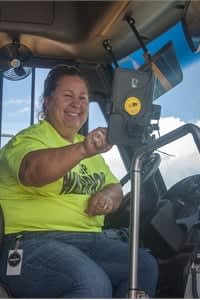
Secured Mobility’s SMART tag lets bus drivers pull up student information on a tablet, since some special-needs students are not able to manage cards. Diana Gomez, a special-education bus driver for Grand Prairie (Texas) Independent School District, is shown here using the tablet.
Districts save time, resources
What went from about one week of getting bus drivers to turn in paperwork, verifying accuracy, and having the administrative department process the data to submit for reimbursement now only takes a couple hours for Adams County (Colo.) School District 14.
When Albert Francisco, manager of transportation at the district, came aboard in 2009, the transportation department used paper forms for reimbursement reporting. The drivers would manually log every day that their students rode, and those forms would be gathered every week or two and sent to the special-needs department, which would review and submit them.
However, the district stopped doing that during Francisco’s first year there.
“They told me that the reimbursement didn’t pay for the hours that went into doing all that,” he explains.
In 2014, the district’s administrative department revisited the topic of Medicaid reimbursement, and Francisco explained that Zonar’s Z Pass, which the transportation department had been using for the past two years for student tracking, could help simplify the process. The district started using the program to track Medicaid reimbursement data that fall.
“We’re able to quickly pull that data, whereas before we would have to go into paper files and look at the IEP again,” he says. He adds that it only takes him about 15 minutes to prepare the documents.
Meanwhile, New Caney (Texas) Independent School District was able to increase the frequency of reporting from annually to monthly and make the process easier by using SMART tag, says Josh Rice, director of transportation services.
“When we print out [paper records] of 400 students, I can go through them by bus number,” Rice explains. “It has all the required information.”
Drivers used to fill out forms by hand, adding a check mark each time a student rode. Now, the system’s doing that while they’re driving, so they no longer have to do that paperwork.
“At the end of the year, someone had to take that massive pile of paper and count all those check marks to get reimbursed,” Rice says. “That would take several days, and now it takes just a few minutes.”
More Management

How to Build a Better Driver Training Program
Ready to boost up your school bus instructor training? Here’s how to pick the right talent and improve recruitment, retention, and safety.
Read More →
CALSTART and Forth Combine to Form Catalyst Mobility
The new name represents a renewed vision for the nonprofit focused on advancing clean, equitable, and affordable transportation solutions that move people and goods.
Read More →
What Makes a Great School Bus Driver Trainer?
Choosing the right school bus driver trainer takes more than experience. Learn six keys to selecting and developing trainers and evaluating program effectiveness.
Read More →


School Bus Contractors Expand Through New Deals, Acquisitions & Partnerships
STA's Canadian division acquires Ontario-based G&L Stevenson Transport while Durham School Services adds a new district contract in California, First Student adds a New Jersey contract, and Minnesota Coaches acquires Halo Transportation.
Read More →
Logan Bus Company Rolls Out AI Phone System for NYC School Bus Families
A summer pilot found that AI agents could handle most routine calls, freeing up time for customer service staff to focus on emergencies and complex family concerns.
Read More →
From Intent to Impact: What I Learned About Leadership from TAPT
A Texas transportation supervisor shares lessons on self-awareness, accountability, managing stress and building trust — and why investing in leadership development matters at every stage of your career.
Read More →
NAPT Names 2026 Award Recipients, Hall of Fame Inductee
Who earned national recognition for their work in student transportation? This year, NAPT named five recipients of its 2026 awards for service, safety, and leadership, plus its newest Hall of Famer.
Read More →
2026 State of Student Transportation Report
Driver shortages. Rising costs. Growing safety expectations. More data, but not enough time to act on it. The 2026 State of Student Transportation Report reveals what transportation leaders say is putting the most pressure on their operations—and where they’re investing next. See how your priorities compare.
Read More →
How to De-Escalate an Angry Person: 5 Steps for Handling Workplace Conflict
What makes emotions run high, and how should you handle an angry colleague or parent? Follow these steps for staying calm, listening, showing empathy, and resolving conflict.
Read More →
What Readiness Looks Like This School Year
Learn about the challenges shaping the 2026–2027 school year, from persistent driver shortages and budget pressure to technology and readiness gaps. See how school districts are responding and adapting in Zonar’s 2026 Back-to-School Readiness Report.
Read More →