




Diesel Buses Still Dominate, But Some See Bright Future for Alt-Fuels
Last year, more than 90% of the large school buses sold were diesels. But as alt-fuel options catch on and stricter emissions standards loom on the horizon, some experts project that diesel will make up less than two-thirds of the market by 2020.


Cook-Illinois Corp.’s school bus purchase this year was all propane (pictured) and gasoline models. “This was the first year we did not buy one diesel bus,” says COO John Benish Jr., third from right.

Cook-Illinois Corp.’s school bus purchase this year was all propane (pictured) and gasoline models. “This was the first year we did not buy one diesel bus,” says COO John Benish Jr., third from right.
Large contractor Cook-Illinois Corp. usually buys between 100 and 200 new school buses each year, so this year’s order of 150 was no different — except for one significant detail.
“This was the first year we did not buy one diesel bus,” says John Benish Jr., chief operating officer of Cook-Illinois.
With a fleet of about 2,300 school buses, the Oak Brook, Illinois-based company is the fifth biggest contractor in the country. Cook-Illinois has included alternative-fuel buses in its purchases for many years but has continued to also buy diesels, until now.
The company’s latest purchase was all propane and gasoline models. Benish says that one of the key reasons for shifting away from diesel engines is that the aftertreatment systems — put in place to meet the Environmental Protection Agency’s last round of emissions standards — have created constant maintenance challenges for the company.
“Diesels have gotten so finicky and difficult to work on and service,” Benish says. “They’re not the kind of bulletproof engine that you were buying 10 years ago. Reliability is an issue.”
Some other contractors and school districts have taken a similar tack, bringing new propane or compressed natural gas (CNG) buses into their fleets. Along with wanting to avoid aftertreatment maintenance issues, these operators typically cite a desire to decrease their carbon output, reduce dependence on foreign oil, and lower their operating costs.
But even as proponents have heralded alt-fuel success stories — often with findings of savings in fuel and maintenance costs — industry sales data show that the vast majority of operators are still sticking with diesel.
In the latest available sales year, 2015, SBF research found that 93% of the large school buses (Type Cs and Ds) sold in the U.S. and Canada were diesel models.
Still, some industry experts are forecasting a big shift in the coming years, projecting that diesel will make up less than two-thirds of the market by 2020.
Sticking with diesel
Not far from Cook-Illinois’ Oak Brook headquarters, Naperville (Ill.) Community Unit School District 203 continues to operate an all-diesel fleet, with a total of 136 school buses.
“Diesel makes the most sense. … For us, it’s the most cost-effective,” says Tom Pelletier, the district’s fleet maintenance manager.
Pelletier cites several reasons for Naperville’s commitment to diesel engines. One, he says, is their proven reliability and durability.
“We keep our buses for eight years,” he says. With a diesel engine, “You’re going to get all your money out of it in eight years.”
Another reason is the convenience of having a more uniform fleet, which helps with parts inventory.
“The advantage for us is to keep it all the same,” Pelletier says. “We’re stocking parts for one type of vehicle.”
Also, low diesel prices of late have been a boon to Naperville and many other school bus operations. The average diesel retail price in the U.S. was $2.71 per gallon in 2015, and the Energy Information Administration’s latest forecast puts the average diesel price at $2.31 per gallon in 2016 and $2.70 in 2017.
“We’re reaping the benefits of that,” Pelletier says, “although we paid for it the past few years when fuel prices were high.”
Indeed, about two-and-a-half years ago — March 2014, to be precise — the average diesel price peaked at $4.02 per gallon.
The infrastructure of fueling is another reason that Naperville hasn’t embraced an alternative fuel. The district’s transportation facility is tight, with 136 buses and two above-ground tanks that hold a combined 5,000 gallons of diesel.
“If we get something else [another fuel type], we’d have to find space for it. We just don’t have it right now,” Pelletier says, adding that he doesn’t see fueling at an off-site facility as a cost-effective option.
As for maintenance of the newer diesel buses and their aftertreatment systems, Pelletier says that his technicians have gotten up to speed on them, and drivers are good about reporting any issues — for example, a check engine light indicating that the diesel particulate filter (DPF) needs to be cleaned.
“Any time you add something new to a vehicle, there’s going to be a learning curve to it. … It’s something that you’ve got to stay on top of,” Pelletier says. “Yeah, there’s a little cost to it, but in the long run, it’s going to do its job. The DPF systems, if they’re working good, you’re not polluting the air.”
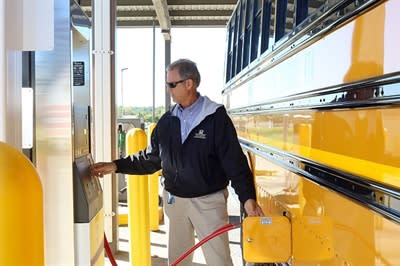
David Curry, lead trainer at North Kansas City Schools, refuels one of the district’s 124 new CNG buses.
Giant leap to CNG
In Missouri, North Kansas City Schools has taken a giant leap into alternative fuels. The district recently replaced the majority of its diesel fleet with 124 new CNG school buses. With 36 remaining diesels, for a total of 160 buses, the CNG models make up more than three-fourths of the fleet.
Lon Waterman, director of transportation for North Kansas City Schools, said that the move to an alternative fuel ties in with the district’s overall environmental goals.
“The district has looked at green initiatives in other departments, including the building of schools,” Waterman says. “For the board, they felt that transportation was the natural next step.”
With growing student enrollment, North Kansas City Schools needed to add more buses, and the existing buses were in need of replacement.
“Our fleet was aged beyond industry standards,” Waterman says. “The cost of maintenance and repairs was more than the fleet was worth.”
The district spent about two years analyzing the pros and cons of the various fuel options for school buses, ultimately settling on CNG for its local availability, its clean-burning properties, and its relatively stable price.
“We wanted to make sure we could control our costs and project them reasonably,” Waterman says.
Along with acquiring a new fleet of CNG buses, North Kansas City Schools installed fast-fill and time-fill fueling infrastructure. Most of the buses use the fast-fill station, which is akin to filling up at a diesel pump. About 50 of the buses use the time-fill station, which takes about four to five hours.
While some school districts tap into grant funding to offset the higher purchase prices of alt-fuel buses, North Kansas City Schools took a different route. The district financed its CNG bus purchase with a combination of three-year leases and long-term lease purchases.
“With the short-term leases, every three years we’re trading these buses in, which keeps our fleet costs down,” Waterman says. “It created a replacement cycle within our fleet that was never there before.”
"Electrification of school buses will be the next clean fuel coming onto the scene. The technology is certainly getting better every year, and the costs will eventually come down." Trish Reed, VP and GM IC Bus
Multiple alternatives
Collectively, the three major large school bus manufacturers — Blue Bird, IC Bus, and Thomas Built Buses — now offer diesel, gasoline, propane, and CNG models. For Type A (small) school buses, Collins offers all of those options, and Micro Bird has diesel, gasoline, and propane models.
Electric power is a newer option for school buses that is being tested in a handful of states. Lion Bus recently launched a Type C electric model, and Trans Tech offers an electric Type A. Other electric school buses are in the works, including a Starcraft model. (Lion, Trans Tech, and Starcraft also offer diesel and/or gasoline models.)
Of the current alt-fuel options, propane has seen the highest sales numbers in recent years. In 2015, 1,936 (6%) of the large school buses sold in the U.S. and Canada were powered by propane. CNG models accounted for 204 (about 1%) of the large school buses sold.
Some school bus OEMs expect the alt-fuel numbers to ramp up significantly over the next few years.
Trish Reed, vice president and general manager of IC Bus, forecasts that by 2020, diesel will decrease to about 65% of the Type C and D school bus market, with gasoline, propane, and compressed natural gas accounting for about 35%.
Trey Jenkins, Blue Bird’s vice president of alternative fuels, says that “Blue Bird has seen a growing rate of acceptance with its alternative fuels offerings and expects this to be an increasing trend in the future.”
Ken Hedgecock, vice president of sales, marketing, and service at Thomas Built Buses, says he expects diesel to remain the dominant fuel source in the pupil transportation industry for the foreseeable future.
“It’s much cleaner than it was years ago, and the existing infrastructure, dependability, proven performance, and its familiarity with fleet owners will keep it a primary fuel source in the market,” Hedgecock says.
Still, he notes that many districts are seeing success with alternative fuels, and “fuel of choice is not a one-size-fits-all model.”
Cummins, which manufactures diesel and natural gas engines for school buses, also expects diesel to remain the preferred fuel for pupil transportation for the foreseeable future.
“Multiple options are becoming available, and some folks are dipping their toes in the water to see what they might want to try based on their areas and routes,” says Laura Chasse, general manager of North American bus for Cummins. “But when you look at the sales, predominantly it’s a diesel market.”
Enhancing diesel engines
Cummins is making changes to its diesel engines for 2017 that the company says will boost fuel economy and make maintenance easier.
Sumit Nema, product manager for Cummins’ on-highway B-series engine, says that the 2017 B6.7 for school buses will provide up to a 5% fuel economy improvement across all ratings, and up to a 7% fuel economy improvement for the Efficiency Series ratings (200 hp to 260 hp).
“We were able to do that on the 6.7 while keeping the same level of reliability and the same level of DEF [diesel exhaust fluid] consumption,” Nema says.
Meanwhile, the 2017 B6.7 and L9 diesel engines will use an optimized single module aftertreatment for better reliability and thermal management; a Stage 1 NanoNet fuel filter for improved water separation; and better operator interface and communication through dash lamps, according to Cummins.
Also, the B6.7 will utilize an improved VGT turbocharger with a heavy duty bearing system for better system robustness, and the L9 will make use of an improved oil pan with enhanced sealing technology for better oil control and serviceability, according to Cummins.
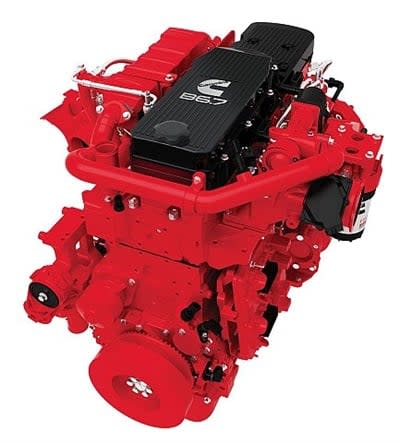
According to Cummins, the 2017 B6.7 diesel engine for school buses will provide up to a 5% fuel economy improvement across all
ratings.
Stricter standards ahead
Engine manufacturers have more work ahead to meet the next round of federal standards, this time focusing on reducing CO2 emissions and fuel consumption. For the vocational vehicle category, which includes school buses, the standards start in model year 2021, with increased stringency in model year 2024 and a fully phased-in stringency level in 2027.
What types of technology the engine manufacturers will use to meet the more stringent standards remains to be seen, as does the impact on the cost of a new school bus.
“What we’ve heard is that [engine] manufacturers are going to meet the first round through calibration, which is good,” Blue Bird’s Jenkins says. “But we don’t know what it’s going to look like in the next rounds, what the equipment is going to be.”
That uncertainty could lead more school bus operators to explore alternative fuels, including electric power. Reed of IC Bus says that 10 years down the road, if the greenhouse gas standards significantly increase the cost of diesel engines, electric school buses could become a more viable option.
“Electrification of school buses will be the next clean fuel coming onto the scene,” Reed says. “The technology is certainly getting better every year, and the costs will eventually come down. … That will be exciting to see as the technology improves.”
More Alternative Fuels

CALSTART and Forth Combine to Form Catalyst Mobility
The new name represents a renewed vision for the nonprofit focused on advancing clean, equitable, and affordable transportation solutions that move people and goods.
Read More →
Alt-Fuel Moves: New Buses, Charging Hubs & Real-World EV Testing
Propane and electric school bus deployments continue to grow as districts add new vehicles, expand charging infrastructure, and gather more real-world operating data.
Read More →
Fewer Electric School Bus Models Reshape the U.S. Market
WRI’s latest buyer’s guide points to a consolidating electric school bus market, but fewer options may reflect a maturing industry rather than fewer meaningful choices for school bus operators.
Read More →
The Fuel Budget You Can Actually Predict: How Propane Autogas Keeps Money in the Classroom
Learn how propane autogas helps school districts manage fuel costs with predictable pricing, lower maintenance, and reduced emissions from former transportation director Joel Stutheit.
Read More →
Hendrickson, Driventic Introduce New Electric Powertrain for School Buses
ELECTRAAX, the electrified, lightweight drive axle offers integrated ePowertrain efficiency and modular flexibility for Class 6–7 school bus use.
Read More →
The Mobility House Joins PowerFlex in Fleet Electrification Deal
The acquisition combines intelligent charging software, bidirectional charging expertise, and fleet electrification services to support the growing adoption of electric school buses across North America.
Read More →
Alt-Fuel Moves: Electric School Bus Investments Hit the Road
See which districts across the U.S. are putting electric school buses into service, expanding charging infrastructure, and planning the next phase of fleet electrification.
Read More →
With Fuel Volatility Ahead, School Districts Turn to Propane
While diesel prices peaked above $5 this spring, districts with propane autogas-powered fleets paid under $2 per gallon, according to PERC.
Read More →
EPA Unveils Proposed Changes to 2027 Heavy-Duty Engine Rules
The federal agency has proposed changes to next year’s targets that would eliminate DEF derates, ease warranty requirements, and retain current NOx emissions standards.
Read More →
Alt-Fuel Moves: EV Charging & Infrastructure Projects Gain Momentum
The latest developments include new funding, charging infrastructure, utility investments, and fleet technologies designed to support the transition to electric school buses nationwide.
Read More →