




Decade by Decade: 50 Years of Pupil Transportation History
Countless occurrences have shaped the school bus industry over the past half-century, from safety innovations to key legislation to tragic accidents. Here's an overview of noteworthy news that SCHOOL BUS FLEET has covered.

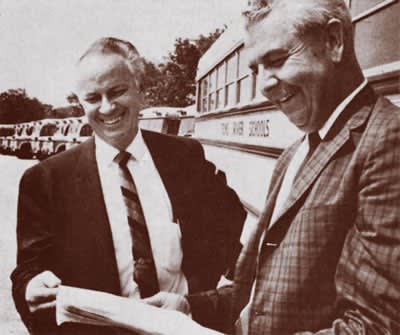
Countless occurrences have shaped the school bus industry over the past half-century, from safety innovations to key legislation to tragic accidents. Here's an overview of noteworthy news that SCHOOL BUS FLEET has covered.
1956-1965: A Decade of Transformation
1956: Beginning of a Trend
Countless occurrences have shaped the school bus industry over the past half-century, from safety innovations to key legislation to tragic accidents. Here's an overview of noteworthy news that SCHOOL BUS FLEET has covered.
The number of schoolchildren transported nationwide at public expense passes the 10 million mark.
1957: Need a Lift?
A school bus with a built-in elevator, believed to be the first of its kind, begins transporting special-needs students to and from school in San Lorenzo, Calif. The bus, which was designed and built by Gillig Brothers, is also fitted with floor attachments where wheelchairs can be anchored and individual seat belts for each child.
1958: Tragic Plunge
Twenty-six pupils and their school bus driver are killed after the bus strikes another vehicle and plunges into the Big Sandy River in Prestonsburg, Ky. The state superintendent issues 10 compulsory precautions to prevent another such tragedy
1959: Pushing safety program
After a Maryland school bus-train collision in which seven children were killed, the National Safety Council distributes a three-point program to safeguard school bus passengers. The program focused on:
Selection and training of drivers.
Inspection and preventive maintenance of buses.
Establishment of legal standards for the behind-the-wheel performance of school bus drivers through driver licensing.
1961: Diesel Proves Popular
In a statewide survey, 87 percent of California school transportation officials say they prefer diesel to gasoline power. Four percent say they don’t prefer diesel, while the remainder want more experience with the fuel. The fleets represented in the survey comprise 574 gas-powered school buses and 122 diesels. The first diesel school buses in the state went into service in 1954.
Hitchcock changes the name of School Bus Trends to School Bus Transportation.
1962: Lights Lower Accident Rates
New Jersey mandates a new system of eight identification lights on school buses — two red and two amber on the front and back. The number of accidents at bus stops over the following year drops 68 percent from the average of the past five years.
1963: Gate Inhibits Accidents
Superior Coach introduces a bumper-mounted, hydraulically operated gate to prevent children from crossing too close to the front of the bus.
1964: New voice for contractors
The National Association of School Bus Contract-Operators, later renamed the National School Transportation Association, is founded to represent the interests and concerns of private pupil transporters.
1965: Momentous Makeover
Sporting a new name, look and vision, SCHOOL BUS FLEET debuts as the successor to School Bus Transportation, which Bobit Publishing has bought from Hitchcock Publishing.
1966-1975
1966
Landmark Safety Act
The National Traffic and Motor Vehicle Safety Act of 1966 charges the government with reducing traffic crashes and developing Federal Motor Vehicle Safety Standards.
Testing school bus durability
Researchers at the Institute of Transportation and Traffic Engineers (ITE) at UCLA conduct the first series of school bus collision studies. The findings, which will raise the bar for new national safety standards, are later presented to Congress in a 165-page tome titled School Bus Passenger Protection.
1968
Tougher Safety Standards
Indiana House Bill 1868 empowers the state’s School Bus Committee to issue rules for safe pupil transportation. The act mandates that children be seated during transit and that the number of passengers not surpass the manufacturer-rated capacity.
NASDPTS Established
The National Association of State Directors of Pupil Transportation Services is formed. The membership will represent all 50 states and several U.S. territories.
1969
Computer aids in scheduling
IBM’s nascent computerized vehicle scheduling program, the VSP/360, is given a trial run with New Jersey school buses. The technology expedites scheduling tasks and is deemed a huge success.
1970
National safety week launched
Organized by pupil transportation consultant Dick Fischer, the first National School Bus Safety Week debuts.
Key stats collected
The Kansas Department of Transportation begins collecting national data on deaths in school bus loading and unloading zones.
1971
National roadeo debuts
The National Association of School Bus Contract-Operators hosts the first National School Bus Safety Roadeo in Portland, Ore.
Fatal crash in Colorado
Driver inexperience and brake failure are cited as the causes of a fatal crash in Gunnison, Colo., that results in nine fatalities. The majority of the occupants are ejected from the school bus. The driver had lost control of the bus on a treacherous mountain pass.
1972
Standard 17 adopted as law
The National Highway Traffic Safety Administration issues Standard 17, a set of national guidelines establishing mandates in school bus operation, inspection, maintenance and driver and passenger training.
1974
Bolstering safety
The Motor Vehicle and School Bus Safety Amendments of 1974 authorizes $115 million to carry out the mandates of the National Traffic and Motor Vehicle Safety Act of 1966. The Department of Transportation is required to establish minimum school bus safety standards within 15 months.
NAPT founded
The National Association for Pupil Transportation (NAPT) becomes a formal organization. Robert A. “Bob” Larson of Minneapolis is named its first president.
1975
Act shifts bus drivers’ role
The passage of the Education for All Handicapped Children Act guarantees equal rights for every school-age child while expanding the role and responsibility of those who transport special-needs students.
[PAGEBREAK]
1976-1985
1976
Infamous kidnapping
Three armed men hijack a school bus carrying 26 students in Chowchilla, Calif. After transferring the children and driver into two vans and driving them around for 11 hours, the kidnappers imprison them in a moving van they had buried in a quarry about 100 miles away. As the captors were trying to arrange for a $5 million ransom, the driver and some of the older boys managed to dig their way to freedom and summon help after 16 hours underground.
First hydrogen-powered bus
Billings Energy Research Corp. reveals the first hydrogen-powered bus, a 19-passenger converted Winnebago Minibus that uses advanced hydride storage technology.
Cutting accident costs
The National Safety Council creates the Accident Investigation Manual to assist in minimizing accident cost and to prevent future accidents. The publication is management-oriented and uses a direct approach.
New braking standard
The National Highway Traffic Safety Administration (NHTSA) requires buses weighing 10,000 pounds or less to be capable of stopping from a speed of 30 miles per hour in a distance of 69 feet. Heavier school buses, traveling at the same speed, are expected to stop within 88 feet. The new federal safety standard becomes effective Oct. 12.
1977
Raising the bar on construction
Change is now — new federal standards dealing with six areas of school bus production go into effect on April 1. The areas that need modifications are: emergency exits, roof strength, joint strength, seating, fuel system integrity and hydraulic brake systems. All buses made after this date must follow new regulations and have adjustments that comply with safety standards.
Longest bus body
What is called the longest bus body in the world rolls out of the production line at Wayne Corp.’s Richmond, Ind., plant. The bus measures in at 62.3 feet long and weighs 24,023 pounds. It is intended to transport workers in the oil fields of Egypt.
1978
Braking standards revisited
FMVSS 121 requires a bus traveling at 60 miles per hour to stop without skidding in 293 feet or less. The reinstituted requirement applies to all air-brake-equipped buses built after Jan. 1.
Maintenance council formed
SCHOOL BUS FLEET announces the creation of the School Bus Maintenance Council. The first meeting follows the National Association for Pupil Transportation’s annual conference.
1981
Special bus developed
The transportation department of Metropolitan Nashville Public Schools works with Blue Bird Body Co. to create a bus to transport autistic children. The bus includes padded personal cubicles, footboard restricts and an isolated environment for the driver and driver aide to give care to the children.
1983
Accidents exact high toll
A NHTSA report titled “The Economic Cost to Society of Motor Vehicle Accidents” estimates that the total annual economic cost of deaths, injuries and property damage in motor vehicle crashes is more than $57 billion.
9 dead in Arkansas crash
A school bus traveling on an Arkansas highway loses control on a curve, resulting in a deadly accident. Four students, five teachers and the driver are killed, and 29 others are injured. The 41 passengers were going to an annual industrial arts competition at the state capital.
1986-1995
1986
Seat belt law in effect
The ever-present battle as to whether the use of seat belts should be mandated in school buses wages on. New York becomes the first state to require them by law in their new buses. The decision comes in response to an incident in which a coroner’s report concluded that a boy killed in a Westchester County bus accident would have survived if he had been wearing a proper seat belt.
1987
New special-needs rules
The Missouri State Board of Education enacts new guidelines requiring children who use wheelchairs to be positioned in school buses face-forward and restrained by both lap and shoulder belts.
1988
Bus drivers under 18 fired
Although drivers under 18 represent 14 percent of the bus driver workforce, the U.S. Department of Labor in North and South Carolina orders that anyone under that age be terminated prior to the 1988-89 school year. The decision is due to the disproportionate number of fatal accidents involving drivers under 18.
Carrollton catastrophe
In a fiery crash that kills 27 people and injures 30 more, a small pick-up truck driven by a drunken driver strikes a school bus carrying church members home from an amusement park in Carrollton, Ky. The tragedy spurs a number of school bus safety measures across the nation for years to come.
1990
Truck driver faulted in Texas crash
The National Transportation Safety Board finds the driver of a Valley Coca-Cola delivery truck, who failed to halt at a stop sign, at fault in a crash with a school bus that took the lives of 21 students and injured about 50 others in Alton, Texas, in 1989. The bus had launched over an embankment and into a water-filled pit. The board issues 14 national guidelines for safety improvements, including a proposed increase in emergency evacuation drills.
1992
CDL required for all drivers
Per the Federal Highway Administration, the nation’s bus drivers must now obtain a Commercial Driver’s License.
Conference covers special needs
The first National Conference and Exhibition on Transporting Students With Disabilities and Preschool Transportation Workshop convenes in Dallas. Representatives of two wheelchair manufacturers and school transportation officials create a committee to discuss safe transportation of students who use mobility devices. The committee plants seeds for the development of the WC-19, a voluntary standard for transport wheelchairs.
Arms of the law
Stop arms are required on all new school buses under Federal Motor Vehicle Safety Standard 131.
1995
Testing for drugs, alcohol
School bus fleets with 50 or more drivers must now implement federal drug and alcohol testing. In 1996, fleets with fewer than 50 drivers will have to implement the testing.
Fox River Grove tragedy
Seven students are killed and many more are injured in a crash involving a school bus and a commuter train in Fox River Grove, Ill.
Industry loses a ‘father’
Frank Cyr, the “Father of the Yellow School Bus,” dies at age 95. Cyr organized the first national standards conference for school transportation in 1939, in which industry officials agreed upon dozens of standards for school buses, including a specific, highly visible shade of yellow.
[PAGEBREAK]
1996-PRESENT
1996
FHWA gives bus drivers ‘F’
The Federal Highway Administration (FHWA) releases the Assessing the Adequacy of Commercial Motor Vehicle Driver Training: Final Report document, which finds that 66.7 percent of all bus drivers fail to meet adequate driver training requirements.
1998
Protecting preschoolers
The National Highway Traffic Safety Administration (NHTSA) creates new regulations for transporting toddlers and pre-k children.
New roadeo debuts
The first National Special-Needs Team Safety Roadeo is held in Orlando, Fla.
2000
Tennga tragedy
Three children are killed and four are severely injured in a train-school bus collision in Tennga, Ga. The National Transportation Safety Board investigates and finds that the bus driver failed to follow procedures by not stopping prior to crossing the tracks and having the bus radio on and the door closed.
NCST refines title
At the 2000 National Conference on School Transportation, delegates decide on a new title for the conference’s resultant document: National School Transportation Specifications and Procedures. Previous incarnations had been called National Standards for School Transportation. The change is made to more precisely describe the contents and intended use of the document.
2001
Responding to terror
Anti-terrorism legislation signed by President George W. Bush following 9/11 includes school buses and school bus drivers in its “mass transportation systems” definition. Previously, they had been excluded.
Nebraska crash claims four
Three students and one adult are killed and more than two dozen are wounded in Omaha, Neb., when their school bus swerves to avoid an oncoming motorcoach, crashes though a guardrail and drops about 50 feet into a creek.
2002
Compartmentalization corroborated
NHTSA issues a report to Congress on occupant protection in school buses. The report is not definitive in its recommendation, but it does validate the effectiveness of compartmentalization and warn against the use of lap belts on large buses.
2003
Roof weld defects found
The School Bus Information Council issues a warning to school bus operators to examine and possibly pull from service buses in their fleets manufactured by Carpenter and built at the company’s Mitchell, Ind., plant between 1986 and 1995. A school bus rollover accident in Florida, in which the roof of a 1991 Carpenter collapsed to the seat line, shed light on dangerous roof weld defects that were also found in Carpenter buses in use elsewhere in the country.
2005
Driver fatally shot by student
School bus driver Joyce Gregory of Stewart County (Tenn.) Schools is fatally shot by one of her passengers, 14-year-old Jason Clinard. The teen was allegedly upset over Gregory reporting to school officials his use of smokeless tobacco.
Buses to the rescue
Hundreds of school buses from across the country are deployed to help in emergency evacuations and in delivering supplies after Hurricane Katrina strikes. The storm devastates much of New Orleans and adjacent shore boards.
More Safety
National School Bus Safety Week 2026: Tips, Toolkits & Resources to Keep Students Safe
School bus safety takes more than awareness. Explore expert tips, enforcement strategies, and free resources to help protect students on every ride.
Read More →
2 Killed, Dozens Injured in Florida School Bus Crash
A multi-vehicle collision caused a Polk County school bus carrying 37 students to overturn on its way to Winter Haven High School.
Read More →
Illegal School Bus Passing Drops 24% in New York Districts
With fewer than 5% of citations involving repeat offenders, Westchester County officials said enforcement, education, and community partnerships are helping change driver behavior.
Read More →
School's Back. Here's What Happened to Traffic, Speeding & Distraction
What happens to traffic when school resumes? New data analysis examines changes in distracted driving, congestion, and speeding around schools.
Read More →
Geotab Expands Fleet Safety Tools With Video Coaching, Risk Insights
New safety and video capabilities aim to help fleet managers assess risk, support drivers, and take targeted action through video coaching, red-light violation detection, and more.
Read More →
How to Build a Better School Bus Driver Training Program
Is it time to strengthen your driver training? Here’s how to pick the right talent and improve recruitment, retention, and safety. This video is brought to you by IC Bus.
Read More →
Recent School Bus Accidents Leave 2 Dead, 2 Injured
Four school bus crashes in Florida, Illinois, and Georgia highlight risks in transportation lots, at bus stops, and during student loading and unloading.
Read More →
When Every Second Matters, Clarity Keeps Routes Moving
From routine delays to urgent incidents, strong communication practices help drivers, dispatchers, schools, and families respond with confidence.
Read More →
What Happens When a School Bus Catches Fire — and What Can Help
School bus fires are rare but can be devastating. Learn how advances in fire suppression and asset protection help fleets detect fires earlier, reduce damage, and improve safety.
Read More →
Geotab Launches Tool to Help Fleets Investigate Road Incidents
Geotab Investigations combines telematics data, video, documents, and other evidence to help fleets reconstruct incidents, resolve claims, and determine what happened.
Read More →