No matter how serious an accident is, bus drivers and school officials should be ready for the worst with proactive emergency reaction plans in place to respond quickly and keep students safe. Here’s what to do.
The best way to stay ahead of accidents is to prepare, train, and plan in advance, so drivers don't have to figure it out on the fly.
Photo: Getty Images/Brandy Taylor
10 min to read
While we all hope every student’s ride on the big yellow bus is always safe and sound, unfortunately, accidents happen.
Earlier this year, a speeding Ford Mustang crashed into a school bus in Albuquerque, N.M., causing injuries to five people. And in Maryland, a school bus crashed with two other vehicles before hitting a tree. In the latter case, four students, the driver, a bus aide, and the driver of one of the cars, were hospitalized.
Ad Loading...
NHTSA data shows that from 2011 to 2020, about 70% of the deaths in school bus-related crashes were occupants of vehicles other than the school bus, and 16% were pedestrians. About 5% were school bus passengers, 5% were school bus drivers, and 3% were pedal cyclists.
Some 109 people lost their lives in school bus-related crashes in 2019, according to the National Safety Council. That number went down by about 50% in 2020, likely due to fewer trips during COVID-19.
However, it’s important to note that a school bus is still the safest way to transport students. The NHTSA says students are 70 times more likely to have a safe ride in the bus versus by car or by walking because buses are designed with that intent and are the most regulated vehicles on the road.
But when an accident does happen, it’s imperative that school transportation officials have plans and procedures in place for the driver to respond, report the accident, and protect the riders without having to figure it out on the fly. Proactive preparation, training, and communication are paramount to success.
Defining an Accident vs. Incident
When we talk about accidents, it’s important to define what constitutes one. An act easier said than done, as nearly every state and school district sets its own standards for what counts. Often it comes down to whether students were on or off the bus, and if there was damage.
Ad Loading...
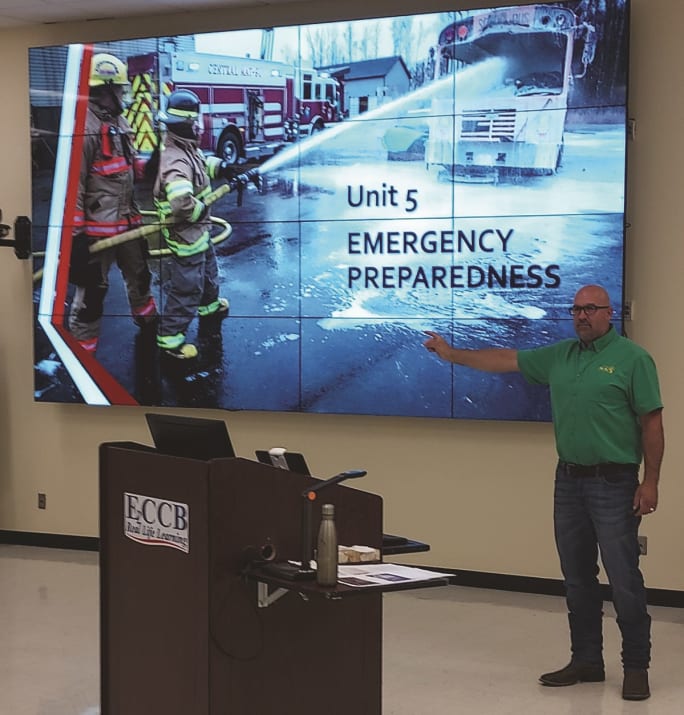
CTS instructor Jay Ballard teaches different accident topics during Chautauqua Transportation Services’ classroom-style training program for new school bus drivers.
Photo: Pete James
The USDOT defines an accident as anything that involves a fatality, and anything with an injury or damage requires the driver to receive a citation.
Nate Roadman, president of RWR Group, Inc., an insurance advisor in Pennsylvania, defines an accident as an event that causes property damage and/or bodily injury. An incident, however, is a “near miss” that has the potential to cause property damage and/or bodily injury.
“The importance of incidents is because frequency breeds severity,” Roadman said. “While a driver may bump into a fixed object that results in no damage or injury, it is important to evaluate the situation, because next time it could be a pedestrian. Our agency reports accidents to the insurance company but we keep incidents as a record only to discover trends that could lead to more severe accidents.”
Pete James, director of Chautauqua Transportation Services, Inc., says that in New York, if no student is involved, then it’s considered to be a motor vehicle accident and not a school bus accident.
The key takeaway: Check with your state government for specific laws, rules, and regulations relevant to your district.
Ad Loading...
Steps to Take & Reporting Response
At the scene of an accident, Roadman says drivers should follow these 12 steps:
Stop. Do not leave the scene of an accident. Use your hazard lights to indicate the bus is stopped.
Do not move the bus. Document the position of all vehicles involved. Unless you are in danger of another situation that could cause more harm, stay put until directed by police or a supervisor.
Assess the situation. Evaluate the scene so you can create a plan to react accordingly. Decide what immediate action needs to be taken, such as injuries that need assistance, or children to evacuate.
Reassure the students. Keeping the children calm will help you handle the situation more effectively.
Notify dispatch. Make your message clear and urgent. Start by stating the bus number and that it’s an emergency. This will allow dispatch to pin down your bus even if there is no other information available.
Apply first aid, but only within your limits of training. Never move an injured child unless they are in imminent danger. Put your attention on life-threatening injures first, and do not exceed the limits of your first aid training.
Protect the scene. Use reflectors, flares, and cones to warn oncoming traffic. If children are evacuated, make sure they are in a safe place.
Account for all passengers. If possible, document where each passenger was located at the time of the accident. Make a list of all passengers on board and provide emergency responders with this list.
Document what happened. Use an accident investigation kit located in the bus to document the details. Find witnesses on the scene to gather their names, phone, and address. Capture key information such as other vehicles and drivers involved and write a description of the accident.
Do not release students. Unless evacuation is necessary, children are safer waiting on the bus rather than outside. Do not release to Good Samaritans, neighbors, or anyone else. Do not allow children to walk away on their own.
Cooperate with authorities. As emergency services arrive, you can let them take over the scene.
Don’t make statements at the scene. Be respectful and polite, but do not place or take the blame for the accident. What you say at the scene can be admissible in court. Do not discuss any information with anyone other than law enforcement, your supervisor, your insurance company, your company attorney, or your school district. Refer the media to your supervisor.
From there, Shannon Weber, director of transportation at Florence Unified School District (FUSD) #1 in Arizona, shares the next steps her district takes. A call is made to the families on the route with a notice of information, often noting that there will be delay and all students are safe but being released by EMT or other specific instructions. Once students are released from the scene for continued transport, a relief bus is deployed to continue their route to or from school. The bus is then returned to the base location with permission of law enforcement, and the driver returns to complete a post-accident summary report and a required post-accident drug and alcohol screen.
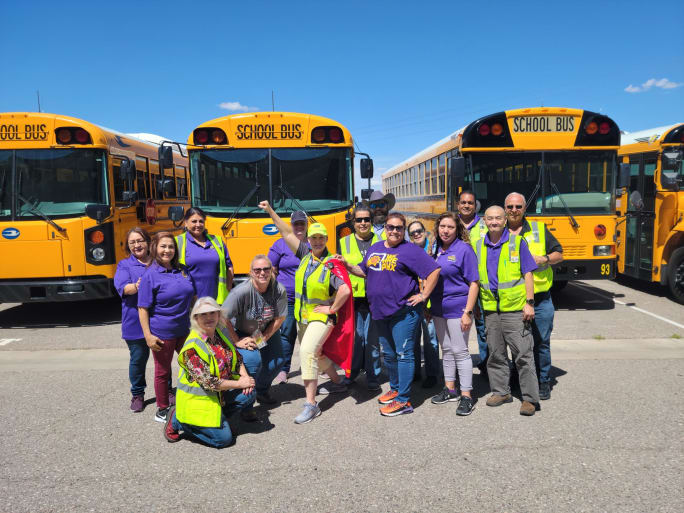
The Florence Unified School District #1 transportation staff in Arizona has some fun after safety week, which was filled with refresher and reminder activities to minimize driver complacency and raise awareness.
Photo: Shannon Weber
“The most important thing is to have a plan in advance,” said Rich Kelly, founder of RC Kelly Law Associates and general counsel for NSTA. “Nobody wants to get in an accident, but the possibility is always there. School bus operators should provide training to their drivers in how to respond.”
Keystone Insurers Group, which works with many school bus contractors, also recommends keeping an accident reporting form in buses. This details information such as the vehicles involved, witnesses, and insurance. Technology on buses such as cameras and GPS systems provide detail and assist in the adjustment of claims as well.
Ad Loading...
“Much of the current safety protocols are the result of what was discovered in the accident investigation,” says Linda Neff, executive director, School Transportation Program, Keystone. “The investigation may minimize future legal issues and help with managing costs.”
Weber is happy to report that in recent years, her district has had very few accidents, and none with any injuries. She does mention one rear-ending from another motorist at a stop sign, but no students were on board. In that case, the directive was for the driver and monitor to stay put, verify they had no injuries, and reassign their next stops to an alternate while the process at the scene was completed.
FUSD has exceeded 600,000 student transportation miles to date. “If I look back three full years in our district, 15 incidents/accidents in alignment with what defines an accident for us were documented,” she said.
Neff says the accident should be classified by preventable vs. non-preventable and at fault vs. not at fault. “Typically, there is a policy of the number of preventable accidents allowed for a driver,” she explained. “An accident related to a weather condition may be non-preventable but still at fault. All of the details in the accident report will help determine which description applies.”
After paperwork, Neff suggests an action plan, which could include driver retraining, probation, staff communication, or evaluation of procedures and the route. She recommends reviewing accident reports annually to identify trends and eliminate unsafe conditions and prevent future events.
Ad Loading...
Don’t forget to have a communications plan as well. Beyond notifying staff, authorities, insurance, and parents, formulate a media response plan. For large-scale accidents, especially, drivers must know how to provide appropriate responses to on-site media requests and who to direct them to at the district for formal comments. “Don’t leave the driver wondering what to do; let them execute the plan as you have laid it out,” Kelly said.
Of course, these days, many students have cell phones and may have recorded an incident or already communicated with their parents. “It is a much more quickly evolving dynamic than it ever has been in the past,” Kelly said.
The Importance of Training & Planning
Just like a fire or tornado drill, schools should have plans and policies in place to direct proper response for bus accidents. And those should be practiced and retrained often.
“If we don’t go through the motions of the scenarios, we don’t know what to do in an emergency,” Weber said. “Our kids are the most important thing, and we must equip our driving teams with tools and resources to be great in all instances. We here at FUSD provide scenarios, discussions, and specific failure models for evacuation to review, discuss and brainstorm in a non-emergency setting for a deeper dive and discussion amongst peers.”
SBF talked to James as he was on-site delivering a training for new school bus drivers in New York, where the state mandates 30 hours of classroom training on several topics, including defensive driving, accident prevention and emergency response, on-board first aid and evacuation training. He adds that it’s also important to test drivers’ physical performance, which is an important piece of accident preparation. New York requires this test prior to service and every two years. With such a broad range of fleet types, the state director at SED, Paul Overbaugh, works closely with an advisory committee from the field representing various operations to continually develop, update, and approve training curricula.
Ad Loading...
Kelly says that state associations can often assist in facilitating training and helping districts figure out the best response, too.
A Special Needs Bus Program
An innovative new program has rolled out, courtesy of the Pennsylvania School Bus Association, to assist the needs of special needs students on board the bus. Called the E.R.I.C. Yellow Dot Program, it helps riders in need of emergency care following an accident if they are not able to communicate their needs themselves or the driver is incapacitated. Forms on each student is kept on board the bus and contains emergency medical information. Local EMTs in the state have been briefed on where to find the box and access the information.
And of course, prevention techniques should be a focus, including general safety precautions such as having mirrors properly adjusted, making sure the stop-arm and cameras are working, and practicing safe driving behavior.
James also recommends having an in-house expert on rules and procedures at every school. “We’ve become a world of specialists, and it’s hard for one person to know everything,” he said. “But I think every operation needs to have a transportation expert, because the more knowledge we have at all levels of command, the better off we are.”
Insurance Considerations
The definition of an accident should be defined in your insurance policy, according to Linda Neff of Keystone Insurers Group. And all incidents and accidents should be reported to help identify trends.
“If there is more than one occurrence at a specific intersection, that route may need to be re-evaluated,” Neff said. “[Near misses] may not need to be reported to the insurance company. However, any accident resulting in injury or potential injury or damage to property needs to be reported as soon as possible.”
Ad Loading...
As for how to pick your provider and policy, Neff advises to look for a company that understands school bus transportation exposures. “Risk management is the most important tool for mitigating losses,” she said. Included in risk management would be a review of loss runs and claims management.
Other considerations include the ability to offer unique coverages that all school contractors need such as abuse and molestation, environmental liability, full coverage for vehicles stored on the lot, and high umbrella limits.
Nate Roadman also urges schools to have an abuse/molestation policy, which includes mental anguish and bullying. “The best policy is written on a general liability form so it protects you on and off the bus,” he explained. “The reason to include ‘off the bus’ coverage is in case you drop a student off at the wrong stop and a sexual abuse accident would happen as a result. The policy should include student-on-student as well as driver-on-student coverage.”
He also advised that for commercial auto policies, to be aware of limitations for physical damage when buses are parked in the school bus yard.
James added that in New York, training programs are approved to qualify school bus drivers for point and insurance premium reductions on their personal auto insurance, as they are considered in a better risk pool due to their continual training, monitoring, re-certification, and working in a safety-sensitive environment. The state’s DMV also provides good stewardship of both initial and continual ongoing school bus driver qualifications, including licensing, continual monitoring of driver records and criminal records, and continual re-certification of each driver.
With fewer than 5% of citations involving repeat offenders, Westchester County officials said enforcement, education, and community partnerships are helping change driver behavior.
New safety and video capabilities aim to help fleet managers assess risk, support drivers, and take targeted action through video coaching, red-light violation detection, and more.
Is it time to strengthen your driver training? Here’s how to pick the right talent and improve recruitment, retention, and safety. This video is brought to you by IC Bus.
Four school bus crashes in Florida, Illinois, and Georgia highlight risks in transportation lots, at bus stops, and during student loading and unloading.
School bus fires are rare but can be devastating. Learn how advances in fire suppression and asset protection help fleets detect fires earlier, reduce damage, and improve safety.
Geotab Investigations combines telematics data, video, documents, and other evidence to help fleets reconstruct incidents, resolve claims, and determine what happened.
Sai Darshana Yekolu of Moseley Middle School in Prosper, Texas, was named the newest winner for her artwork, bringing the theme of “Safe Rides, Everyday Heroes” to life.