




Contractors see safety as an investment
Executives for some of North America's largest school bus companies discuss how allocating resources toward such efforts as driver training and preventive maintenance can benefit the operation by improving safety and employee morale, which, in turn, enhances profitability.

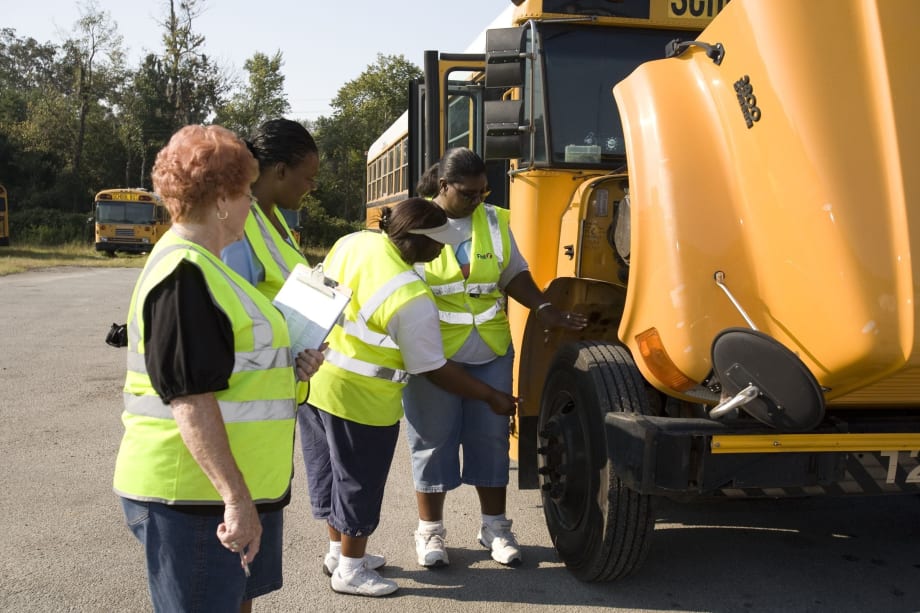
At First Student, well maintained and safely operated buses lead to a long service life, and Senior Vice President of Commercial Development Roger Moore says maintaining a safe operation also enables the company to retain the best employees.
First Student Inc.
Cincinnati
Is safety profitable?
The only profitable operation is a safe one. If you take a close look at the costs of operating school buses, it becomes clear that unsafe operations are unprofitable. Medical payments, physical damages, loss of revenue, legal judgments and a bad reputation can quickly eat up the modest margins of any contractor’s operation.
How does a safe operation help contractors succeed from a business perspective?
Our customers know that we take our responsibility to transport their children safely to and from school very seriously. They know that students are in good hands. That is of paramount importance.

Roger Moore, senior vice president of commercial development
Maintaining a safe operation allows us to retain the best employees; no one wants to work for an unsafe bus company.
Safe operations also allow us to utilize resources to enhance profitability. If our buses are well maintained and safely operated, they will have a long service life. If our employees are well trained, held to tight safety standards and appreciated for their contributions, they have lower absenteeism and a great attitude.
FLEET FACTS
Number of school buses: 54,450
School district contracts: 1,400
Company head: Dennis Maple, president
Website: www.firststudentinc.com
Krapf Bus Companies
West Chester, Pa.
Is safety profitable?
Safety is part of the overall excellent service we provide and is the differential that has helped us attract new clients and retain the existing ones. It is a must when you are looking to provide school student transportation. Due to our excellent safety record, we continue to maintain the first two accounts that George Krapf Jr. & Sons obtained over 70 years ago.
We provide above and beyond the minimum state-required training for new drivers and have excelled in veteran driver safety training. Our veteran driver safety training has been so successful that recently we provided a session at the Pennsylvania School Bus Association’s annual convention to benefit the membership/industry as a whole.

Shawn McGlinchey, vice president of risk management
How does a safe operation help contractors succeed from a business perspective?
Where the savings come in are in our insurance costs. Due to our safety program and the performance of it, we have achieved better than market rates for fleet insurance, thus giving us a competitive edge. Safety is our top priority and part of our core values.
FLEET FACTS
Number of school buses: 2,475
School district contracts: 37
Company head: Blake Krapf, CEO
Krapf School Bus division website: www.krapfbus.com/school-bus
[PAGEBREAK]

Michele McDermott, senior vice president, safety and human resources
National Express Corp.
Warrenville, Ill.
Is safety profitable?
Safety is an investment that will always pay dividends. Every dollar we spend on safety is going to come back to us in safe operations, happy employees and satisfied customers. That absolutely pays off. Safety is the pathway to many good things, including profitability and good customer relations.
How does a safe operation help contractors succeed from a business perspective?
From a business perspective, safety allows for an efficient and effective operation. Safety is one core value that we use to guide us in our decision-making process. We view everything through the lens of safety, and with that as our backdrop it leads to successful business operations.
Tell us about some of the safety-related initiatives and programs in place at National Express Corp.
Our safety program is all-encompassing, from the recruiting process to the training initiatives when an employee is on board. We put safety first — it’s our No. 1 value.
There are many initiatives we are always looking at, and one is different onboard technology [for school buses] to enhance our safety program.
A second initiative that we have in place is the “Safety Brigade,” which is our safety theme for 2014. It’s a way to bring everyone in the company — no matter what their role is — together around our core value.
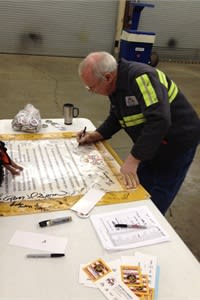
At National Express Corp., all employees have signed a proclamation that they’re enlisting in the company’s Safety Brigade.
We kicked off the program in February with every employee signing a proclamation to enlist in the brigade. It was a great ritual to get everyone’s personal buy-in.
As a Safety Brigade, our shared purpose is to protect our riders, our employees and those around us by always putting safety first. We are primarily made up of drivers, but we can’t forget that everyone in the company has an effect on safety.
A third initiative we’ve put into place is a support program for our technicians to become ASE-certified master technicians. The company is reimbursing the costs for taking ASE certification tests and has also established a recognition program.
FLEET FACTS
Number of school buses: Over 21,000
School district contracts: Over 450
Company head: David Duke, president and CEO
Website: www.nationalexpresscorp.com

John Benish, Jr., chief operating officer
Cook-Illinois Corp.
Oak Forest, Ill.
Is safety profitable?
Yes, it is always profitable to be safe. Cutting corners in any area regarding safety makes no sense. Lack of training or lack of maintenance, for example, increase your chances of having problems in the future and will certainly catch up with you — it’s just a matter of time.
Also, school districts need to understand that choosing low-dollar bids is sometimes not the correct choice when it comes to school busing. Most districts will not take the lowest bidder for services such as legal or architects, but they will for school buses. Choosing the right carrier always comes down to safety.
FLEET FACTS
Number of school buses: 2,248
School district contracts: Over 200
Company head: John Benish Jr., chief operating officer
Website: www.cookillinois.com

Don Weir,
director of safety and compliance
Student Transportation Inc.
Wall, N.J.
Is safety profitable?
Our business is built on a culture around safety, from our driver recruitment and training programs all the way to our intensive preventive maintenance programs. Our job is to transport students to and from school safely each day. To operate safely is an investment in our business.
How does a safe operation help contractors succeed from a business perspective?
There are many financial benefits to operating with the highest level of safety. The safety of our operations affects our employees’ and customers’ well-being, our insurance costs, maintenance costs and vehicle downtime. For example, our maintenance and insurance costs go down if we are safer because that reduces accidents.
More importantly, when we perform our duties safely every day, our customers are more likely to renew or extend our contracts and even refer us to other schools that seek the same level of safety. Keeping our people, our passengers and the public safe is a very successful way to do business.
FLEET FACTS
Number of school buses: 11,000
School district contracts: 275
Company head: Denis J. Gallagher, chairman and CEO
Website: www.RideSTBus.com
More Safety
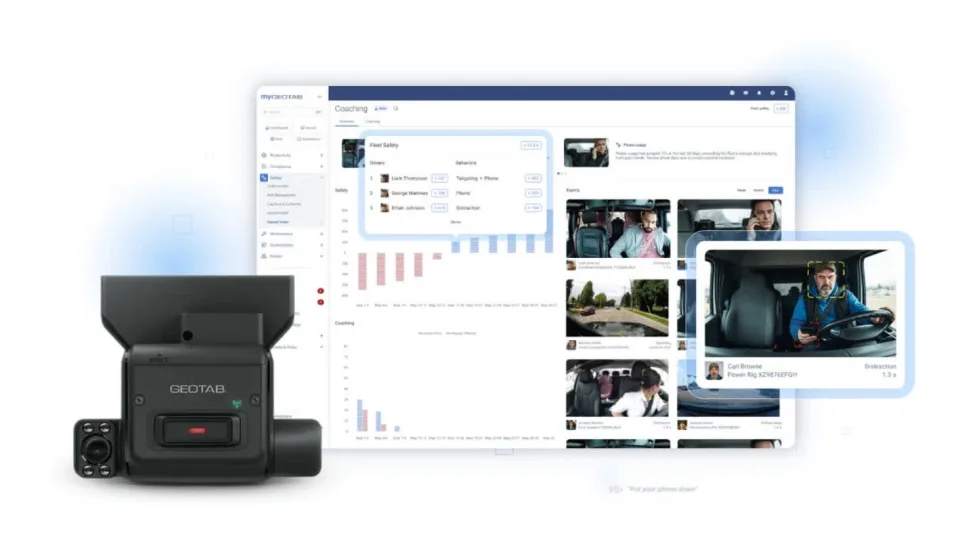
Geotab Expands Fleet Safety Tools With Video Coaching, Risk Insights
New safety and video capabilities aim to help fleet managers assess risk, support drivers, and take targeted action through video coaching, red-light violation detection, and more.
Read More →
How to Build a Better School Bus Driver Training Program
Is it time to strengthen your driver training? Here’s how to pick the right talent and improve recruitment, retention, and safety. This video is brought to you by IC Bus.
Read More →
Recent School Bus Accidents Leave 2 Dead, 2 Injured
Four school bus crashes in Florida, Illinois, and Georgia highlight risks in transportation lots, at bus stops, and during student loading and unloading.
Read More →

When Every Second Matters, Clarity Keeps Routes Moving
From routine delays to urgent incidents, strong communication practices help drivers, dispatchers, schools, and families respond with confidence.
Read More →
What Happens When a School Bus Catches Fire — and What Can Help
School bus fires are rare but can be devastating. Learn how advances in fire suppression and asset protection help fleets detect fires earlier, reduce damage, and improve safety.
Read More →
Geotab Launches Tool to Help Fleets Investigate Road Incidents
Geotab Investigations combines telematics data, video, documents, and other evidence to help fleets reconstruct incidents, resolve claims, and determine what happened.
Read More →
Texas Sixth Grader Wins 2026 National School Bus Safety Poster Contest
Sai Darshana Yekolu of Moseley Middle School in Prosper, Texas, was named the newest winner for her artwork, bringing the theme of “Safe Rides, Everyday Heroes” to life.
Read More →
Doing More With Less: How Transportation Directors Can Prioritize Safety Amid Budget Uncertainty
With diesel prices soaring and nearly one-third of transportation directors expecting budget cuts, maintaining student safety has never been more challenging. Download this guide to learn how leading districts are prioritizing risk, funding critical safety technology, and building stronger budget cases with data.
Read More →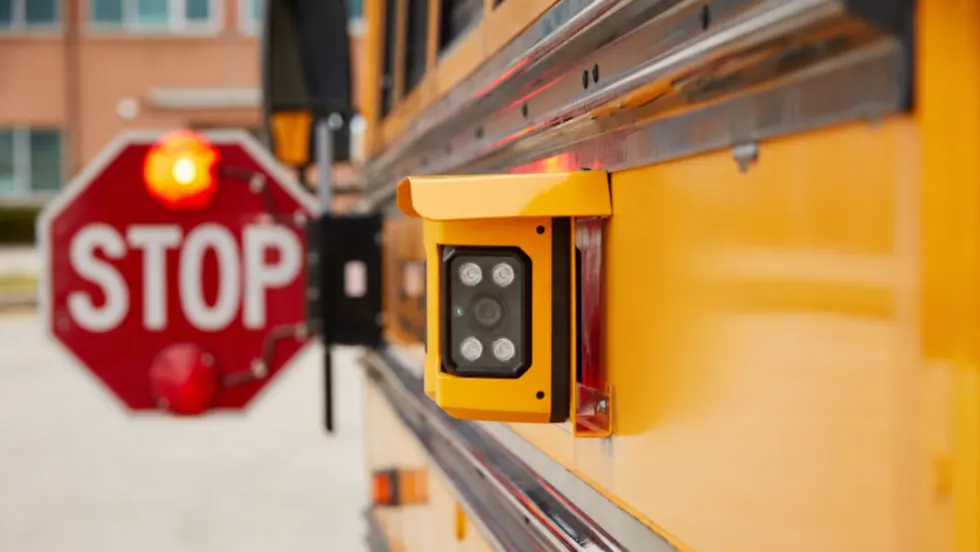
Walton County Schools Adds Gatekeeper Stop-Arm Enforcement System
The Florida district will deploy Gatekeeper’s updated Student Protector technology, which now incorporates AI to improve video evidence.
Read More →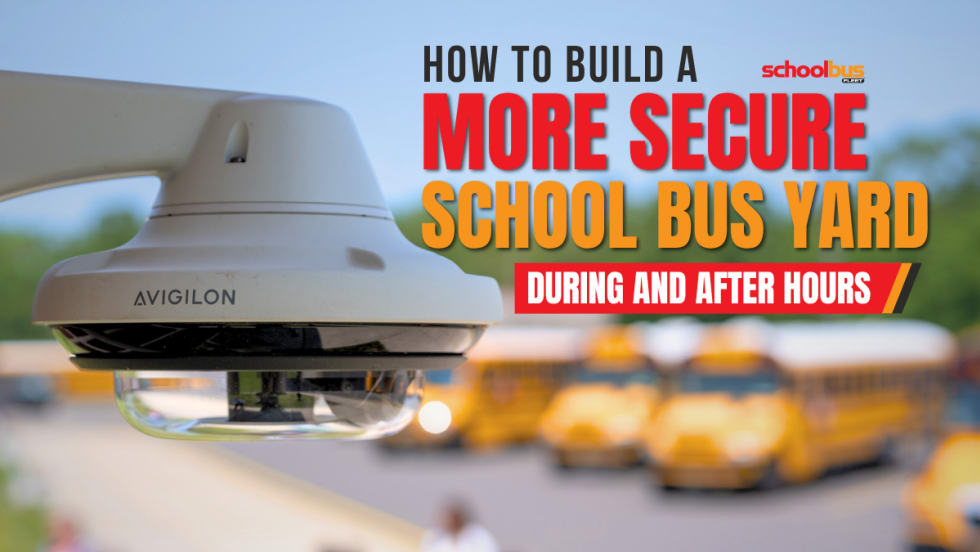
How To Build a More Secure School Bus Yard During and After Hours
As thefts and overnight security threats continue, school transportation leaders are combining stronger operational practices with AI-enabled surveillance to better protect buses, facilities, and staff.
Read More →