




Best Practices in Reflective Materials
In the ongoing quest to make school buses safer, the past 10 years have brought a focus on making buses more visible at night, in early morning hours,...
In the ongoing quest to make school buses safer, the past 10 years have brought a focus on making buses more visible at night, in early morning hours, in inclement weather and in other low-light conditions. As outlined in Federal Motor Vehicle Safety Standard 108, increased visibility can be attained with the use of "lamps, reflective devices and associated equipment."
In the form of tape, sheeting and decals, reflective materials have grown quickly in popularity and usefulness on school buses. To regulate the use of these products, the National Conference on School Transportation has issued guidelines (see sidebar) for reflective materials, and states have developed their own requirements based on these recommendations.
"Starting from a grassroots level, there is a heightened awareness not only to meet minimum requirements, but also for expanded use of school bus reflective markings," says Angie Hadrits, commercial marketing manager for 3M Traffic Con-trol Material, the St. Paul, Minn.-based maker of Scotchlite and Diamond Grade reflective materials. "New York, for example, is now completing a retrofit regulation that requires expanded use of the markings. We expect other states to follow suit."
But how will the movement toward increased use of reflective materials affect school bus operations? First, a look at the most common practices is necessary.
Standard applications
Currently, the brightest, most intense equipment available is high-conspicuity reflective material. High-conspicuity tape and decals provide a noticeable improvement over conventional grades of reflective material.
"Basically, you have two grades," says Jack Soppelsa, president of SunArt Decals Inc. in Berea, Ohio. "The engineer grade, or regular grade, is made from tiny glass beads that do the retro-reflective work. Then you have the high-conspicuity products, with either a polycarbonate or metalized membrane and a film that has layers of reflective material piled up to a polyester or vinyl laminent." This translates to a prism-like reflection of light.
According to Roger Cook, president of Cook School Bus Lines Ltd. in Mount Forest, Ontario, it doesn't take much effort to determine the effectiveness of high-conspicuity materials. "All you have to do is drive past a group of buses where some buses have high-conspicuity tape and some don't, and you will see a dramatic difference in visibility."
Subsequently, high-conspicuity reflective tape and signs have become very convenient, especially when used in concert with strobe lights in areas with long winters or heavy fog. Says Hadrits, "Districts understand the climate conditions and increased hours of operation their buses will be operating in." That is why there is an increased use of reflective materials in many states. In fact, when New York's regulations become effective this month, the state will have the most extensive guidelines for school bus reflective materials in the nation.
Recent innovations
For the most part, reflective materials have been used only as specified by national or state guidelines — with strips of tape and school bus decals. This doesn't mean there haven't been new creations or variations in uses of existing materials.
Says Alfred Hopkin, chairman of Arrow Safety Devices, a distributor of reflective tape in Mt. Holly, N.J., "Many companies have experimented with reflective strips inside a plastic housing, and many school districts buy aluminum housings that can contain reflectors for the side of the bus."
Other options include reflective sheeting for printing school district or company names. Decals or stickers made of reflective material with letters, numbers and symbols can be acquired for the interior or the exterior of a school bus. In addition, most manufacturers are open to customization based on user preference.
Dusty Emerson, owner of Pro-Motion Graphics, a decal manufacturer headquartered in Nixa, Mo., says that the products in the company catalog are standard but can be custom-produced in different ranges of color or at different reflectivity levels. "If someone wants something that's not in our catalog, we have them describe it, our artist draws it up and then we send them a proof. It's really no big deal," he says.
As for the future of reflective technology, Hadrits says 3M is working on a new fluorescent reflective product that will provide better reflectivity levels than anything used before. "Durable fluorescent technology is very new," she says. "It enables optimum visibility by absorbing short light wavelengths and re-emitting them at longer wavelengths for superior brightness and visibility."
With reflective materials, safety is enhanced not only by what type of products you use, but also by where you use them. For instance, operations have placed reflective tape on tire flaps, wheels, on vans and other vehicles and on buildings and facilities. One potentially effective idea not mentioned in the national standards is to place reflective material on the stop arm.
Says Jeff Flatt, school bus owner and operator for Rutherford County Schools in Smyrna, Tenn., "I have personally retrofitted stop arms with high-conspicuity decals, and it makes them more visible at sharp angles and in low light."
Another logical place to put reflective materials is on human beings. Safe Reflections, a maker of reflective apparel in St. Paul, does exactly that. Amanda McGowan, spokesperson for the company, says that crossing guards and school bus drivers are ideal candidates to wear reflective clothing. "Our vests have reflective strips attached to the fabric, so that the wearer can be recognized by oncoming traffic," she says. Using this same concept, reflectors placed on children's backpacks also work to increase visibility.
Installation and maintenance
Perhaps the most appealing aspect of reflective equipment is the limited installation effort required to reap considerable safety rewards. Gene Amling, lead driver for North Slope Borough School District in Barrow, Alaska, has helped install reflective tape on many buses in an area that experiences total darkness 24 hours a day from November to January. "You just make sure the bus is clean, pull off the backing and lay down the markings; they go on real smooth," he says.
Making sure reflective equipment is maintained properly is also easy, but requires closer attention. Soppelsa of SunArt recommends frequent cleaning to make sure the materials are clear. "If you are in a state like Ohio in the winter, there is a tremendous amount of salt on the road. When you cover the strip with a film of salt, dirt and grit, you reduce its effectiveness."
Aside from consistent cleaning, another way to minimize this problem is to use thicker strips of reflective tape or sheeting. National guidelines specify a minimum thickness, but maximum width should be regulated by common sense. Says Kristina McCloud, marketing manger for Avery Dennison, a manufacturer of high-conspicuity reflective tape, "We will sell it in rolls of any width the user asks for up to 48 inches."
National Standards
The National School Transportation Specifications and Procedures handbook gives the following guidelines for using reflective materials on school buses. Most states base their specifications on these standards.
A. The front and/or rear bumper may be marked diagonally 45 degrees down to centerline of pavement with non-contrasting reflective stripes measuring 1.75 to 2.25 inches.
B. The rear of the bus body shall be marked with strips of reflective national school bus yellow (NSBY) material to outline the perimeter of the back of the bus using material which conforms with requirements of Federal Motor Vehicle Safety Standard (FMVSS) 131, Table 1. The perimeter marking of rear emergency exits per FMVSS 217 and/or the use of reflective "SCHOOL BUS" signs partially accomplishes the objective of this requirement. To complete the perimeter marking of the back of the bus, strips of at least 1.75-inch reflective NSBY material shall be applied horizontally above the rear windows and above the rear bumper, extending from the rear emergency exit perimeter, marking outward to the left and right rear corners of the bus. Vertical strips shall be applied at the corners connecting these horizontal strips.
C. "SCHOOL BUS" signs, if not of lighted design, shall be marked with reflective NSBY material comprising the background for lettering of the front and/or rear "SCHOOL BUS" signs.
D. Sides of the bus body shall be marked with at least 1.75-inch reflective NSBY material, extending the length of the bus body and located (vertically) between the floor line and the beltline.
E. Signs, if posted, placed on the rear of the bus relating to school bus flashing signal lamps or railroad stop procedures may be of reflective material as specified by each state.
Source: The 13th National Conference on School Transportation, 2000.
More Safety

HopSkipDrive Reports Progress on Safety Advisory Council
More than a year after forming the council, independent safety experts have helped shape new rider-safety features and policy progress, with a new goal to address rider behavior.
Read More →
What the 2026 National School Bus Safety Month Resolution Means for Student Transportation
The bipartisan resolution highlights illegal school bus passing, student safety during loading and unloading, and the need for driver training and public education.
Read More →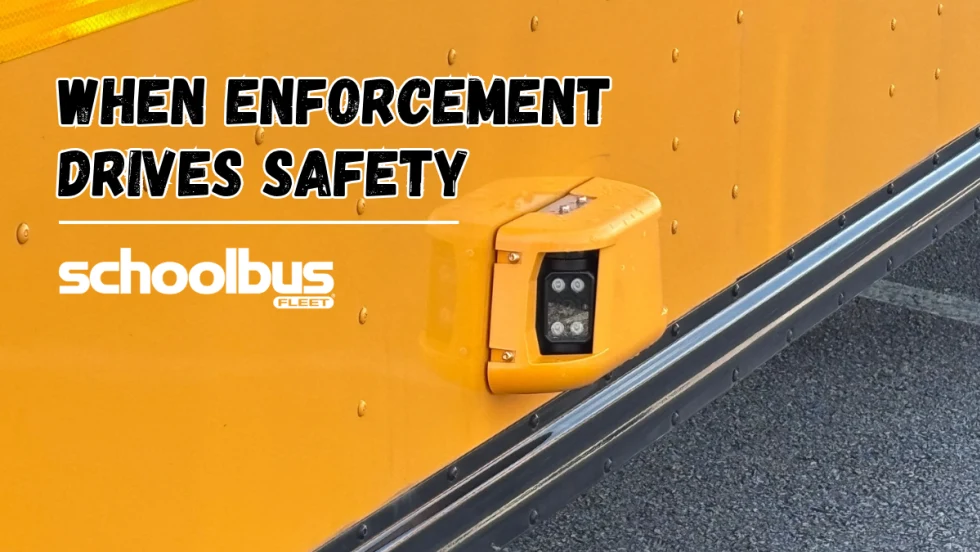
School Bus Stop-Arm Violations Decline 53% Across Verra Mobility Programs
Verra Mobility shares how school bus stop-arm cameras and school zone safety programs are changing driver behavior, reducing violations, and protecting students.
Read More →
Most Bus Crashes Aren’t Your Fault. Here’s How to Prove It.
A guide for what to do in between a school bus crash and a claim: what to preserve, who to notify, and how to keep the facts available when they matter.
Read More →
National School Bus Safety Week 2026: Tips, Toolkits & Resources to Keep Students Safe
School bus safety takes more than awareness. Explore expert tips, enforcement strategies, and free resources to help protect students on every ride.
Read More →
2 Killed, Dozens Injured in Florida School Bus Crash
A multi-vehicle collision caused a Polk County school bus carrying 37 students to overturn on its way to Winter Haven High School.
Read More →
Illegal School Bus Passing Drops 24% in New York Districts
With fewer than 5% of citations involving repeat offenders, Westchester County officials said enforcement, education, and community partnerships are helping change driver behavior.
Read More →
School's Back. Here's What Happened to Traffic, Speeding & Distraction
What happens to traffic when school resumes? New data analysis examines changes in distracted driving, congestion, and speeding around schools.
Read More →
Geotab Expands Fleet Safety Tools With Video Coaching, Risk Insights
New safety and video capabilities aim to help fleet managers assess risk, support drivers, and take targeted action through video coaching, red-light violation detection, and more.
Read More →
How to Build a Better School Bus Driver Training Program
Is it time to strengthen your driver training? Here’s how to pick the right talent and improve recruitment, retention, and safety. This video is brought to you by IC Bus.
Read More →