




Best Practices for Loading and Unloading Wheelchair Students
Although there are exceptions, industry experts say specific lift procedures need to be closely followed. Driver and attendant training is critical, they add.
Transporting children in wheelchairs provides challenges every day — new and different wheelchair designs, missing or broken wheelchair equipment, complications with lifts or difficulties with frightened children. Not to mention the fact that drivers could find themselves without any assistance. Complications such as these have a significant impact on the safety of school bus passengers. In order to reduce complications in the boarding process, we consulted experts from across the country, asking them what they considered to be the best way to load and unload wheelchair students. Obviously, in the real world, the best way is not always possible. But in order to at least strive for it, we must first define it. The following guidelines represent what experts agree to be the safest approach to boarding of wheelchair students.
2-person team is best
Transportation professionals agree that it is essential to have two adults participating in the loading and unloading process. Along with the driver, the team can include a bus aide, a parent, a teacher or a classroom aide. Any helper not trained to work on a special-needs bus should not be operating the lift. That person should provide other support services, such as guiding the chair onto or off the lift and holding onto the chair on the lift. A bus aide may operate the lift if properly trained. The decision about who runs the lift should be based on who will be most effective in that role. Jean Mann, director of transportation for Lincoln (Neb.) Public Schools, says that sometimes the driver or assistant may have a special relationship with the student or his parents and would be better suited for helping the child onto the lift. At Fairfax County (Va.) Public Schools, the bus aide always runs the lift, and the driver takes the position inside, where he can deal with any problems the bus or students might have. It is the driver who runs the lift at St. Paul (Minn.) Public Schools because, says Mark Vogel, transportation safety coordinator, “the driver is the one who is ultimately responsible for what occurs.” Whether the driver or bus aide runs the lift, they must both be trained in proper loading and unloading procedures.
Pre-boarding procedures
Before allowing a wheelchair student to board the bus, you must be certain that his chair is in safe condition. If there is any problem with the chair, it must be remedied before he can board the bus. Transportation providers should have equipment that can be loaned to students in emergencies and, whenever possible, someone in the operation should be trained to work on minor chair repairs. Occupational therapy/physical therapy (OT/PT) staff or bus mechanics can often fix simple problems like a loose wheel. However, if nothing can be done on the spot to make the wheelchair safe for transportation, the child should not be allowed to board the bus. As Vogel puts it, “It’s better to watch out for the safety of the student than to follow the rule of providing transportation.” Once you have determined that a student’s chair is safe, remove the lap tray, if the chair has one. Lap trays not only interfere with safety restraints, but they can also become projectiles in the event of an accident.
Raising a manual chair
After the lift is lowered, back the student onto the platform and set the brakes on the chair. Secure the wheelchair with the student facing outward (back to the bus), so he doesn’t risk pinning his feet beneath the bus as the lift goes up. Be sure that the roll-stop is up before running the lift. As the lift rises, the adult on the ground should keep one hand firmly on the chair. This not only aids in stabilizing the chair, but it also lends a sense of security to the child on the lift. When the student reaches the top, the adult inside the bus will remove the safety restraints, release the brakes and wheel the student onboard and into place.
Raising a motorized chair
Motorized wheelchairs should be turned off while on the lift. If the gears on a motorized chair are accessible (sometimes they are not reachable), they should be disengaged to prevent the chair from rolling. Note: on some motorized chairs, disengaging the gears may actually prevent the brakes from working. For this reason, it is imperative that drivers understand the correct way to operate each of the chairs used by their passengers. If they have any questions or concerns, they should immediately consult the student’s parents or a member of the OT/PT staff. A student in a motorized chair can be permitted to motorize himself onto or off the lift when it’s at ground level, if his OT/PT, parent or bus driver deems him capable of safely doing so. (You may wish to document this decision in the student’s IEP, Individualized Education Program). When the lift is at bus level, however, a student should not be allowed to motorize himself onto or off of it. The student will be several feet in the air, where a mistake at the controls could lead to significant harm. Tom Italiano, special-needs transportation coordinator at Fairfax County Public Schools, remembers a time when a student made a mistake at the controls and accidentally drove off the front of the lift. Though the student only got a few bumps and bruises, it was a harsh reminder of the danger of having the power on while a wheelchair is on the lift. Some transportation providers, including Italiano, continue to allow capable students to motorize themselves onto and off the lift at bus level, explaining that it is part of the student’s learning process and road to independence. Though controversy continues, most transportation professionals we spoke to agreed that students should not be allowed to motorize onto and off the lift when it is in the up position. When the lift reaches bus level, all chairs should be moved inside manually. Though a student’s independence is important, turning the power on while the chair is still on the lift involves too great a risk. There are exceptions to the rule. If the student and chair together weigh too much to be moved manually by the driver or aide, the student can be allowed to motorize himself onto and off the lift in its up position. (If he is deemed capable of controlling the chair’s movement).
Going it alone
What if a driver has no one to assist her in the loading and unloading process? Though no transportation provider recommends running a wheelchair lift bus without an assistant, most have faced that situation. There is no good solution to this dilemma. The first option a driver has is to ride the lift with the student, thus operating the controls while remaining beside the student and holding on to his wheelchair. The second option is to operate the lift from the ground, returning inside to move the student onto the bus when the lift reaches the top. Both options involve a risk to the student, the first by standing on the lift with him, the second by leaving him unattended. Jean Zimmerman, district resource therapist at the School District of Palm Beach County in West Palm Beach, Fla., remembers an accident in her county years ago where a driver, lacking proper assistance, was unable to prevent a child from falling off the lift. According to district policy, parents were supposed to assist in the boarding process. One mother, however, left her child and returned to her car as he was riding up on the lift. Something went wrong with the front of the lift, and the child fell headfirst onto the pavement. Luckily, he only sustained a broken nose — but it was an accident that could have been prevented had there been someone holding on to the chair from the ground. Before loading or unloading students by herself, a driver should enlist the help of an available adult, such as a parent or a school official. Though there may occasionally be complications with assistance along the route, a classroom aide or school administrator should always be made available to help with the loading and unloading process at the school site. As we’ve just seen, safety is compromised when drivers are forced to do it on their own.
Get proper training
The best way to train special-needs drivers in the loading and unloading process is to put them through hands-on practice with other drivers in training. Drivers should take turns playing the roles of driver, aide and student. Each driver will get in a wheelchair, ride the lift, get secured in the bus and go for a spin. This will help them understand how their students feel — a feeling one driver described as the most vulnerable he has ever been. Drivers and students alike receive wheelchair lift training at Lafayette (Ind.) School Corporation. Drivers of lift buses must be certified in wheelchair transportation by the district. What’s more, every new wheelchair student receives a visit at home by a driver before he ever rides the bus. Special-Needs Coordinator Cheryl Wolf explains that drivers first put a Raggedy Ann doll in a wheelchair on the lift to show the student what it will be like. Then they put the student in the lift and take it up a little ways. If the student is frightened, they will drop it back down. They will keep doing this until the student feels secure with it. Because of this practice, she says, students have greater confidence in their drivers and rarely have qualms about riding the lift.
The well-rounded driver
When it comes down to it, best practices are simply that — best practices. They cannot be followed in all situations and there are unique cases in which these practices are not the best for the child and driver involved. That’s why training is key. Drivers need to be able to think on their feet so they can deal with those situations that do not conform to a “best practices” scenario. If they understand what it feels like to be in a wheelchair suspended several feet in the air, they are one step closer to understanding the needs of their students and making the best choices to ensure their safety.
Standing on the lift
Though most industry professionals agree that no student or adult should be permitted to stand on the lift, they consistently tell stories of surrounding districts where the practice persists. Some even admit to doing it themselves. Students who don’t use a wheelchair but who can’t maneuver the bus steps are allowed to stand on the lift to board the bus at Fairfax County (Va.) Public Schools. “I feel it’s safe for them to stand on the lift if they’re capable,” says Special-Needs Coordinator Tom Italiano, who explains that the district’s lifts all have handrails. If they are not capable of standing on the lift, the driver will put them into a wheelchair for the purposes of loading. At St. Paul (Minn.) Public Schools, no one is allowed to stand on the lift. “If you bend down while the lift is going up, it can cause vertigo and then you’re completely disoriented and likely to fall off,” explains Mark Vogel, transportation safety coordinator. “If something goes wrong,” he adds, “the driver has a better chance of being able to help the child if he’s not on the lift with him.” In fact, say transportation specialists, if someone is standing on the lift with a student in a wheelchair, the odds are that person will take the chair with him if he falls off the lift. At the very least, he will tip the chair over. It is safest, they say, to maintain a policy of no standing on the lift. Those students who can’t maneuver the bus steps should use a wheelchair to be loaded by lift. Like with all other policies, however, there are exceptions. At Lincoln (Neb.) Public Schools, one small child is allowed an adult escort on the lift. “This 2-year-old is very afraid, and it seems to help if an assistant is there,” says Jean Mann, transportation director. “This is an exceptional case.”
More Special Needs Transportation
Kelli Goterba Named 2026 Special-Needs School Bus Driver of the Year
Through building trust with students and strengthening her transportation team, Goterba exemplifies the impact special-needs drivers can make.
Read More →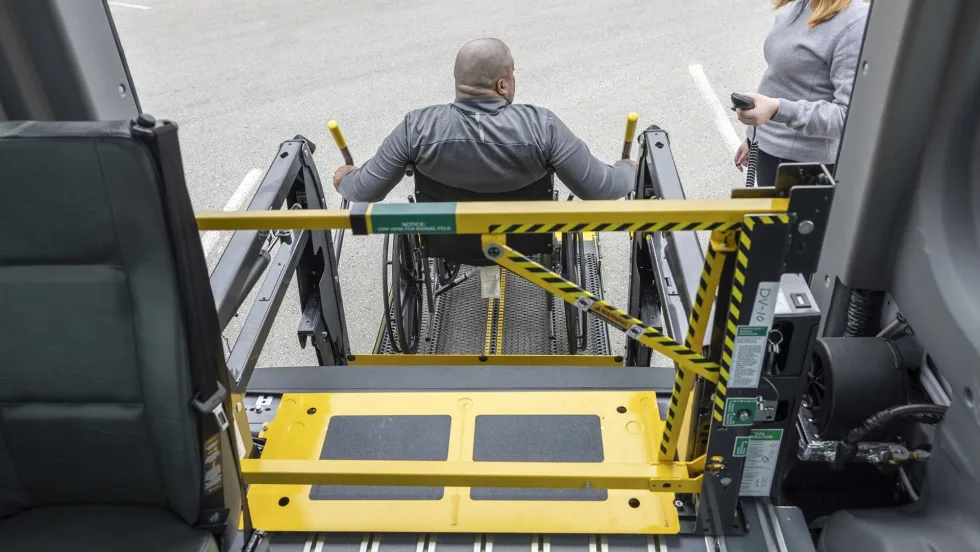
BraunAbility Introduces New Safety Barrier for Wheelchair Lifts
LiftSentinel is designed to add another layer of protection during wheelchair loading and unloading and can be retrofitted to many existing commercial lift installations.
Read More →
HopSkipDrive Launches New Safety, Driver Consistency Features for 2026-27 School Year
The company’s free ride recording, live ride tracking, and consistent driver assignments aim to improve safety and continuity for diverse student transportation needs.
Read More →
The Most Common Wheelchair Securement Mistakes on School Buses (and How to Fix Them)
Small missteps in wheelchair securement can have serious consequences. Here are 32 tips from experts to reduce risk and increase student safety on the bus.
Read More →
Inside AMF Bruns’ New Showroom: School Bus Securement Solutions Explained
Go inside AMF Bruns America’s new Ohio showroom with Maritza Valentin to see its FutureSafe technology, driver training tools, securement systems, and seating innovations.
Read More →
What AMF Bruns’ New Facility Means for Customers [Video]
Inside AMF Bruns’ new Stow, Ohio, operations: See how expanded space and innovation will enhance customer support and operations.
Read More →
AMF Bruns Expands in Ohio, Investing in Growth and Community
With expanded production space, local investment, and a growing workforce, AMF Bruns is scaling its U.S. presence. Here’s an exclusive first look inside the new Stow, Ohio, HQ.
Read More →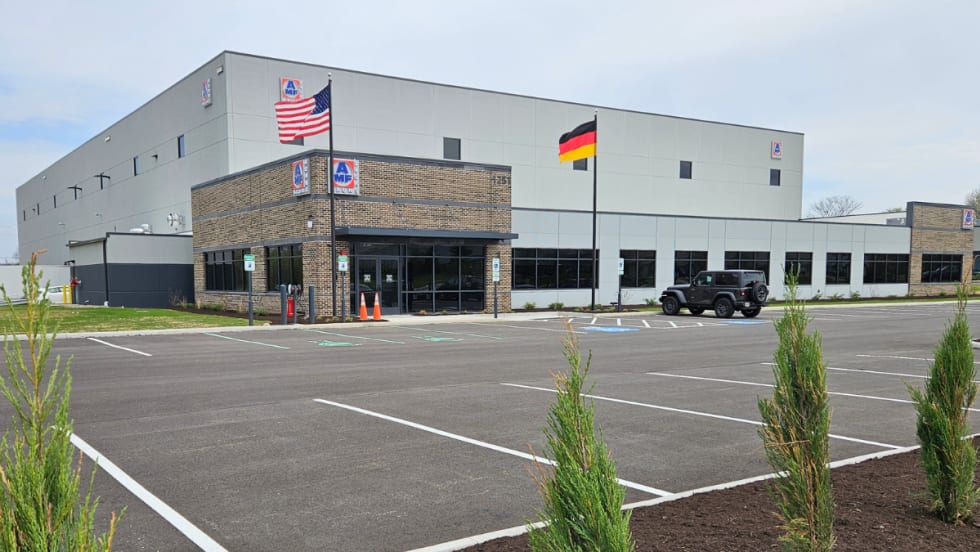
Inside AMF Bruns of America’s New Ohio Manufacturing Facility [Photos]
Take a behind-the-scenes look at AMF Bruns of America’s new 41,000-square-foot Stow, Ohio, headquarters, featuring advanced manufacturing, expanded space, and future-ready mobility solutions.
Read More →
First Student Boosts Student Support in Wichita & Texas
First Student and Wichita Public Schools are using behavioral support strategies to improve student ride experiences, while a separate initiative expands access to after-school programs through a bus donation.
Read More →
2026 Special-Needs Transportation Survey
What’s changing in special-needs transportation? This year, student transportation operators report a rising need, easing driver shortages, growing tech adoption, and evolving challenges. Sponsored by AMF Bruns of America.
Read More →