




After the Storm: Rebuilding the Bus Plant
When a microburst inflicted heavy damage on Collins Bus Corp.’s manufacturing facility, employees pulled together to keep bus production rolling throughout the repair process.

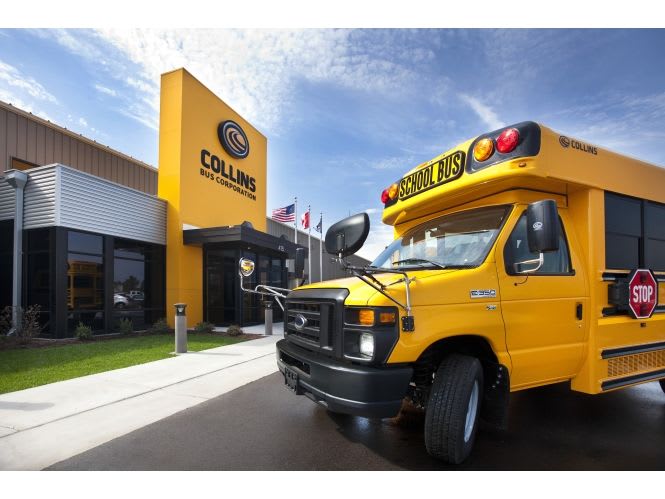
Collins Bus Corp.’s newly rebuilt manufacturing plant.
On a stormy night in the summer of 2009, a few employees were working the swing shift at Collins Bus Corp.’s manufacturing facility. The region was experiencing a severe thunderstorm, but a more destructive phenomenon was brewing.
Suddenly, the area around the South Hutchinson, Kan., bus plant was hit by a microburst — a powerful meteorological event similar to wind shear. Heavy, cold air at the top of a thunderhead abruptly drops and hits the ground at incredibly high speeds.
The microburst on this night — June 7, 2009 — created winds estimated at 120 miles per hour. The winds struck the northern side of the Collins facility, inflicting heavy damage.
“Whole walls were crumpled, we lost major sections of the roof, and our sales and engineering offices were destroyed,” says Kent Tyler, president of Collins Bus Corp.
Fortunately, the few employees who were working that night were able to take refuge in the company’s storm shelter, and no one was injured. But major repairs would have to be made.
[IMAGE]645[/IMAGE]
Evolving bus plant
As North America’s largest builder of Type A school and activity buses, Collins’ manufacturing facility had evolved over the years to meet production needs.
The west section of the plant was originally built in 1976. A southeast wing was added in 1998. Then in 2007, the company launched a major reconfiguration of the production flow through the plant when it began its Lean manufacturing initiative — a production practice that seeks to optimize efficiency.
After the microburst hit in 2009, Collins quickly took action to mitigate the damage and protect vital equipment.
“We were in the middle of our busiest production period, with over 1,200 chassis on the ground to support our customers’ school start requirements,” Tyler says. “As you can imagine, it was a terrible time to experience such an interruption.”
Temporary repairs were made, and Collins employees pulled together to clean up the mess and help figure out how to modify production flow to work around the damaged areas.
Tyler says that the employees’ experience with kaizen events — workshops that deal with improving manufacturing processes — as part of the company’s Lean production system helped them assess the situation and quickly come up with solutions to the manufacturing dilemma.
“Incredibly, we were back at full production one week later,” Tyler says. Also remarkable was that Collins launched its hybrid-electric and propane buses during the rebuilding of the plant.
The Lean production system has driven the Collins bus plant for nearly four years. With employees participating in the kaizen events, the company’s manufacturing processes are improved in some way almost every week.
[PAGEBREAK][IMAGE]646[/IMAGE]
Working through repairs
After the initial temporary repairs, Collins’ contractor worked on the permanent construction. Collins was under full production for the entire reconstruction, so the contractor had to work on small sections at a time, only taking down the temporary repairs that could be completely reconstructed in a day.
That limitation stretched the entire project out for a full year, but the Collins staff worked through it.
“Throughout this period, our employees’ dedication to safety enabled them to meet production needs, coordinate with the construction contractor, and avoid accidents and injury,” says John Doswell, Collins’ vice president of sales and marketing.
The company was recently recognized for this performance when it earned Safety and Health Achievement Recognition Program (SHARP) certification. The program is administered by the Kansas Department of Labor in association with the federal Occupational Safety and Health Administration.
“SHARP is an award only presented to companies that have achieved excellence in the area of safety and health and have met rigid OSHA criteria,” says Clifford Morris, acting director of the Kansas Department of Labor’s Division of Industrial Safety and Health. “Collins Bus Corporation is one of only 157 companies that have achieved this distinction in Kansas.”
To qualify for SHARP certification, companies must undergo a comprehensive evaluation and series of audits, correct any identifiable hazards, demonstrate that effective safety and health programs are in place, and maintain lostworkday injury and illness rates below the national average for the past three years.
Collins’ SHARP certification is good for two years. It frees the company from OSHA compliance inspections during that period, and it can be renewed for another two years.
The SHARP certification is one of two safety awards that Collins earned in 2010. In June, the company received the Kansas State Safety Award for operating more than 500,000 hours without a time-lost injury.
Local flavor
The combined cities of Hutchinson and South Hutchinson (where the Collins plant is located) have a population of about 41,000. They are about 50 miles northwest of Wichita, in the south-central region of Kansas.
“We’re pretty much in the middle of the country,” Tyler says.
Every year, Hutchinson hosts the Kansas State Fair and the National Junior College Athletic Association’s National Basketball Championship.
“Hutch,” as locals call it, is home to the Kansas Cosmosphere space and aviation museum. It’s known as “The Salt City,” as it sits on top of the most productive salt mine in North America. Visitors can go 650 feet below the surface to the Kansas Underground Salt Museum (as shown on the cover of the January 2011 issue).
Fortunately, microbursts and tornadoes don’t regularly hit the Hutchinson area.
“Just like California has their fires and earthquakes and the East Coast gets the hurricanes, we in the Midwest have our occasional severe weather,” Tyler says. “Most of the dangerous storms that hit [Kansas] don’t affect heavily populated areas. That being said, we certainly pay close attention to the weather forecasts and warnings.”
[PAGEBREAK][IMAGE]647[/IMAGE]
Coming back stronger
Tyler notes that storm-proofing an entire plant would be virtually impossible, but the company did take the “opportunity” of the microburst damage to rebuild its facility with up-to-date construction methods to make it a much stronger building.
Collins also upgraded its storm shelters across the plant and significantly improved its parts department’s ability to support customers.
The rebuilt office spaces include a new employee break room, training and conference spaces, and a lobby that houses Old #1, the first Collins small school bus, which was manufactured in 1967.
Currently, about 220 employees work in the Collins facility, which has a total of 265,000 square feet of production space.
The company’s three Type A brands — Collins Bus, Mid Bus and Corbeil — are all manufactured in the plant. It has the capacity to build about 4,000 buses per year.
Though the microburst wrought great damage on the Collins Bus Corp. facility, responding to it seems to have bolstered the company.
“I think all the employees take pride in the rebuilt facility, especially in the way that they pulled together to keep the buses moving through the production process in light of all the challenges after the storm,” Tyler says. “Our new entrance and signage is a huge visual reminder to everyone of the strength of our company.”
More Management

How to Build a Better Driver Training Program
Ready to boost up your school bus instructor training? Here’s how to pick the right talent and improve recruitment, retention, and safety.
Read More →
CALSTART and Forth Combine to Form Catalyst Mobility
The new name represents a renewed vision for the nonprofit focused on advancing clean, equitable, and affordable transportation solutions that move people and goods.
Read More →
What Makes a Great School Bus Driver Trainer?
Choosing the right school bus driver trainer takes more than experience. Learn six keys to selecting and developing trainers and evaluating program effectiveness.
Read More →


School Bus Contractors Expand Through New Deals, Acquisitions & Partnerships
STA's Canadian division acquires Ontario-based G&L Stevenson Transport while Durham School Services adds a new district contract in California, First Student adds a New Jersey contract, and Minnesota Coaches acquires Halo Transportation.
Read More →
Logan Bus Company Rolls Out AI Phone System for NYC School Bus Families
A summer pilot found that AI agents could handle most routine calls, freeing up time for customer service staff to focus on emergencies and complex family concerns.
Read More →
From Intent to Impact: What I Learned About Leadership from TAPT
A Texas transportation supervisor shares lessons on self-awareness, accountability, managing stress and building trust — and why investing in leadership development matters at every stage of your career.
Read More →
NAPT Names 2026 Award Recipients, Hall of Fame Inductee
Who earned national recognition for their work in student transportation? This year, NAPT named five recipients of its 2026 awards for service, safety, and leadership, plus its newest Hall of Famer.
Read More →
2026 State of Student Transportation Report
Driver shortages. Rising costs. Growing safety expectations. More data, but not enough time to act on it. The 2026 State of Student Transportation Report reveals what transportation leaders say is putting the most pressure on their operations—and where they’re investing next. See how your priorities compare.
Read More →
How to De-Escalate an Angry Person: 5 Steps for Handling Workplace Conflict
What makes emotions run high, and how should you handle an angry colleague or parent? Follow these steps for staying calm, listening, showing empathy, and resolving conflict.
Read More →
What Readiness Looks Like This School Year
Learn about the challenges shaping the 2026–2027 school year, from persistent driver shortages and budget pressure to technology and readiness gaps. See how school districts are responding and adapting in Zonar’s 2026 Back-to-School Readiness Report.
Read More →