




75 Great Ways to Improve Your Operation (Part V)
Even if you've got a top school bus operation, you've likely got room for improvement. Here are more than six dozen of the best tips, tricks, and techniques any outfit can employ, part 5 of 5.

Adjusting driving techniques can help reduce the amount of fuel buses use.
Even if yours is one of the top school bus operations in the county, you've likely got room for improvement. Maybe you need to cut even more costs to accommodate a deteriorating budget, or the kids on that one route just won't behave. Here are more than six dozen of the best tips, tricks, and techniques any outfit can employ. Our thanks to all who contributed.
61. Seek consultation
As any transportation director knows, time management and organization are critical challenges facing a school district transportation department. Your staff is constantly being asked to do more with less, faster, cheaper and with fewer mistakes.
Some school districts have found a solution to these problems in the form of consultants. Atlanta-based Weber Associates Inc., for example, specializes in developing programs for businesses to deal with a fast-paced work environment. The company’s programs teach effective ways to follow up, document, plan, organize, reduce stress, retrieve information, manage workspace and more.
This approach can be applied to Palm and handheld devices, paper organizers and computer software programs such as Microsoft Outlook, ACT! or Lotus. Weber’s programs are ideal for school transportation because they apply to an “interrupt-driven” environment.
For more information, visit www.weberassociates.com.
62. Watch fuel economy
Unstable fuel prices aren’t the only reason to adopt a policy of wise fuel consumption. Good fuel economy increases vehicle performance, extends the lifespan of the bus and is good for the environment. Here are some quick-hitters from the Society of Automotive Engineers:
1. Get into high gear as soon as possible with automatic transmissions.
2. Keep light, steady pressure on the gas pedal when accelerating.
3. Avoid sudden stops at lights or stop signs.
4. Merge smoothly without interrupting your momentum.
5. Keep tires inflated to recommended pressure levels.
63. Ask key questions of charter providers
Hiring charter operators for transporting students on field trips or to athletic events is a common practice. Too often, however, schools don’t take enough time to comprehensively evaluate the company that’s being retained.
Despite the fact that most coach operators provide perfectly adequate transportation, they are not equally safe.
Here are some questions that the Federal Motor Carrier Safety Administration (FMCSA) suggests that you ask the carrier:
- What is your company’s U.S. DOT number?
- Does your driver have a current CDL with a passenger endorsement?
- Does your driver have a valid medical certificate?
- Does the company have a driver drug- and alcohol-testing program that complies with U.S. DOT regulations?
- Will the trip be completed within the legal limit of 10 driving hours? If not, will a second driver or overnight rest stop be necessary to perform the trip legally?
- Are the buses inspected annually?
- Does your company have the required $5 million public liability insurance?
- Does your company subcontract for equipment and/or drivers? If so, what is the name of the second bus company and its U.S. DOT number?
- What company procedures exist for roadside emergencies and breakdowns? Asking these questions is a great start, but schools should enlist the help of the transportation department to determine if the bus company’s responses are acceptable.
64. Winter reminders
A short reminder list for winter driving:
- Traction is greater when you slow down. Slow speeds mean more control.
- Stopping is harder than going. Ice, snow or water on the ground will mean you need more room to stop.
- Turning can be trouble. Ice and snow prevent turning problems. Keep the wheels turning through curves.
- See and be seen. Check lights, wipers and defroster before you go and occasionally while en route. Always use headlights.
- Skidding is easier to avoid than to control. Slow speeds and gradual movement avoid skids. Aggressive driving creates them.
- Know your limits. Sometimes the only safe thing to do is stop.
65. Enjoy vicarious expertise
In the classroom, students with special needs are attended by teachers with four- to six-year college degrees in special education. On the bus, however, the same students are often in the care of employees with only a few in-service training sessions under their belts. So how can you better educate staff members in charge of transporting students with special needs?
Drivers charged with understanding the special considerations of children while safely driving the bus can benefit from observing the experts. Have your special-needs transportation personnel spend a day or even a few hours in a special education classroom. Set up meetings or interaction between educators and transportation personnel, if possible. School administrators will likely welcome the initiative, while your staff will get the next best thing to professional training. Don’t forget to pay staff for time spent taking notes in the classroom.
66. Answer tough questions with a few keystrokes
Have a school transportation-related question, but can’t seem to find anyone in your network of friends and acquaintances to provide an answer?How about widening your arc by posting the question in the SBF Forums? Every month, the Forums are visited by thousands of people, representing an incredibly deep and diverse knowledge bank. This online community, which has posted more than 65,000 messages, is receptive to almost any type of question and embraces new members with open arms. More than a dozen categories have been created to help members target their messages to the proper audience.
For example, “Professional Garage” is used by maintenance personnel to trade information about concerns in the shop. “Management/Operations” is designed for supervisors and others to share information on the nuts and bolts of running a transportation program. “Question of the Month” allows you to weigh in on a controversial or sticky topic. If you’ve got a question, the Forums has a place for you to find an answer. Click here or on the "Forums" tab on our navigational sidebar and try to stump SBF’s online enthusiasts.
67. The power of storytelling
Drivers who want their youngest passengers to absorb advice about the dangers of misbehaving on the bus might want to utilize a good story instead of the usual lecture.For example, for a child who fails to wait for a driver to signal him safely across the street, the driver might want to tell the sad tale of the youngster who was injured by a passing motorist. To a child who doesn’t return to the bus on time during a field trip, the driver can spin the sorry tale of a student who was left behind alone and had to be picked up by his parents. And to the child who doesn’t sit down during the ride, the story of the girl hurt in a crash because she always stood up never fails to reach a curious youth. These stories don’t have to be true, but if they are based on truth, they will get the point across clearly and honestly. In fact, an archive of stories at the transportation office is a good resource for drivers to access and share.
68. Too sleepy to drive?
Nearly one in three motorists admits to having fallen asleep behind the wheel at least once. The inherent danger of dozing drivers is obvious, but what isn’t so obvious are the dangers of fatigued drivers who may not fall asleep.Fatigue can have a subtle effect on a motorist. For example, it can cause him to recognize a dangerous traffic situation just a fraction of a second too late. Or it can create a momentary loss of focus that allows his vehicle to veer into oncoming traffic or off the road. In addition, it can create errors in judgment. Lancer Insurance (www.lancer-ins.com) says fatigue for school bus drivers has several causes.
Not getting enough sleep — Most people need more than seven hours of sleep a day. Failing to get this amount can put the driver in jeopardy the following day.
Medical issues — Some people have medical conditions that make them fatigued or require them to take medication that can make them sleepy.
Sleep deficits — When inadequate rest on one night is followed by one or more additional nights of deprivation, the risks multiply due to the accumulation of sleep deficit.
Circadian rhythms — Any situation that demands full alertness and concentration between 2 and 6 a.m. and during the hour after lunch can put the driver at risk.
Work hours that change — Drivers who switch starting and ending times regularly are at risk of creating fatigue problems.
Natural tendencies — Matching a driver’s natural body rhythm to his work hours is important because, yes, there really are night owls and early birds. If you need information about how to get the proper amount of sleep, visit www.goodsleep.com.
69. Spread the word
Take a lesson from top advertisers on how to market your operation’s mission to the community. In order to be credible, communication must be consistent, and consistency is based on repetition. For example, everyone knows that McDonald’s sells hamburgers, but that doesn’t stop the company from advertising this fact.To establish good repetition, determine what medium is desired for your situation. Newsletters to parents, achievement reports to administration and safety bulletins to drivers are all good ideas. Next, decide on a frequency — monthly, quarterly, bimonthly, etc. After you have the means figured out, choose your key messages. These will be the points you will continue to make to your audience over and over again. Your department’s high safety record, the success of your cost containment efforts or the need for behavior management on your school buses are potential messages worth being repeated.
Finally, remember to use the right tone. It’s smart to relay both good and bad news, but make sure each is reported in a responsible manner, with an emphasis on solutions for the bad news. Also, think about how large companies use targeted marketing techniques, such as advertising toys during cartoons or beer during football games. With this in mind, you might decide that administrators will respond better to technical language than parents. Make sure to address your audience appropriately.
70. Explore the Web
There are myriad sources on the Internet for pupil transportation information. Beyond these national organizations, visit Websites for associations in your state to keep up to date on news, regulations and events.- www.napt.org (National Association for Pupil Transportation)
- www.nasdpts.org (National Association of State Directors of Pupil Transportation Services)
- www.yellowbuses.org (National School Transportation Association)
- www.ptsi.org (Pupil Transportation Safety Institute)
- www.schoolbusinfo.org (School Bus Information Council)
- www.nasdpts.org/NCST-NSTSP (National Conference on School Transportation)
- www.nhtsa.dot.gov (National Highway Traffic Safety Administration)
- www.ntsb.gov (National Transportation Safety Board)
71. Put a lid on gossip
"Have you heard about Janice’s new boyfriend? He just got out of prison.” “Vernon’s getting extra field trip work because he hangs out with John at the strip bar after work.” ”Don told Sharon that he’s fed up with that guy in the shop with the bad haircut. What’s his name again?”
Bus yards are not immune from the trading of gossip. In many cases, the results are mild. After all, you can’t stop people from talking about each other. In some cases, however, gossip can harm morale and lead to performance problems, rampant absenteeism and high turnover.
Management needs to take action when gossip is ruining the culture of an organization. First, it needs to emphasize that gossip is toxic in nature. Managers also need to make sure that they aren’t contributing to the problem. Under no circumstances should supervisors be engaging in the gossip trade. If employees are gossiping because of perceived cronyism or other unfair practices, they should be encouraged to talk with a supervisor. If they feel they’ve been wronged because of gossip, they need to report the problem to their supervisor and let him or her mediate the dispute.
72. Just checking
Most (hopefully all) school transportation operations have thorough emergency response plans in place. But does your preparation include any of the following less-than-obvious considerations:- Training students to operate school bus roof hatches?
- Establishing alternate routes for drivers to avoid accident sites?
- Adding emergency phone numbers to student ID cards?
- Assigning a bilingual employee to help at accident scenes?
73. Share and share alike
Both drivers and assistants share responsibility for maintaining appropriate student bus behaviors. The old paradigm of “I’m the driver, and all I’m responsible for is driving the bus; you’re the assistant, and you’re responsible for managing student behavior” is gone.
Both driver and assistant are jointly responsible for managing student behavioral intervention strategies and should be specially trained for specific student behavioral requirements. Among those requirements are behavioral contracts formulated by the student’s IEP committee that directly affect how and what driver and assistant are to respond to in student behavioral crises. It’s also important to report serious student behavioral infractions on appropriate behavioral incident reports. The driver or assistant, preferably both, should complete the report. The report is then submitted to the building principal or vice principal for administrative action. Depending on the seriousness of the behavior, a variety of actions can be taken by the building administrator.
— Submitted by Dr. Ray Turner, special education transportation coordinator at Northside Independent School District in San Antonio
74. Got healthy drivers?
Healthy workers make happy workers, but with the non-traditional hours and sedentary nature of school bus driving, wholesome diets and dedicated exercise routines are elusive goals. But it never hurts to encourage healthy living around your work environment. Here are some creative tips to do so:- Encourage or set up partnerships among coworkers who want to improve their health.
- Sponsor a charitable fundraiser — a walkathon, a table tennis tournament or a team sports competition.
- Create a driver workout room by suggesting to management that fitness equipment is a smart business investment.
- Convert vending machines to include healthier snacks such as fruits, juices and bottled water.
- Allow exercise opportunities during downtime and promote them with posters on buses and in the drivers’ lounge.
75. How to say thanks
It doesn’t always take money to show appreciation. In the absence of pay raises, here are some things you can do to let your employees know they are valued.
Letters home — Managers of family-oriented operations recommend sending a letter home to an exemplary employee’s significant other to announce a notable contribution. The note can be accompanied by a gift certificate, monetary reward or half-day-off certificate.
Meeting treats — Perk up monthly meetings by making popcorn or baking cookies. It may sound like a gimmick, but the treats make meetings a lot more fun.
Team Building Committee — A group of volunteer staff members can help plan events. Divide the staff into teams to compete at miniature golf or bowling. Each team can come up with a name and theme, complete with costumes. The winning team could be awarded a prize. Photos of events could be posted in the office or added to a company photo album.
More Management

How to Build a Better Driver Training Program
Ready to boost up your school bus instructor training? Here’s how to pick the right talent and improve recruitment, retention, and safety.
Read More →
CALSTART and Forth Combine to Form Catalyst Mobility
The new name represents a renewed vision for the nonprofit focused on advancing clean, equitable, and affordable transportation solutions that move people and goods.
Read More →
What Makes a Great School Bus Driver Trainer?
Choosing the right school bus driver trainer takes more than experience. Learn six keys to selecting and developing trainers and evaluating program effectiveness.
Read More →

School Bus Contractors Expand Through New Deals, Acquisitions & Partnerships
STA's Canadian division acquires Ontario-based G&L Stevenson Transport while Durham School Services adds a new district contract in California, First Student adds a New Jersey contract, and Minnesota Coaches acquires Halo Transportation.
Read More →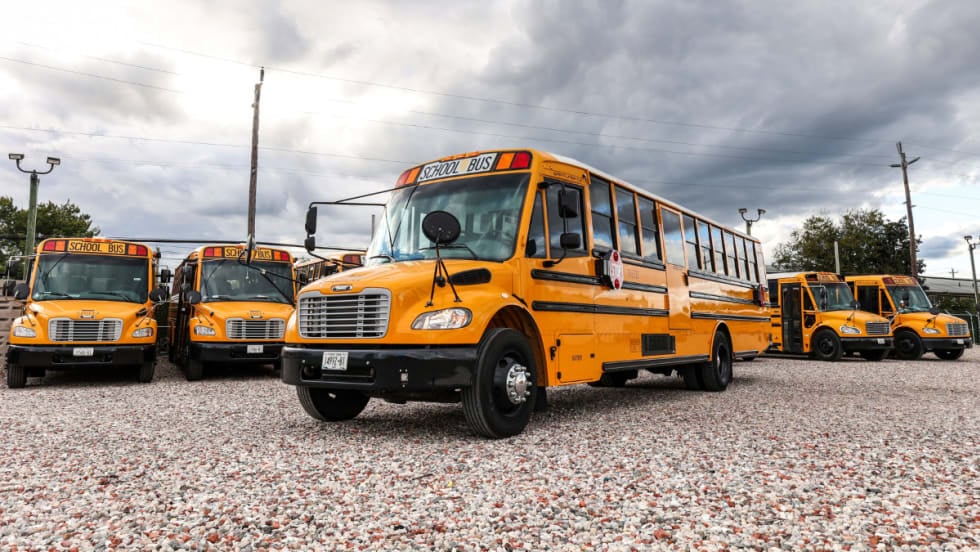
Logan Bus Company Rolls Out AI Phone System for NYC School Bus Families
A summer pilot found that AI agents could handle most routine calls, freeing up time for customer service staff to focus on emergencies and complex family concerns.
Read More →
From Intent to Impact: What I Learned About Leadership from TAPT
A Texas transportation supervisor shares lessons on self-awareness, accountability, managing stress and building trust — and why investing in leadership development matters at every stage of your career.
Read More →
NAPT Names 2026 Award Recipients, Hall of Fame Inductee
Who earned national recognition for their work in student transportation? This year, NAPT named five recipients of its 2026 awards for service, safety, and leadership, plus its newest Hall of Famer.
Read More →
2026 State of Student Transportation Report
Driver shortages. Rising costs. Growing safety expectations. More data, but not enough time to act on it. The 2026 State of Student Transportation Report reveals what transportation leaders say is putting the most pressure on their operations—and where they’re investing next. See how your priorities compare.
Read More →
How to De-Escalate an Angry Person: 5 Steps for Handling Workplace Conflict
What makes emotions run high, and how should you handle an angry colleague or parent? Follow these steps for staying calm, listening, showing empathy, and resolving conflict.
Read More →
What Readiness Looks Like This School Year
Learn about the challenges shaping the 2026–2027 school year, from persistent driver shortages and budget pressure to technology and readiness gaps. See how school districts are responding and adapting in Zonar’s 2026 Back-to-School Readiness Report.
Read More →