




6 Tips for Saving Water With Bus Wash Systems
Measures to cut water use while maintaining a clean fleet include brush systems, nozzle upkeep, and using foams and soap alternatives such as vehicle wash agents, suppliers say.

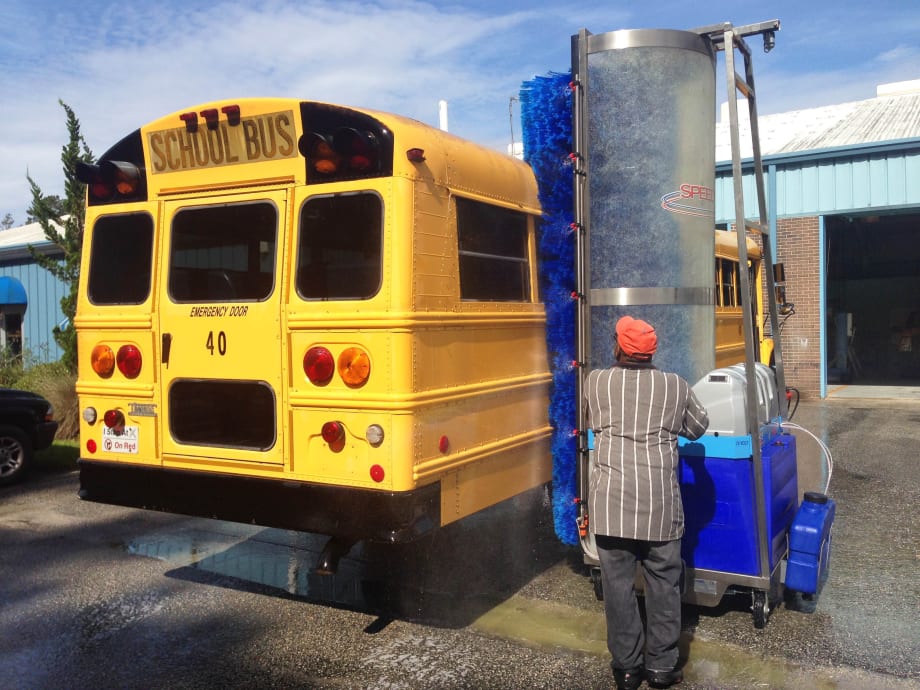
Bitimec’s 626-EZ saves more water by applying soap through misting circuits, which also use less soap. The system is shown here washing a school bus at Brunswick County Schools in Bolivia, North Carolina.
The drought in California, as well as other parts of the West Coast and Texas, has districts and school bus operators there thinking even more about water conservation.
However, many school bus operations are not currently reducing water use as much as they could, says Christian Murillo, office manager for Bitimec, because they’re washing buses by hand, with a garden hose or pressure washer, instead of using a bus wash system.
“The pressure washer’s great, but it wastes a lot of water and you don’t have a start and a stop,” he points out. “There is no limit to how much water you can use, whereas with the machines, it’s metered, calculated and adjustable. You don’t have to use a full blast. You can use half the pressure and still wash [the bus effectively]. The machine will only utilize the water it needs, and the brush is doing most of the work.”
1. Maintain, replace nozzles
Jack Jackson, president of Awash Systems Corp., says increased requests from customers in drought-stricken areas for advice on conserving water spurred the company to look at the nozzles on its systems to try to cut water consumption.
Awash resized its nozzles to a smaller diameter to use less water in response to the requests, and was able to reduce water use in the wash cycle by about one gallon per minute.
“There are two cycles: the wash cycle — putting soap on — and the rinse cycle — taking soap off,” Jackson explains. “On the wash cycle, it takes about two minutes to wash a bus and now requires as low as 4 gallons of water [instead of] 10 gallons. We found you don’t need to put as much water on with brushes spinning, because you’re basically just misting soap on the bus. Then when you do the rinse, we use five gallons of water a minute.”
Jeff Ross, president of Ross and White Co., says customers should be diligent about replacing the spray nozzles on their bus wash systems regularly to reduce water, because they wear down over time.
“[Some customers] might be using a lot more water than they need to because of worn nozzles. You can reduce the amount of water you use by having fresh nozzles and nozzles with a lower flow characteristic.”
2. Misting feature saves soap
Bitimec’s most water-efficient systems are its autonomous models: the battery-powered 626-EZ and the diesel-powered A225, says Bruno Albanesi, president of Bitimec. These systems save more water because they apply soap through misting circuits, which means using less soap, requiring less water to rinse it off.
“[The machines] use a quarter of the water that a normal nozzle would use, therefore using a quarter of the soap,” Albanesi says. “It works a lot more than throwing [soap] on and watching it run down the side of the bus.
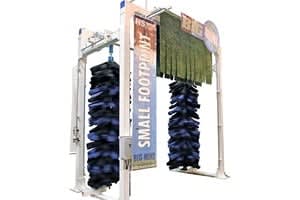
NS Corp. now offers in systems like its Big Mini, shown here, a detergent foam arch feature, which applies the chemical as a suds-like foam, and saves water because it stays on the bus longer.
3. Use new foam system
NS Corp. now offers detergent foam arch, which applies the chemical as a suds-like foam, a technique that is gaining popularity, according to Francis Tenggardjaja, executive vice president at NS Corp. The system injects the water with the chemical and mixes it with air to cut water use.
“You save a lot more water because the foam or suds will stay on the bus longer,” Tenggardjaja says. “When you spray the water and chemical, it runs down the bus right away. When you apply foam, it will stay on the surface longer because it doesn’t drip as fast. You can save between about 30% to 35% of the water just at the entrance of the bus.”
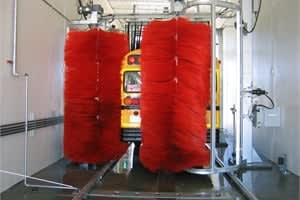
In recent testing, Ross and White Co. found that enzyme-based vehicle wash agents clean and rinse quickly, saving more water. Shown here is the supplier’s combination brush and touchless system.
4. Use vehicle wash agents
In Chula Vista, California, Ross and White Co. recently tested reverse osmosis for higher-quality recycled water to increase the amount of water its systems conserve and found that the most effective water-saving device in the project was an enzyme-based vehicle wash agent that cleans and rinses quickly.
“It’s not a typical soap-based product,” Ross says. “The trouble with a soap-based or surfactant-based product as a chemical in washing is that it’s not easy to rinse off the vehicle because it creates soap bubbles and you need a lot of water to rinse it off. Vehicle wash agents or enzyme-based products don’t require the same amount of rinse water.”
The supplier found that using the agents reduced rinse water by about 50%, which is significant, because rinsing water is usually the bulk of the process, Ross adds.
“If a normal rinse application might be 80 gallons a minute on a big drive-through system, you can get your water down to maybe 40 gallons a minute or even less by using a wash agent as opposed to a surfactant-based chemical or an alkaline-based soap.”
Ross sees the use of surfactant-based chemicals on the West Coast quickly dropping because enzyme-based products will fast replace them, he says.
5. Choose a brush system
Like Murillo, Awash’s Jackson says using brushes cuts the amount of water needed. Conversely, a touchless system requires significantly more water and chemical to clean the buses because there is no friction.
In fact, Jackson adds, the biggest advancement in bus wash systems is the use of brushes because they provide the friction needed to fully clean the bus.
“With today’s technology, you’re not scratching paint, damaging the finish or pulling the decals,” he says. “In the 1960s and 1970s, brushes were notorious for doing damage. Nowadays, they don’t. Your water consumption is minimal when you use a brush system.”
Jackson adds that touchless car wash systems need to use a lot more water because there’s no friction, only chemicals and water to clean the vehicle, and typically it doesn’t clean everything because there’s still a film of dirt it can never take off.
“What truly gets the dirt off is friction,” he says. “Today’s technology in friction will reduce water consumption by far more than any other system.”
Ross agrees. “The idea of a system that doesn’t use as much water drives you toward brushing the vehicle because it does a better job of cleaning and doesn’t require as much water to get a cleaner vehicle,” he says.
For brushing, NS Corp. mainly promotes Lammscloth, a synthetic type of fur, because it needs very little water to clean the bus, Tenggardjaja adds.
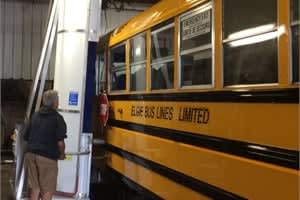
Awash Systems Corp. resized its nozzles to a smaller diameter to use less water in response to requests for water-saving tips from customers in drought-stricken areas, reducing water use by about 5 gallons per bus.
6. Wash more frequently
Jackson recommends washing daily, because then it takes less water to keep the bus clean.
“When vehicles are really dirty, it takes a long time to wash and you’re putting water on them for a long time. The bus needs to be in [the system] a lot longer to get cleaned and it needs more water,” he says. “If you wash them every day, it doesn’t take that long. Some people say if you wash it less often, you use less water, but the life of the vehicle is cut down, and you buy new vehicles more often.”
More Maintenance
The essential guide to school bus maintenance and student safety
Reactive maintenance puts students at risk of breakdowns, delays and roadside emergencies. This guide gives transportation directors a data-driven framework to predict failures, extend bus lifespans and improve fleet reliability across every route.
Read More →
The Evolution of DEF Header Technology: What School Bus Operations Should Know at Replacement Time
See what school bus fleets should consider when replacing DEF headers to improve reliability, reduce repeat repairs, and control maintenance costs.
Read More →
Kerry Brothers Grows Michigan School Bus Repair Network
The acquisition of Downriver Truck and Bus expands Kerry Brothers’ school bus maintenance footprint across southeast Michigan, adding repair capacity, diagnostic resources, and state inspection support.
Read More →
Noregon Introduces CAN Bus Diagnostic Tool, Expands JPRO Features
CAN Mentor and the latest JPRO update aim to simplify vehicle network diagnostics and improve repair efficiency for technicians of all experience levels.
Read More →
Cummins on Smarter, Simpler Engine Innovation
Cummins discusses its first-ever gasoline engine for school buses, EPA 2027, and why bus fleets still want durable, simpler internal combustion options.
Read More →
Report: 72% of Diesel School Buses Now Use Advanced Low-Emission Engines
New data shows advanced low-emission diesel technology continues expanding across school bus fleets, even as electric bus adoption gains momentum.
Read More →
Vampire Tools' CAIMAN 7.5-Inch Multi-Purpose Screw Extractor Long-Nose Pliers with Crimper
Vampire Tools introduced the VAMPLIERS Caiman 7.5-inch multi-purpose pliers, combining screw extraction, cutting, crimping, and gripping functions into a single tool designed for fleet maintenance professionals.
Read More →
How Advanced Diagnostics Helps Bus Fleets Stay Ahead of Repairs
Chat with Noregon’s Kevin Smallhorn at ACT Expo about bus diagnostic tools, telematics integration, CNG maintenance support, and strategies to help reduce downtime and improve uptime.
Read More →
How School Bus Fleets are Getting Ahead of Breakdowns
Don’t let bus downtime wear you down. Here’s how bus operators are shifting from manual processes to AI-powered, data-driven maintenance systems for improved reliability and safety.
Read More →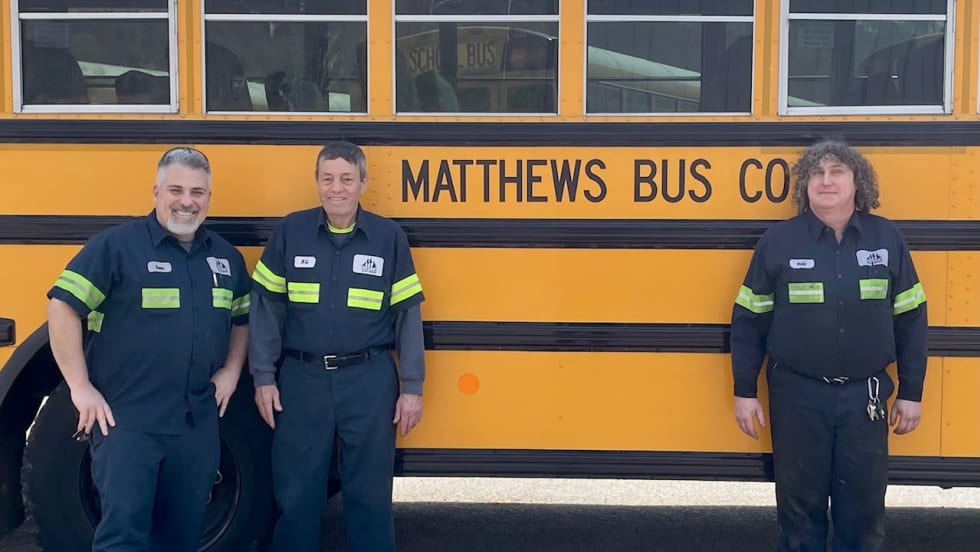
Pennsylvania School Bus Maintenance Team Praised for Dedication to Safety
Matthews Bus Company’s West Jefferson received a letter of commendation from the Pennsylvania State Police for their fleet inspections.
Read More →