




6 Steps to Prep for a New School Bus Program
East Aurora School District’s first transportation service has curbed student truancy and boosted safety. Here, the industry veteran hired to helm the program shares the setup process step by step.
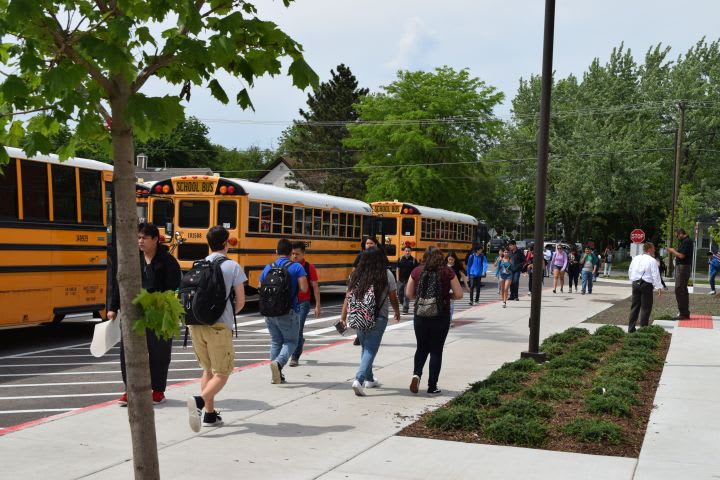
For the first time in at least 100 years, school buses are transporting students throughout East Aurora (Ill.) School District 131.
History was made on April 17, 2017, when the district’s seven-member board of education voted unanimously to add school bus transportation for general-education students.
East Aurora School District was one of 371 school districts not required to provide transportation among the 862 school districts in the state. Based on an old charter put together by the state 100 years ago, East Aurora had not provided school bus transportation before now, except for special-education, kindergarten, and preschool students.
The addition of school bus service was a big effort aimed at boosting student safety and attendance. Here’s how we launched the program, and what the results have been so far.
Targeting Truancy, Safety
East Aurora School District 131 is located about 40 miles west of Chicago. The district serves more than 14,000 students, of whom 87% are Latino and 75% are low income.
In January 2017, the East Aurora school board urged the administration to look into the possibility of providing student transportation, as their preliminary research projected that state reimbursements would cover the transportation costs without the need for a referendum or a tax increase.
Leaders throughout the district believed that reliable transportation would be key to lowering the chronic truancy rate as well as provide safety to students who had been walking to school during the Midwest’s inclement weather and interminable sub-zero winters.
Based on the state’s transportation eligibility criteria for students living more than 1.5 miles from their school of attendance, East Aurora district administrators estimated that roughly 3,000 students met the criteria and were eligible for busing. The school board members were pleased with the administration’s presentation and agreed that providing student transportation was a priority.
At the school board meeting on April 17, 2017, a contract for student transportation was awarded to First Student. This would complement the contract for special-education, kindergarten, and preschool transportation currently held by Durham School Services.
With the new contract awarded, East Aurora had to move quickly to prepare for the new service, which would start four months later, on Aug. 28. Here are the district’s six basic steps to preparing for the program’s launch.
1. Recruit a Transportation Director
With the impending launch of East Aurora School District 131’s new transportation service, the district had to hire a transportation director who could create and implement a system within two months and solicit support from all the stakeholders.
I joined the district and accepted the challenge of quickly developing a system and presenting the plan to all principals and district administrators. With little time to meet this challenge, our plan had to be structured, organized, and planned to minimize confusion and dispel fear of the unknown while maintaining districtwide confidence in our goal.
Unlike in real estate, where “location, location, location” is the key point, I knew our focus and success would be a result of “communication, communication, communication.” Adding to the challenge: This had to be accomplished during the summer, when most staff members were away.
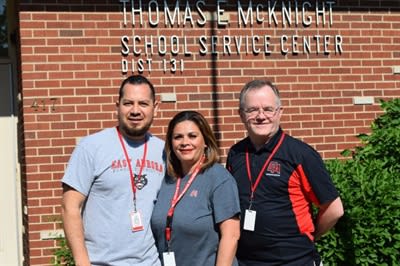
Assistant Director Walter Doughty (right) leads East Aurora’s transportation team, which includes José Juárez, transportation specialist, and Sonia Magana, transportation secretary.
2. Get Stakeholders on Board
Being new to East Aurora, I needed to perform due diligence to learn how each school building within the district functioned. Our schools’ communities look to the administration as the experts and counsel when seeking answers, so it was important to facilitate understanding and create confidence in the new plan. This confidence would transfer to school staff and then to student families and households.
I set up a meeting with our technology department to understand the transference of data from our student information system into our Versatrans routing software. An initial blueprint was presented to the district parent liaison employees to learn how our families would receive and process the information, which clearly addressed the who, what, when, where, why, and how questions.
Because East Aurora is an older urban school district (the first established in Illinois), there was no thought to school bus transportation planning in community or school design. Within our district, we have a public transit system, which provided the direction of roads and streets to assess for our forthcoming school bus routes. I was able to facilitate the elementary schools as true community bus stops to serve our eligible middle and high school students.
As our plan developed, my office continued to communicate, providing email updates to all principals so everyone would know how the process was unfolding.
Another important stakeholder community that needed to be informed was the Aurora Police Department, as they needed to understand the district’s organizational blueprint. Equally, we needed to understand their situation and position throughout the district as our partner for a successful “win-win.”
Internally, we added our central registration and student services departments to our team’s circle of communication. Our community relations office was instrumental in updating our website as well as sharing key elements on Facebook and Twitter for our followers.
3. Inform the Community
The third step was creating a community outreach campaign. This plan included multiple meetings in schools throughout our district.
Because many people are visual learners, we created a transportation pyramid and distributed it to all schools in the district. The pyramid (see below) comprises four triangles. There are three across the bottom, from left to right: a blue triangle for “home,” an inverted red triangle for “less than 1.5 miles — walking,” and a yellow triangle for “school.” The top green triangle represented “over 1.5 miles — bus rider.” Along the bottom of the pyramid is a roadway with the question, “What is the distance between your home and the school?”
To inform the community about the new transportation program, East Aurora held meetings during the day at six schools and in the evening at the high school, allowing families to attend the one that was most convenient for them.
Each meeting was preceded by a private information session for the district’s staff and personnel so they could be knowledgeable allies. Then the meetings opened with a “Welcome to Transportation” presentation, followed by the basic rules of transportation and eligibility, bus stop rules, whom to call, and parent supervision expectations.
Presentations were short and simple to maximize the hour timeframe and to ensure that questions were answered. A copy of frequently asked questions with answers was provided to all attendees, and electronic copies were forwarded to all schools.
4. Develop Routing Program
The fourth step in launching the new transportation service was a concerted effort to develop the routing software program, which required identifying schools’ attendance boundaries and walking boundaries, and the creation of bus route files.
A data file extracted from the student information system was developed for use in the routing program. Identifying eligible students, bus stop assignments, and route development followed, as the opening of school was quickly approaching.
Once the refinement of all details was completed, we were able to prepare for the creation and printing of eligible student transportation letters, which were scheduled to be mailed Aug. 8.
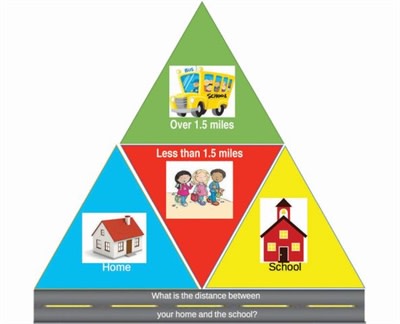
East Aurora created a transportation pyramid that illustrates student walking distance and school bus eligibility.
5. Enlist Buildings and Grounds Team
Step five involved East Aurora’s buildings and grounds department — a very important on-the-ground team player. In addition to its usual pre-opening preparations, this department was needed to help prepare school campuses for the transition to the new transportation system. The buildings and grounds team painted school curbs to accommodate the buses, and they marked separate bus lanes and private vehicle lanes to redirect logistical patterns.
6. Review Details Daily
Step six was the countdown. In the final phase of our preparation for opening day, it was paramount to conduct a daily review, making sure all of the details were taken care of.
We worked to answer questions as they arose and shared the latest communications regarding our transportation plan as we welcomed staff back to school. We eagerly anticipated opening day, confident that we were well prepared.
Successful Launch
I must commend the East Aurora School District 131 staff, households, and community, for they were all-stars in the transition process.
On Aug. 28, the new school bus service proceeded as smoothly as if the district had been providing transportation for decades. Lines of yellow school buses entering our high school, middle schools, and elementary schools were an impressive sight. An average of 1,400 East Aurora students rode the school bus per day in the first year of the new service.
Our schools’ environment has changed for the better, as our campuses are student-free just 10 minutes after dismissal. We have reduced the number of on-campus incidents between students after school, and we have experienced a 31% decrease in truancy.
Also, we were able to offer after-school transportation for middle and high school students who wished to join clubs, receive curriculum support, and participate in athletics.
As the inaugural year of transportation service drew to a close, East Aurora was very pleased with this new initiative, and we hope to expand the number of school bus stops and increase access to transportation services.
I am grateful for the opportunity to lead the transportation team at East Aurora. The new school bus service has benefited so many students and their families — and it will continue to benefit them in the years ahead.
Walter Doughty is assistant director of transportation for East Aurora School District 131 in Aurora, Illinois. He has more than 30 years of experience in pupil transportation. He can be reached atopsbusman@gmail.com.
More Management

How to Build a Better Driver Training Program
Ready to boost up your school bus instructor training? Here’s how to pick the right talent and improve recruitment, retention, and safety.
Read More →
CALSTART and Forth Combine to Form Catalyst Mobility
The new name represents a renewed vision for the nonprofit focused on advancing clean, equitable, and affordable transportation solutions that move people and goods.
Read More →
What Makes a Great School Bus Driver Trainer?
Choosing the right school bus driver trainer takes more than experience. Learn six keys to selecting and developing trainers and evaluating program effectiveness.
Read More →


School Bus Contractors Expand Through New Deals, Acquisitions & Partnerships
STA's Canadian division acquires Ontario-based G&L Stevenson Transport while Durham School Services adds a new district contract in California, First Student adds a New Jersey contract, and Minnesota Coaches acquires Halo Transportation.
Read More →
Logan Bus Company Rolls Out AI Phone System for NYC School Bus Families
A summer pilot found that AI agents could handle most routine calls, freeing up time for customer service staff to focus on emergencies and complex family concerns.
Read More →
From Intent to Impact: What I Learned About Leadership from TAPT
A Texas transportation supervisor shares lessons on self-awareness, accountability, managing stress and building trust — and why investing in leadership development matters at every stage of your career.
Read More →
NAPT Names 2026 Award Recipients, Hall of Fame Inductee
Who earned national recognition for their work in student transportation? This year, NAPT named five recipients of its 2026 awards for service, safety, and leadership, plus its newest Hall of Famer.
Read More →
2026 State of Student Transportation Report
Driver shortages. Rising costs. Growing safety expectations. More data, but not enough time to act on it. The 2026 State of Student Transportation Report reveals what transportation leaders say is putting the most pressure on their operations—and where they’re investing next. See how your priorities compare.
Read More →
How to De-Escalate an Angry Person: 5 Steps for Handling Workplace Conflict
What makes emotions run high, and how should you handle an angry colleague or parent? Follow these steps for staying calm, listening, showing empathy, and resolving conflict.
Read More →
What Readiness Looks Like This School Year
Learn about the challenges shaping the 2026–2027 school year, from persistent driver shortages and budget pressure to technology and readiness gaps. See how school districts are responding and adapting in Zonar’s 2026 Back-to-School Readiness Report.
Read More →