




6 Benefits of Utilizing a Driver as a Mechanic’s Helper
A school bus driver who assists in the shop can help improve communication, boost productivity, and increase safety, all while saving money for the transportation department.
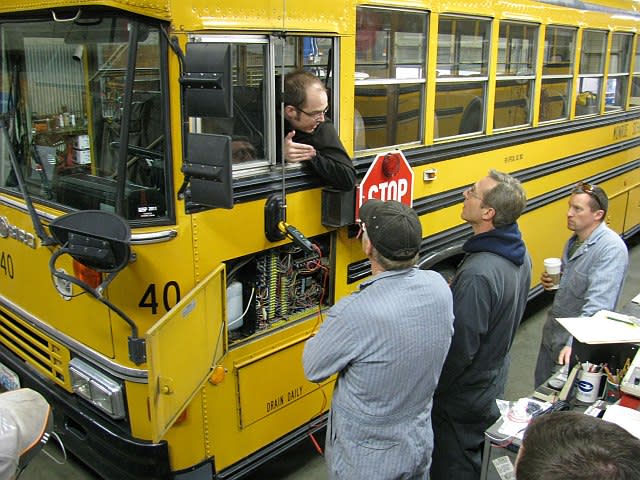
A school bus driver who also works in the shop can enhance communication between mechanics and drivers, keeping both abreast of vehicle particulars.
Photo courtesy Zonar
When structuring the workforce in a transportation department, there are numerous factors to consider. Without a doubt, safety for students and employees should be priority No. 1 and should never be sacrificed.
Beyond that, efficiency should be prominent on the list of priorities. On a superficial level, lowering the cost while getting more work done appears to be a simple math and numbers game. However, there are other factors, such as morale and direction of focus, that factor into the equation.
With these things in mind, we’ll examine six reasons why using a school bus driver as a mechanic’s helper can be beneficial to a transportation department. These benefits cover such areas as communication, economics, productivity, and safety.
1. Improving communication
When a school bus driver has an issue with a bus, it should be written up. That is simple in concept, but drivers and mechanics may not always understand the particular concerns of the other or exactly what they might be looking for.
For example, a driver may feel or smell something in a bus after two hours of driving, something a mechanic will not experience in a brief road test. On the other side, a mechanic may be dealing with issues that are more complicated and work-intensive than a driver realizes.
When a driver also works in the shop, there is potential for this communication to be enhanced. Perhaps more than anyone else, the driver who also serves as a mechanic’s helper experiences both sides of the garage wall and can keep mechanics and drivers abreast of vehicle particulars and what other team members are doing.
Additionally, other drivers might feel more comfortable talking to a fellow driver than a regular maintenance staff member. This can provide more opportunity for questions, feedback, and learning.
2. Saving money
Here we shift our focus more to the math and numbers aspect of what creates efficiency. Is it possible to spend less money and complete the same amount of work, or even more work? By utilizing a mechanic’s helper, the answer is yes.
To illustrate this concept, we’ll consider two transportation departments. One has five mechanics and no helper, while the other has four mechanics plus one helper.
Obviously, the labor expenses of the first department are greater: paying five mechanics’ wages plus five correlating sets of benefits.
The second department can pay its fifth worker, the mechanic’s helper, a lower rate, and as a part-time worker that helper can save significant money in benefits. At the same time, the driver who serves as a mechanic’s helper is given an opportunity to work more hours and supplement his or her income.
An added bonus of using a driver is that no additional hire needs to be made, thus saving money in licensing, clearances, and other administrative costs.
3. Contributing to productivity
On the other side of the equation, a mechanic’s helper can maintain or increase the shop’s work output. It is possible for the helper to lighten the workload for some or even all of the other mechanics by assisting them in their work or performing separate tasks altogether.
When a helper is effective in limiting distractions and taking care of relatively menial tasks, the mechanics are unbridled and, as a result, can be more productive.
4. Focusing on specific tasks
Mechanics have an array of issues to deal with. They are often responsible for a large number of vehicles. Inspection, repair, and maintenance are incessant. Unpredictability can never truly be eradicated, no matter how new or well maintained a fleet may be. By nature, a mechanic must be able to perform many tasks well.
By contrast, a helper may actually have a greater opportunity to become a specialist. As opposed to focusing on particular buses, focus can instead be placed on particular tasks. Examples could be seat repair, light replacement, fluid checks, or ensuring that paperwork is up to date in each vehicle. A mechanic may have exceptional ability but, by nature of the job, may lack the opportunity to focus on specific areas like a helper can.
By focusing on a particular task and learning its intricacies, a helper may become quite skilled. He or she may also devise methods to enhance efficiency. For example, creating a station to add diesel exhaust fluid, washer fluid, coolant, and motor oil in one spot can save time compared to doing each individually
5. Increasing bus safety
A respected mentor once told me that the ultimate goal of everything we do in the shop is making it safer for the students. I took his words to heart, and that philosophy is one that I always keep, whether pursued through direct or indirect means.
For school bus drivers, safety is No. 1. For someone working in the garage, the means may change, but the goal is the same.
As a mechanic’s helper, working directly on buses can certainly make them safer. Ensuring the structural integrity of seats, functioning of brake lights, and proper labeling and function of emergency exits, among many other items, enhances the safety of our students.
However, there is more to it than that. For one thing, having someone walking through the bus yard for various tasks gives you an extra set of eyes and ears — and even a nose.
Despite being in the yard for a totally unrelated reason, the mechanic’s helper might happen to spot a loose axle bolt, hear a crossing arm motor running, or notice coolant leaking onto the ground. Such incidental catches can help save time and money in addition to preventing a safety risk. They shift the paradigm from being reactive to being proactive.
A mechanic’s helper who is also a driver may get to know fellow drivers and their traits and tendencies, which can further the helper’s knowledge of what to pay attention to on particular vehicles.
6. Boosting shop safety, cleanliness
A mechanic’s helper can enhance safety in another, more indirect way. By assisting mechanics, particularly during busy periods, a cleaner and safer environment can be maintained. Simple tasks such as taking out trash, sweeping the floor, or cleaning a work area can go a long way in ensuring that others have a safe and clean place to work.
Additionally, performing tasks such as filing papers or mounting tires can reduce the mental and physical fatigue on mechanics. This can reduce the chances of them making a mistake or getting injured. As a result, the mechanics are able to perform their jobs more effectively, which ultimately leads to the enhanced safety of students.
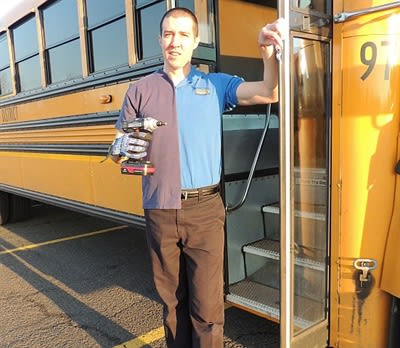
For the mechanic’s helper, getting to know fellow drivers and their tendencies can reveal what to pay attention to on particular vehicles.
Photo by John Horton
Strong potential
Every transportation department is unique in terms of structure, dynamics, and personnel. Because of this individuality, whether to use a school bus driver as a mechanic’s helper is not a one-size-fits-all decision.
Of course, you must be able to identify a driver with certain physical abilities and an appropriate temperament for the work. In turn, the design of the shop can impact how effective a helper can be.
The answer is not about absolutes but potential. With the right conditions, the potential exists to efficiently and economically increase productivity in the shop while simultaneously enhancing safety. The potential for that highly sought combination is certainly worth considering.
About the Author: Larry Hannon Jr. is a school bus driver for Centennial School District in Warminster, Pennsylvania. He also competes in local and state school bus safety competitions. His father, Larry Hannon Sr., has been driving for Centennial for more than 40 years and has placed first at the School Bus Driver International Safety Competition nine times.
More Maintenance
The Essential Guide to School Bus Maintenance and Student Safety
Your district's buses carry students to school every day. This guide shows how predictive maintenance powered by fleet data helps keep buses reliable, drivers accountable and students safer from the first bell to the last stop.
Read More →
Kerry Brothers Grows Michigan School Bus Repair Network
The acquisition of Downriver Truck and Bus expands Kerry Brothers’ school bus maintenance footprint across southeast Michigan, adding repair capacity, diagnostic resources, and state inspection support.
Read More →
Noregon Introduces CAN Bus Diagnostic Tool, Expands JPRO Features
CAN Mentor and the latest JPRO update aim to simplify vehicle network diagnostics and improve repair efficiency for technicians of all experience levels.
Read More →
Cummins on Smarter, Simpler Engine Innovation
Cummins discusses its first-ever gasoline engine for school buses, EPA 2027, and why bus fleets still want durable, simpler internal combustion options.
Read More →
Report: 72% of Diesel School Buses Now Use Advanced Low-Emission Engines
New data shows advanced low-emission diesel technology continues expanding across school bus fleets, even as electric bus adoption gains momentum.
Read More →
Vampire Tools' CAIMAN 7.5-Inch Multi-Purpose Screw Extractor Long-Nose Pliers with Crimper
Vampire Tools introduced the VAMPLIERS Caiman 7.5-inch multi-purpose pliers, combining screw extraction, cutting, crimping, and gripping functions into a single tool designed for fleet maintenance professionals.
Read More →
How Advanced Diagnostics Helps Bus Fleets Stay Ahead of Repairs
Chat with Noregon’s Kevin Smallhorn at ACT Expo about bus diagnostic tools, telematics integration, CNG maintenance support, and strategies to help reduce downtime and improve uptime.
Read More →
How School Bus Fleets are Getting Ahead of Breakdowns
Don’t let bus downtime wear you down. Here’s how bus operators are shifting from manual processes to AI-powered, data-driven maintenance systems for improved reliability and safety.
Read More →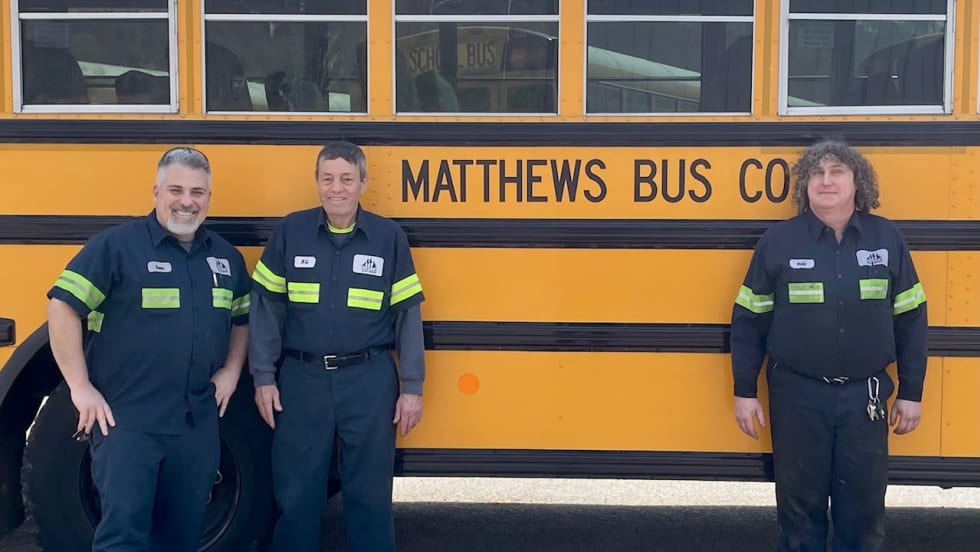
Pennsylvania School Bus Maintenance Team Praised for Dedication to Safety
Matthews Bus Company’s West Jefferson received a letter of commendation from the Pennsylvania State Police for their fleet inspections.
Read More →
From Chaos to Clarity: How School Districts Are Running Leaner Transportation Operations
Covering 38 routes on a Friday afternoon. Buses idling while routes overlap. Parents calling nonstop about late arrivals. Sound familiar? This whitepaper explores how district transportation leaders solved these exact problems — and what measurable results followed.
Read More →