




5 Tips to Streamline Parts Inventory Management
Managers say setting up a barcoding and scanning system, fleet standardization and daily tracking of pricing have been indispensable practices. Additionally, good housekeeping and strategic organizing expedite jobs.

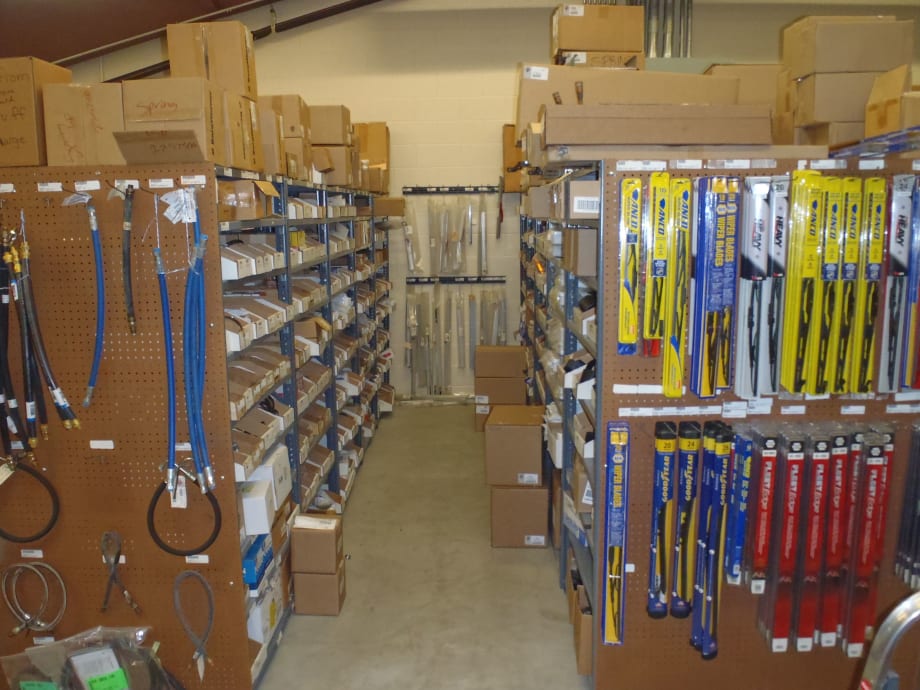
Spring ISD reorganized its two-story parts room last year and now groups fast-moving parts in one area for quicker access.
A school bus maintenance shop is comprised of multiple moving parts that a transportation department cannot thrive without. When a bus needs to be repaired, time is of the essence, so having a smooth-running procedure in place is critical, and that includes seamless parts inventory management.
When a bus breaks down, that sets off a chain of events that impacts several departments, says Jerilynn Boling, vehicle maintenance parts manager of School District of Manatee County in Bradenton, Florida. The parts department has to locate the part needed for the job, which sometimes involves contacting the vendor, who has to order and ship the part. When the shop receives it, they have to get the part to the technician, who has to make the repair and get the bus back on the road as quickly as possible. Then the parts department has to ensure the invoice has the proper coding so funds come from the correct account and tracking of expenditures is accurate.
Boling compares her department to an auto parts store, pointing out that they handle all the steps in this process, from obtaining the parts, to handling the paperwork, to working with the clerical office.
1. Set up a barcoding and scanning system
Boling says her staff adopted a barcoding system to better track parts and make reordering more efficient. After moving into a new, larger building a few years ago, Boling’s department benefited from a new room and used it to set up several filing cabinets to better accommodate the system.
The district uses a tracking system created by RF-SMART, with Oracle’s JD Edwards One World barcoding system, Boling says. Parts department staff members create labels with barcodes and numbers assigned to every part and scan them into the system. Typing a number printed on a part label into the system shows the part name, location, whether it’s specific to a brand of bus, how many are on hand and the reorder points.
The system can automatically generate reorder points, but Boling chooses to set them herself, based on parts turnover. She notes that special projects and seasonal jobs need to be taken into account.
For example, over last summer, the shop replaced lenses on 30 buses to make sure they were up to standard before school started, Boling explains. “If we use 30 of [a part] and let [the system reorder], we’d have 30 on the shelf forever, so I generate the minimum and the maximum levels of inventory."
The system is also helpful when upgrading the fleet and switching out vehicles because the department can code parts based on what brands of bus they go with using a VMRS (Vehicle Maintenance Reporting Standards) code. “I can pull reports [using] that,” she says. “If I get rid of the oldest buses here, the 2001 Thomas Built buses, it will pull up all the Thomas parts on those and then not order more, because they’re going to go to auction.”
Additionally, the entire school district uses the software system, so other departments, such as accounting, also have access to the information, Boling says.
2. Standardize your fleet
Parts inventory starts with standardizing the fleet rather than the parts, says Kevin Kreitz, shop foreman for Spring Independent School District in Houston.
“People tend to look at parts [first], but you really need to look at your fleet,” Kreitz notes. “That helps more than anything with your parts inventory because instead of needing six starters or alternators, you [may] only need three. You also have to look at the age of your fleet and how many spare [buses] you have. That drives what you need [in] your inventory.”
His shop uses Ron Turley & Associates’ RTA Fleet Maintenance, a software package that tracks parts and features scheduled maintenance reminders to restock parts and create reports. The software enables Kreitz’s department to do cycle counts on fast-moving parts weekly, conduct a monthly cycle count randomly of parts bins, and perform a complete wall-to-wall inventory annually.
Kreitz suggests sticking to one brand and model of bus — his transportation department uses International buses — as much as possible. Keep the bus specs as similar as possible from year to year to simplify the process and only deal with two types of engines, and the same brakes, slack adjustors and camera systems, he adds. The process is especially helpful for special-needs buses in keeping the same wheelchair lifts, tie-downs and seats uniform throughout the fleet.
A commenter in the SBF forum Professional Garage agrees. “I try and stay with the same chassis and body [so I] don’t have a lot of parts to deal with.”
Keeping the fleet standardized also keeps parts costs and inventory levels down, saving time and money, Kreitz notes.
He adds that while many districts select the lowest bid when buying buses and may initially save money, that can lead to “a fleet with a dozen different brands and styles of buses, and it gets to be a parts nightmare.”
3. Practice good housekeeping
Boling makes housekeeping a habit in her department not only to keep it running smoothly, but, with taxpayers in mind, to show that the district optimizes its resources.
When staff members are caught up on priority work, they dust the shelves in the back room and front room, she says. In March, during spring break, staff members clean all the shelves from top to bottom and print new labels to replace ones that have become dirty and worn.
“We try to keep our parts room well organized and clean,” Kreitz adds. “This helps with taking inventory and keeping a close eye on your fast-moving parts.”
[PAGEBREAK]
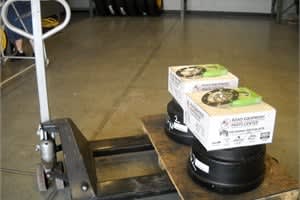
Since brake drums are heavy, School District of Manatee County’s parts department places them on palates with the corresponding brake shoes located on shelves directly above them.
4. Track pricing daily, work with vendors for good deals
Kreitz and Boling also both recommend working with vendors as often as possible to help keep costs down.
“We check our pricing every day, so if we see [a change in the price of a part,] we’ll call the vendor and say, ‘Last time it cost this much. Why does it cost this much [now]?’” Boling explains. “It could be a glitch in their system or a price increase. We keep a log of what our savings are from [switching] vendors.”
Many vendors will also stock parts on their shelves so shops don’t have to, and depending on them to stock the parts can make life easier, according to another SBF forum commenter.
“We buy as much as we can locally. We are fortunate to have a good parts store in town that will keep inventory for more than just cars. By using them we don’t need to stock ‘standard’ things. But, there are so many dealer-only parts that we try to keep on hand only things that can be replaced quickly to get back in service. This makes us depend on the spare buses more often while we order parts to make major repairs.”
Kreitz also advises that when writing a bid spec for parts, make sure to request twice-a-day deliveries to keep up with daily demand. What’s unique about the school bus business, he explains, is because the buses come and go in the mornings and evenings, technicians need parts throughout the middle of the day for repairs.
5. Organize parts strategically
Spring ISD reorganized its two-story parts room last year to make it easier to look them up instead of having them scattered throughout the system. Staff now organizes parts by sections in bins, such as for electrical parts, and engine parts are grouped by engine type. “You don’t want some parts downstairs, and you’re also trying to pull parts from upstairs for the same motor when you can have them in the same area,” Kreitz explains. “It helps when the parts man has to pull them for a mechanic.”
Additionally, Drew Bakke, parts manager for Spring ISD, has placed fast-moving parts in one area for faster access.
Since brake drums are heavy, Boling says her staff has them set up on palates with the corresponding brake shoes located on shelves directly above them in the back room, ready to roll out the door, which saves time. “We just wheel them out to the technician for the brake job,” Boling explains.
In the department’s former building, Boling says, staff used an elevator to deliver brake drums, which were stored upstairs. “You were breaking your back, coming down the elevator to run out [with the brake drums] on a cart to the mechanics. It has come a long way.”
More Maintenance
BendPak Launches Ranger DST30PX Wheel Balancer
BendPak's new wheel balancer handles tires up to 43 inches in diameter, with a reinforced design, precise weight placement, and faster service cycles.
Read More →
Tips for Ensuring School Bus Garages Are Safe and Warm Year-Round
Cold maintenance bays and rising heating costs? Learn how school bus garages can improve comfort with targeted heating, better airflow, and winter preparation.
Read More →
ASE Highlights School Bus Technician Certification Requirements
ASE is encouraging school bus maintenance professionals to maintain their certifications, highlighting seven specialized tests and five-year renewal requirements.
Read More →
International Adds E-Commerce Capabilities to Fleetrite.com
IC Bus customers can now browse, buy, and track shipments for more than 400,000 aftermarket parts online.
Read More →
The Most Expensive Thing You Do Before Selling a School Bus: Wait
When should you sell an aging school bus? Learn how maintenance, mileage, corrosion, specifications, and timing can affect resale value long before the auction.
Read More →
The Evolution of DEF Header Technology: What School Bus Operations Should Know at Replacement Time
See what school bus fleets should consider when replacing DEF headers to improve reliability, reduce repeat repairs, and control maintenance costs.
Read More →
The Essential Guide to School Bus Maintenance and Student Safety
Your district's buses carry students to school every day. This guide shows how predictive maintenance powered by fleet data helps keep buses reliable, drivers accountable and students safer from the first bell to the last stop.
Read More →
Kerry Brothers Grows Michigan School Bus Repair Network
The acquisition of Downriver Truck and Bus expands Kerry Brothers’ school bus maintenance footprint across southeast Michigan, adding repair capacity, diagnostic resources, and state inspection support.
Read More →
Noregon Introduces CAN Bus Diagnostic Tool, Expands JPRO Features
CAN Mentor and the latest JPRO update aim to simplify vehicle network diagnostics and improve repair efficiency for technicians of all experience levels.
Read More →
Cummins on Smarter, Simpler Engine Innovation
Cummins discusses its first-ever gasoline engine for school buses, EPA 2027, and why bus fleets still want durable, simpler internal combustion options.
Read More →