





5 Tips for Electric School Bus Training with First Responders
5 Questions: Gerald "Stretch" Blackard on Life with a Sub-Zero Electric Bus
In the tiny Alaskan town of Tok, Blackard and his wife Sara run a transportation company that includes a Thomas Built Saf-T-Liner C2 Jouley electric school bus that runs even when temperatures fall to -71 degrees Fahrenheit.
December 27, 2021
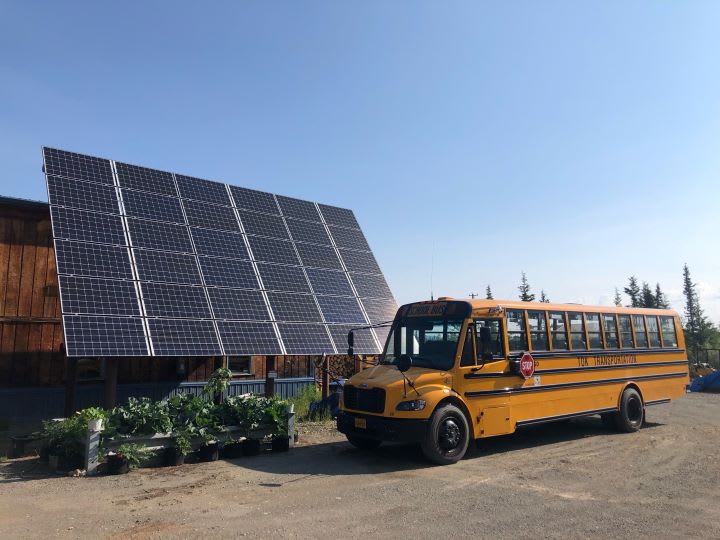
The Thomas Built Saf-T-Liner C2 Jouley carries up to 87 students to Tok School and manages to perform well even when temperatures fall into the negatives.
Photo: Gerald "Stretch" Blackard
3 min to read

Gerald “Stretch” Blackard and his wife Sara run Tok Transportation in a tiny Alaska town.
Photo: Gerald "Stretch" Blackard
Gerald “Stretch” Blackard and his wife Sara moved to the tiny Alaskan town of Tok from his native western Colorado about 11 years ago. In 2017, they purchased Tok Transportation, which has been providing school bus services to Tok School since the 1980s. The company carries up to 87 students on a school day. Last year, the Blackards acquired the town’s first electric bus and got to see first-hand how it performs in sub-zero temperatures. The bus was partially paid for with funds from a program run by the Alaska Energy Authority.
In this interview with School Bus Fleet, Stretch Blackard talks about his experiences with the Thomas Built Saf-T-Liner C2 Jouley and shares advice for other school transportation leaders considering the shift to electric.
1. What concerns did you have about purchasing an electric bus for a town where temperatures can drop to -71 degrees?
The biggest concern I had before receiving the bus was keeping the interior warm. School buses are not very well insulated.
2. How has the Thomas Built Saf-T-Liner C2 Jouley performed since it joined your fleet in Tok?
The bus has performed well. There is a bit of a learning curve going from diesel bus to electric. The electric motor, shifting, and brakes are different.
3. What kind of maintenance or pre-ride prep work is required for the Jouley, especially when it gets so cold? What challenges arise when you’re balancing heating the passenger cabin against prolonging power in the battery?
As part of daily pre-trips, there is nothing different from warmer days. We have put insulation around the battery, covered the front grill vent, wrapped under the engine bay with insulation. This week we insulated the electric heaters to keep them from losing as much heat to the outdoors. Driver comfort is the biggest factor that affects battery usage on days with temps between 30 F to -20 F. We can have a 1kw per mile change in battery usage between drivers. When we get temps below -20 F the usage doesn't change much. The bus uses more electricity to heat than all other circuits combined.
4. What advice do you have for school districts – regardless of climate – that are considering the purchase of electric buses for their fleets?
I think the most overlooked concern is the effect driver habits and comfort have on consumption. Every fleet manager knows the effect an aggressive driver has on a conventional diesel or gas bus: poor mileage, brakes worn faster, drivetrain damage, etc. With our electric bus, the regenerative braking works very well so brakes have become less of an issue, acceleration would be a similar issue as a conventional bus. Like I said previously, the driver comfort level has been our biggest factor.
5. What sort of charging infrastructure do you use?
We use an ABB 22KW charger on 240v.
Subscribe to Our Newsletter
More Alternative Fuels

CALSTART and Forth Combine to Form Catalyst Mobility
The new name represents a renewed vision for the nonprofit focused on advancing clean, equitable, and affordable transportation solutions that move people and goods.
Read More →
Alt-Fuel Moves: New Buses, Charging Hubs & Real-World EV Testing
Propane and electric school bus deployments continue to grow as districts add new vehicles, expand charging infrastructure, and gather more real-world operating data.
Read More →
Fewer Electric School Bus Models Reshape the U.S. Market
WRI’s latest buyer’s guide points to a consolidating electric school bus market, but fewer options may reflect a maturing industry rather than fewer meaningful choices for school bus operators.
Read More →
The Fuel Budget You Can Actually Predict: How Propane Autogas Keeps Money in the Classroom
Learn how propane autogas helps school districts manage fuel costs with predictable pricing, lower maintenance, and reduced emissions from former transportation director Joel Stutheit.
Read More →
Hendrickson, Driventic Introduce New Electric Powertrain for School Buses
ELECTRAAX, the electrified, lightweight drive axle offers integrated ePowertrain efficiency and modular flexibility for Class 6–7 school bus use.
Read More →
The Mobility House Joins PowerFlex in Fleet Electrification Deal
The acquisition combines intelligent charging software, bidirectional charging expertise, and fleet electrification services to support the growing adoption of electric school buses across North America.
Read More →
Alt-Fuel Moves: Electric School Bus Investments Hit the Road
See which districts across the U.S. are putting electric school buses into service, expanding charging infrastructure, and planning the next phase of fleet electrification.
Read More →
With Fuel Volatility Ahead, School Districts Turn to Propane
While diesel prices peaked above $5 this spring, districts with propane autogas-powered fleets paid under $2 per gallon, according to PERC.
Read More →
EPA Unveils Proposed Changes to 2027 Heavy-Duty Engine Rules
The federal agency has proposed changes to next year’s targets that would eliminate DEF derates, ease warranty requirements, and retain current NOx emissions standards.
Read More →
Alt-Fuel Moves: EV Charging & Infrastructure Projects Gain Momentum
The latest developments include new funding, charging infrastructure, utility investments, and fleet technologies designed to support the transition to electric school buses nationwide.
Read More →