




5 Questions: Arby Creach on Effects of Hurricanes, Improving Economy
The president of the Florida Association for Pupil Transportation discusses how the state's school bus systems are working to transport students displaced by last year's hurricanes.


Arby Creach, president of the Florida Association for Pupil Transportation, says that districts in the state are working hard to provide transportation for relocated students.

Arby Creach, president of the Florida Association for Pupil Transportation, says that districts in the state are working hard to provide transportation for relocated students.
Students displaced by last year’s hurricanes and an ongoing shortage of school bus drivers are putting pressure on Florida’s school bus systems, forcing districts to get creative with routing and scheduling. That’s one of the insights shared in this discussion with Arby Creach, president of the Florida Association for Pupil Transportation (FAPT) and director of transportation services for Brevard Public Schools on the state’s Space Coast.
1. Are some school districts in Florida still dealing with after-effects of last fall’s hurricanes?
Yes. Many districts, especially in the Keys, south, and central parts of Florida, are still suffering significantly from the storm effects, particularly from Hurricane Irma. Due to the extensive and widespread damage from high winds and water, thousands of homes were severely damaged enough that they became uninhabitable and/or have been condemned.
Many of the families whose homes became uninhabitable were relocated by FEMA [the Federal Emergency Management Agency] to local hotels and other temporary (now long-term, in some cases) shelters. Too many are still waiting to return to their homes. The ongoing effect on the school districts involved is the immense challenge of finding adequate additional funding resources, school buses, and drivers to provide transportation to the relocated students. Transportation to the student’s school of origin is mandatory, even if the student was relocated by FEMA far from his or her original school zone.
For purposes of efficiency, most districts in Florida use a triple-tier student delivery system to maximize school bus utilization. Each bus is typically required to service as many as three schools.
The challenges of providing transportation to scattered families across multiple school zones to schools all across the district are monumental. The service simply will not fit the typical three-tier bus transportation system and is therefore highly customized. Often, very few students ride these customized route buses each day, so it is very inefficient and extremely costly to a district.
The Orange and Osceola school districts in central Florida, as well as some other districts in the south part of the state, continue to be highly challenged for transportation resources. They are struggling to provide school transportation service to the thousands of students that were evacuated from Puerto Rico after the hurricanes devastated the island and their homes. A very large number of the evacuees moved in with families and friends in the greater Orlando area, which caused a sudden spike in school bus ridership. Due to the unanticipated significant increase in student enrollment, both districts are working very hard just to make sure that the students get to school every day.
2. What are some other key issues for school transportation in Florida?
Currently, the transportation directors of all 67 districts in Florida are carefully watching a new piece of legislation that has recently been introduced. The bill would reduce the long-standing 2-mile student walk limit to 1.5 miles. Additionally, it would increase hazardous walking protections to all K-12 students. In Florida, hazardous walking protections for transportation purposes are currently for K-5 students and sixth-grade students when sixth grade is part of a primary grade school.
While a great safety enhancement for Florida students, if the bill passes in its current form it will require almost every district in Florida to add a significant number of school buses to the road each day. Here in Brevard, we would be required to add approximately 100 buses, as we have an additional 10,000 to 13,000 students who would suddenly become eligible for transportation.
In a quick FAPT survey of about 30 districts, just how big the number of additional buses that will be required became very apparent. The approximate sum total from just the 30 districts that participated in the survey was about 1,750 buses.
While absolutely great news for students, individual districts will be held responsible for compliance and will shoulder the majority of the expense if this legislative effort is passed.
Another key issue for Florida is the seemingly endless need for quality bus drivers. Very high standards, low pay, and nonstandard work days are huge obstacles to recruiting and retaining drivers. A continuing improved economy makes it very hard to fill driving vacancies, as private companies are offering higher wages and at least a standard eight-hour work day. Districts are responding by becoming very creative in the routing and scheduling process as they maximize student loading and combination of routes to fill daily driver vacancies.
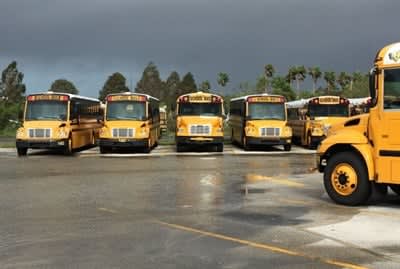
Next school year, Brevard Public Schools will add 35 buses for the reinstatement of transportation to schools of choice. Fortunately, the district’s fleet wasn’t damaged by Hurricane Irma last fall.
3. What are you currently working on with FAPT?
In addition to closely monitoring the changing scope of Florida’s legislative law process, FAPT is creating a new Florida motor vehicle specialty license plate to promote safe student transportation. Our goal is to design a plate that will raise awareness among motorists that when a school bus makes a pupil stop, they must follow the law and stop as well. We are very excited about the prospect, and we have a professional graphic designer working on several different ideas.
FAPT is also deep in the summer conference planning process with the Southeastern States Pupil Transportation Conference (SESPTC). We are very excited to share a rare opportunity for FAPT and SESPTC to join resources and create an outstanding summer conference. This year, the conference will be held at the world-renowned Saddlebrook Resort in Tampa, Florida, July 8-11. The conference covers all facets of student transportation but is primarily focused on student safety initiatives. The highlight is always the exciting and informative trade show.
4. Are there any recent developments at Brevard that you’d like to discuss?
A very important event that is happening here in Brevard is the reinstatement of transportation service to our schools of choice. The local economy of Brevard took a tremendous loss when NASA’s last space shuttle blasted off from Cape Canaveral on July 8, 2011. The end of the shuttle program signaled a downturn in jobs and spelled local economic disaster, as hundreds of NASA workers and support contractors packed up and left the county.
For the very first time, there was an overabundance of bus driver applicants, especially in the north end of our 72-mile-long district, where the Kennedy Space Center is located. Good for transportation, but not good for those families directly impacted by the downturn.
School districts in Florida receive a very large percentage of their operational dollars from the local economy and home ownership taxes. As such, Brevard Public Schools suddenly found itself short on funding. Vacant and foreclosed homes flooded the market, and without large numbers of major manufacturing opportunities or business enterprises to rely on for tax revenue, the district had to act quickly to reduce costs and balance a dwindling strategic reserve of funds.
One of the reductions was the end of the school choice transportation program, which was forecast to remove 35 buses from the road and save the district almost $2 million per year. The cancellation of the program was approved by the board, and when school began in 2012, there were no longer school buses providing transportation service for our out-of-zone choice students.
Over the past five years, the private space industry has taken root in the area and has reduced some of the economic sting from the loss of the shuttle program. There are new jobs being created, and tourism and real estate have improved. With economic stability returning, there recently came a call for the reinstatement of choice busing.
After some very detailed cost projections, the board decided it was time once again to provide more opportunities for students to take a broader range of classes at our choice schools by providing district-wide bus service. We are very pleased that beginning with the 2018-19 school year, the district will add 35 buses to support district-wide transportation to the schools of choice.
5. What was the highlight of 2017 for you?
The personal highlight for me was the birth of my very first grandson. Killian Nicholas was born on Feb. 2, 2017. What tremendous joy he has brought to our lives. Now I just have to figure out how this grandparent thing works!
Professionally speaking, I took over the reigns as the president of FAPT last year. What a tremendous honor to work with one of the most professional and knowledgeable groups of transportation directors in the nation. Florida directors are often called upon by transportation professionals from other states and OEMs for research purposes or for their technical expertise. Our FAPT members are always willing and typically able to help with any transportation project, issue of concern, or operational/maintenance campaign to keep our students safe as we travel millions and millions of miles each year.
More Management

How to Build a Better Driver Training Program
Ready to boost up your school bus instructor training? Here’s how to pick the right talent and improve recruitment, retention, and safety.
Read More →
CALSTART and Forth Combine to Form Catalyst Mobility
The new name represents a renewed vision for the nonprofit focused on advancing clean, equitable, and affordable transportation solutions that move people and goods.
Read More →
What Makes a Great School Bus Driver Trainer?
Choosing the right school bus driver trainer takes more than experience. Learn six keys to selecting and developing trainers and evaluating program effectiveness.
Read More →


School Bus Contractors Expand Through New Deals, Acquisitions & Partnerships
STA's Canadian division acquires Ontario-based G&L Stevenson Transport while Durham School Services adds a new district contract in California, First Student adds a New Jersey contract, and Minnesota Coaches acquires Halo Transportation.
Read More →
Logan Bus Company Rolls Out AI Phone System for NYC School Bus Families
A summer pilot found that AI agents could handle most routine calls, freeing up time for customer service staff to focus on emergencies and complex family concerns.
Read More →
From Intent to Impact: What I Learned About Leadership from TAPT
A Texas transportation supervisor shares lessons on self-awareness, accountability, managing stress and building trust — and why investing in leadership development matters at every stage of your career.
Read More →
NAPT Names 2026 Award Recipients, Hall of Fame Inductee
Who earned national recognition for their work in student transportation? This year, NAPT named five recipients of its 2026 awards for service, safety, and leadership, plus its newest Hall of Famer.
Read More →
2026 State of Student Transportation Report
Driver shortages. Rising costs. Growing safety expectations. More data, but not enough time to act on it. The 2026 State of Student Transportation Report reveals what transportation leaders say is putting the most pressure on their operations—and where they’re investing next. See how your priorities compare.
Read More →
How to De-Escalate an Angry Person: 5 Steps for Handling Workplace Conflict
What makes emotions run high, and how should you handle an angry colleague or parent? Follow these steps for staying calm, listening, showing empathy, and resolving conflict.
Read More →
What Readiness Looks Like This School Year
Learn about the challenges shaping the 2026–2027 school year, from persistent driver shortages and budget pressure to technology and readiness gaps. See how school districts are responding and adapting in Zonar’s 2026 Back-to-School Readiness Report.
Read More →