




25 Events That Shaped School Transportation
How did we get where we are today? Change has been driven by advances in technology, mounting safety concerns and tragedy. Let's look back.
We’ve come a long way from the days of the "kid hack" — the horse-drawn wagon used to transport children to school. Today’s school buses must meet stringent federal standards for joint strength, lighting, mirror performance, crash protection, emergency egress and safety equipment, among other things. And new school buses are powered by sophisticated engines and transmissions that are controlled by computer processors. The next century promises continued technological development and greater attention to human resources. Wages for drivers and other staff members will be forced higher due to shortages of trained personnel. But enough about the future. Here’s a look at some of the key events that shaped the development of school transportation. These are listed in chronological order, rather than order of importance.
(1)
1900 — The start of the 20th century. The need for school transportation was growing. Eighteen states had laws that approved public funding for pupil transportation. The most prevalent transportation mode: horse-drawn wagons.
(2)
Sept. 14, 1920 — The first school bus chassis, a 20-passenger vehicle, was introduced by International. The Chicago-based company, now known as Navistar International Transportation Corp., has become the largest producer of medium-duty truck and bus chassis in the world.
(3)
1936 — Perley A. Thomas Car Works, a streetcar manufacturer in High Point, N.C., won a contract to manufacture 200 school buses for the state of North Carolina. According to Clint Johnson, author of From Rails to Roads: The History of Perley A. Thomas Car Works and Thomas Built Buses, the company’s bid was $195 to build a 17-foot bus, $205 to build a 19-footer and $215 for a 21-footer. In 1972, the company changed its named to Thomas Built Buses. Last year, the company was acquired by Freightliner Corp., a subsidiary of DaimlerChrysler.
(4)
1927 — Albert L. Luce Sr. of Fort Valley, Ga., constructed a school bus body that was sold to a man in Marshallville, Ga., about eight miles south of Fort Valley, who used it to transport children to and from school. The bus later became known as Blue Bird No. 1. Luce, a car dealer, eventually turned his energies toward producing more school buses. By 1932, his production and sale of buses were up to 25. Luce sold his car dealership and named his bus company Blue Bird Body Co. The company has grown tremendously since the early days of Albert Luce. It’s the largest producer of school buses in North America and has sold more than 400,000 units since Luce built his first vehicle. Earlier this year, the company was acquired by Henlys Group PLC, a British transportation company.
(5)
1939 — The first National Conference on School Transportation was held. Representatives of all 48 states attended the seven-day conference, creating 44 standards, including specifications for body length, ceiling height and aisle width. The conference also established the standard color of yellow for the school bus. Since 1939, the event has been held every five years. The 13th National Conference on School Transportation was held May 14-18, 2000, in Warrensburg, Mo.
(6)
1954 — The landmark Supreme Court decision Brown vs. Board of Education called for the elimination of segregated schools. It wasn’t until the mid 1970s that crosstown busing was ordered, sparking violence in some cities. In recent years, however, federal judges have been ending orders for crosstown busing in many cities.
(7)
1956 — New York adopted a law requiring motorists to halt for stopped school buses. The need for increased caution around school buses was growing because of growing congestion on America’s highways.
(8)
1959 — What was believed to be the first diesel school bus in the United States was put into operation in Burlington, N.C. The engine, a Cerlist Model 3, was installed in a 1952 International L-163, 68-passenger coach. A market analyst named C.S. Parker predicted that diesel engines would eventually become prevalent in the United States because of the fuel’s greater economy, lower repair costs and reduced fire hazard compared to a gasoline engine. Parker was right. Over the next 40 years, the transition from gasoline to diesel would be steady. These days, diesel buses dominate the industry, with an estimated marketshare of more than 95 percent.
(9)
1963 — More than 25 years ago, the safety device that has become standard in many states was unveiled. Superior Coach introduced a bumper-mounted, hydraulically operated gate to prevent children from crossing too close to the front of the bus.
(10)
February 1965 — SCHOOL BUS FLEET debuted. The magazine was formerly called School Bus Transportation but was renamed after its purchase by Bobit Publishing.
(11)
1970 — Pupil transportation consultant Dick Fischer is credited with organizing the first "national" school bus safety week. Now an official designation, National School Bus Safety Week is held annually in October and includes a poster contest for students that emphasizes a facet of school bus safety.
(12)
1970 — The Kansas Department of Transportation began collecting national statistics on deaths in the loading and unloading zones of school buses.
(13)
May 1972 — The National Highway Traffic Safety Administration issued Standard #17 — recommendations for school bus operations, maintenance, inspections and driver and passenger training. It was designed to improve the quality and consistency of state pupil transportation programs. In 1992, the standard was updated and renamed Guideline #17.
(14)
1974 — The National Association for Pupil Transportation became a formal organization. Robert A. "Bob" Larson of Minneapolis was named its first president. The organization’s inaugural conference and trade show was held in 1975, in Fort Worth, Texas. Despite some early financial hardships, the association survived and has evolved into the industry’s most influential organization with more than 2,300 members.
(15)
1975 — Passage of the Education for all Handicapped Children Act, which guaranteed a "free and appropriate public education" to all children and expanded the role of school bus operators in transporting children with disabilities. The law has since been amended and reauthorized several times. In 1990, it was renamed the Individuals with Disabilities Education Act (IDEA).
(16)
April 1, 1977 — New federal standards for school bus construction went into effect. The standards dealt with emergency exits, roof strength, joint strength, seating, fuel system integrity and hydraulic brake systems.
(17)
1986 — New York became the first state to mandate seat belts in all new school buses. The measure required installation of the restraints in school buses manufactured after July 1, 1987. The bill did not mandate use of the belts. In 1992, New Jersey also passed a bill requiring seat belts on all new school buses. In the past year, three other states — Florida, Louisiana and California — have passed laws that mandate seat belts in all school buses.
(18)
May 14, 1988 — In Carrollton, Ky., a pick-up truck driven by Larry Mahoney crossed into oncoming traffic and collided with a church bus carrying 66 passengers home from a trip to a Cincinnati amusement park. Twenty-seven people aboard the bus died as fire and smoke swept through the vehicle. In the wake of the tragedy, federal regulators considered amending flammability standards for seating materials. However, NHTSA decided against upgrading the standards and opted instead to bolster emergency exit requirements.
(19)
1991 — NHTSA’s Office of Defects Investigation began investigating reports of incidents involving students snagging drawstrings, book bags and other items on handrails as they exited school buses. At least six fatalities were attributed to "snag-and-drag" accidents. Since 1993, NHTSA has issued 35 handrail recalls involving 429,853 school buses from the 1977 through 1997 model years.
(20)
April 1, 1992 — In an effort to improve safety on the nation’s roads, the federal government required new school bus drivers to obtain a commercial driver’s license (CDL) by this date.
(21)
Sept. 1, 1992 — Stop arms were required on all new school buses after this date. The regulation, issued by NHTSA, was part of Federal Motor Vehicle Safety Standard 131, "School Bus Pedestrian Safety Devices."
(22)
Jan. 1, 1995 — The deadline for school bus fleets with 50 or more drivers to implement federal drug and alcohol testing. The controversial program was part of the Omnibus Employee Testing Act of 1991. In 1996, fleets with fewer than 50 drivers were required to implement the testing rules.
(23)
Oct. 25, 1995 — A commuter train slammed into the rear of a school bus in Fox River Grove, Ill. Of the 35 high school students aboard the bus, five were killed at the scene and two more died of injuries a day later. The tragedy prompted the National Transportation Safety Board to recommend that guidelines be developed for identification of route hazards and for placement of radio speakers.
(24)
Aug. 1, 1995 — Frank Cyr, the "father of the yellow school bus," died at the age of 95. Cyr was instrumental in establishing national standards for school bus construction.
(25)
1998 — NHTSA announced a $1 million, two-year study of occupant protection. The goal is to create the "next generation of occupant protection." The current design standard — compartmentalization — is a passive system that relies on closely spaced, energy-absorbing, padded, high-backed seats.
More Management

Samsara Launches Free Driver Rewards Program
The new Driver Perks program gives eligible professional drivers access to discounts and offers without adding a cost for participating fleets.
Read More →
How Tax-Exempt Municipal Leases Can Help Finance School Buses
Let’s explore school bus financing options, including municipal leases, vendor payable accounts, and balloon payments, and how they can help stretch fleet budgets.
Read More →
Nominate Rising School Transportation Pros Under 40!
We’re searching for the next generation of leaders making an impact across the K-12 student transportation industry to recognize as SBF’s 2027 Trailblazers. Nominations are open now!
Read More →

Changing Lanes: BusWhere, EverDriven, InterMotive, Summit School Services, Switzer-Carty & Thomas Built Buses
Check out who's been hired, promoted, and appointed to leadership positions at various school transportation suppliers, contractors, and manufacturers.
Read More →
The Most Expensive Thing You Do Before Selling a School Bus: Wait
When should you sell an aging school bus? Learn how maintenance, mileage, corrosion, specifications, and timing can affect resale value long before the auction.
Read More →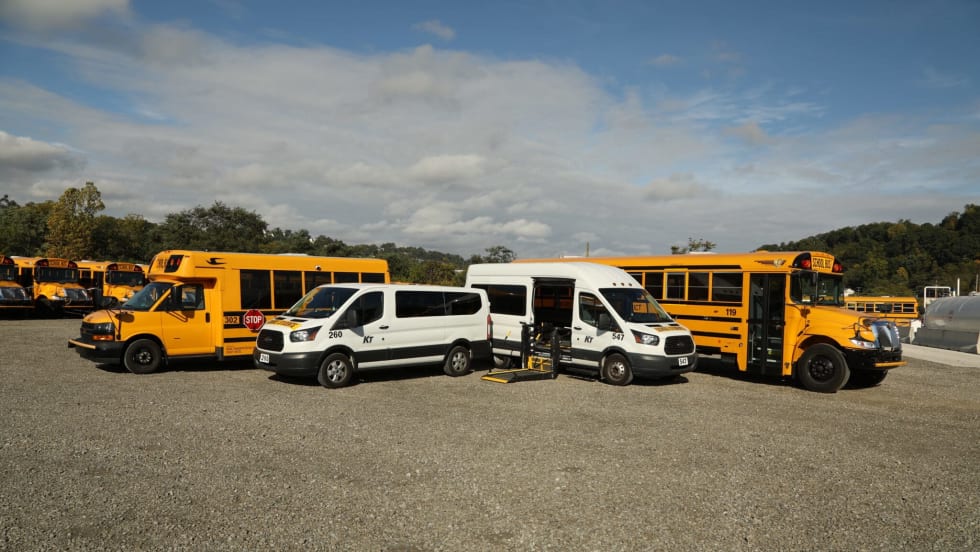
American Student Transportation Partners Acquires AJ Myers and Sons
A new deal brings a 75-year Pennsylvania student transportation provider into one of the nation’s largest private school bus contracting groups.
Read More →
What I Brought Home From SBFX: Relationships, Leadership, and Preparing What's Next
Who could lead your transportation operation tomorrow if you couldn't? Bernando Brown explores succession planning, mentorship, and preparing emerging leaders to step up.
Read More →
Inside School Bus Fleet ConneX 2026: Industry Leaders Connect in Scottsdale [Photos]
See highlights from SBFX 2026 in Arizona, where school bus operators and suppliers gathered for meetings, education, networking, awards, and more.
Read More →
School Transportation’s Biggest Pressures and Opportunities: SBFX Attendees Weigh In
School bus operators point to rising costs, staffing, and vehicle prices as immediate pressures while identifying technology, training, and routing as opportunities for growth.
Read More →
STA Acquires Sunrise Transportation
Student Transportation of America expands in Illinois and Connecticut through Sunrise's fleet of nearly 1,000 vehicles.
Read More →