




2010 Emission Standards: What Are Your Options?
For 2010, North American bus customers will have two choices to be compliant: they can either buy an all-new, add-on after-treatment system using SCR in addition to EGR, which will be offered by most bus manufacturers. Or, they can continue to use an in-cylinder solution with advanced EGR, offered by Navistar in its IC Bus brand school and commercial buses.
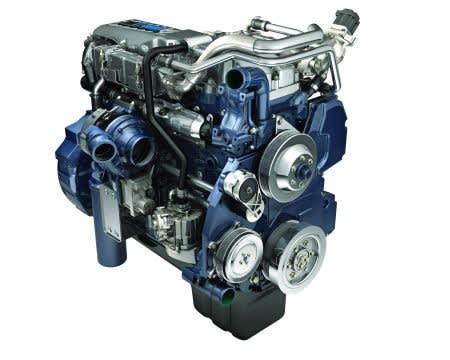
Navistar’s MaxxForce DT diesel engine
For 2010, North American bus customers will have two choices to be compliant: they can either buy an all-new, add-on after-treatment system using SCR in addition to EGR, which will be offered by most bus manufacturers. Or, they can continue to use an in-cylinder solution with advanced EGR, offered by Navistar in its IC Bus brand school and commercial buses.
On Jan. 1, 2010, the U.S. Environmental Protection Agency (EPA) will fully implement the 2007 Heavy Duty Diesel rule, which will require all diesel engines to be at 0.20 grams per brake horsepower-hour (g/bhp-hr) of NOx, or oxides of nitrogen. Two methods that likely will be used to meet these new standards are classified as Exhaust Gas Recirculation (EGR) and Selective Catalytic Reduction (SCR).
The entire commercial vehicle industry utilized EGR to meet the first phase of the EPA’s 2007 emissions regulations. For 2010, North American bus customers will have two choices to be compliant: they can either buy an all-new, add-on after-treatment system using SCR in addition to EGR, which will be offered by most bus manufacturers. Or, they can continue to use an in-cylinder solution with advanced EGR, offered by Navistar in its IC Bus brand school and commercial buses.
SCR vs. EGR
Proponents of SCR, which uses the organic compound urea as the reductant, cite that its chief benefit is that it enables the engine to run more efficiently at higher temperatures and generates a relatively lower amount of particulate matter. Yet, Navistar counters that SCR engines produce more NOx, which is very difficult to eliminate once it is formed.
To reach 0.20 g/bhp-hr, a mixture of 32.5 percent urea and 67.5 percent de-mineralized water is required. This mixture is marketed in the U.S. as diesel exhaust fluid. As European bus fleet operators know, the urea mixture, known as “AdBlue” in Europe, needs to be replenished frequently. “We feel that advanced EGR provides the best solution for our customers, both in terms of operator convenience and overall ownership costs,” says John McKinney, president and general manager, Global Bus Operations at Navistar.
SCR takes place outside of the engine and, as a result, requires special software and an after-treatment system that comprises hundreds of pounds of added equipment to properly utilize urea. “That’s a lot of hardware to find a place for on our buses. We just don’t have a lot of room for it,” says Ed Hartung, director, IC Bus North American Operations.
SCR systems also have to contend with challenges presented by environmental temperatures. Urea freezes at 12 degrees F, requiring buses to be equipped with tank and line heaters. At low operating temperatures, the catalyst can clog. While urea does not require a hazardous materials (HAZMAT) handling certificate to haul, it does begin to decompose at 130 degrees F, resulting in ammonia emissions.
“Evaluate” miles per dollar
North American bus manufacturers opting for SCR tell customers that it improves fuel economy, that it has no effect on service and oil change intervals, that a urea distribution network is being established, and not to worry about its price because widespread use of SCR systems will only increase the total demand for urea by a few percent.
But, with SCR, it takes diesel fuel plus urea to get that improvement, and the greater the improvement in fuel economy, the more urea required, offsetting fuel economy gains. Urea may become widely available over time, but its price may be significantly higher where it is not available in bulk. “Bus operators will need to evaluate carefully their total operating costs and calculate their ‘miles per dollar,’ which takes into account the amount and cost of urea in addition to diesel fuel. Data that includes only traditional miles per gallon of diesel is misleading,” says Randy Ray of Navistar Engine Group.
Navistar’s advanced EGR strategy is to prevent NOx from forming in the engine in the first place. This in-cylinder approach, in combination with higher EGR rates, is key to Navistar’s 2010 solution. They have eliminated the need for complex after-treatment hardware and procedures, simplifying the way for customers to achieve compliance. “This further adds to our ability to keep emissions compliance on our shoulders, while SCR puts the burden of compliance on bus fleet operators.”
So, how can Navistar achieve full compliance without after-treatment? “Navistar has long planned for this level of emissions reduction, following a strategic path toward an in-cylinder solution for the past six years,” Ray says.
Four specific technologies enable Navistar to differentiate from the industry and offer what McKinney calls “a truly customer-focused solution:”
Advanced Fuel Injection Technology
Proprietary Combustion Bowl Designs
Advanced Air-management Systems, and
Proprietary Electronic Calibration Strategies.
High-pressure fuel injection
One of the keys to in-cylinder elimination of NOx is advanced high-pressure fuel injection. Not all engines can handle the necessary pressures. Navistar’s MaxxForce engine platforms, though, have been engineered for high structural strength, well ahead of 2010. Robust and durable block and head designs allow Navistar to achieve emissions compliance with an in-cylinder solution.“This is proven technology that provides simplicity for customers,” adds Ray. With an in-cylinder solution, there is no need for any warehousing, storage or infrastructure changes, any extreme additions of external piping or storage tanks or an additional operating fluid. Service technicians are already trained on EGR systems, unlike SCR, which will require maintenance and technician training to service the system and its additional components. And, with no additional external equipment, bus operators can continue to have available real estate on the chassis for under-carriage luggage, wheelchair lift and air conditioning system placement.
Furthermore, this idea of customer-focused simplicity extends beyond individual vehicles to fleet consistency. Just imagine, for example, the complexity of introducing 15 new 2010-model SCR buses into a fleet of 85 current 2007 EPA-compliant buses: two distinct maintenance routines, an additional procurement effort for urea (which includes an undetermined variable cost) and, if you are operating in a cold climate, two different operating procedures.
But as for offering a simple, proven path to 2010, it turns out Navistar is not the only engine manufacturer to choose an advanced EGR solution. Scania and MAN, two industry leaders in Europe and previously staunch defenders of SCR, are deviating from the SCR path and have recently confirmed plans to meet stricter European emissions standards through a non-SCR, enhanced EGR strategy. “We anticipate that many others will soon be reconsidering SCR,” McKinney adds.
This is the first article in a two-part series. Look for the next installment, “2010 Emissions Choices: Weighing Your Options,” in an upcoming issue.
David Hillman is the global marketing director for IC Bus (a Navistar affiliate) and is a founding member of the American School Bus Council.
More Alternative Fuels

CALSTART and Forth Combine to Form Catalyst Mobility
The new name represents a renewed vision for the nonprofit focused on advancing clean, equitable, and affordable transportation solutions that move people and goods.
Read More →
Alt-Fuel Moves: New Buses, Charging Hubs & Real-World EV Testing
Propane and electric school bus deployments continue to grow as districts add new vehicles, expand charging infrastructure, and gather more real-world operating data.
Read More →
Fewer Electric School Bus Models Reshape the U.S. Market
WRI’s latest buyer’s guide points to a consolidating electric school bus market, but fewer options may reflect a maturing industry rather than fewer meaningful choices for school bus operators.
Read More →
The Fuel Budget You Can Actually Predict: How Propane Autogas Keeps Money in the Classroom
Learn how propane autogas helps school districts manage fuel costs with predictable pricing, lower maintenance, and reduced emissions from former transportation director Joel Stutheit.
Read More →
Hendrickson, Driventic Introduce New Electric Powertrain for School Buses
ELECTRAAX, the electrified, lightweight drive axle offers integrated ePowertrain efficiency and modular flexibility for Class 6–7 school bus use.
Read More →
The Mobility House Joins PowerFlex in Fleet Electrification Deal
The acquisition combines intelligent charging software, bidirectional charging expertise, and fleet electrification services to support the growing adoption of electric school buses across North America.
Read More →
Alt-Fuel Moves: Electric School Bus Investments Hit the Road
See which districts across the U.S. are putting electric school buses into service, expanding charging infrastructure, and planning the next phase of fleet electrification.
Read More →
With Fuel Volatility Ahead, School Districts Turn to Propane
While diesel prices peaked above $5 this spring, districts with propane autogas-powered fleets paid under $2 per gallon, according to PERC.
Read More →
EPA Unveils Proposed Changes to 2027 Heavy-Duty Engine Rules
The federal agency has proposed changes to next year’s targets that would eliminate DEF derates, ease warranty requirements, and retain current NOx emissions standards.
Read More →
Alt-Fuel Moves: EV Charging & Infrastructure Projects Gain Momentum
The latest developments include new funding, charging infrastructure, utility investments, and fleet technologies designed to support the transition to electric school buses nationwide.
Read More →