8 Tips for Cleaning School Buses in the Age of Coronavirus
Steps that pupil transporters can take to ensure their buses are as hygienic as possible are conducting a high-touch audit, considering no-touch cleaning systems, and using microfiber towels.
by Robert Kravitz
May 1, 2020
File photo courtesy Elk Grove (Calif.) Unified School District
5 min to read
File photo courtesy Elk Grove (Calif.) Unified School District
School districts around the country have closed their doors, likely through the fall in many cases, to help protect the health of children, teachers, and staff as a result of Coronavirus, which causes the disease COVID-19.
Whenever schools reopen, now is the most critical time in decades for school districts around the country to re-evaluate their cleaning protocols and ensure they are taking every step possible to clean for health. One of the first areas to pinpoint, and one that historically has been overlooked or given minimal attention, is the school buses children ride in every day.
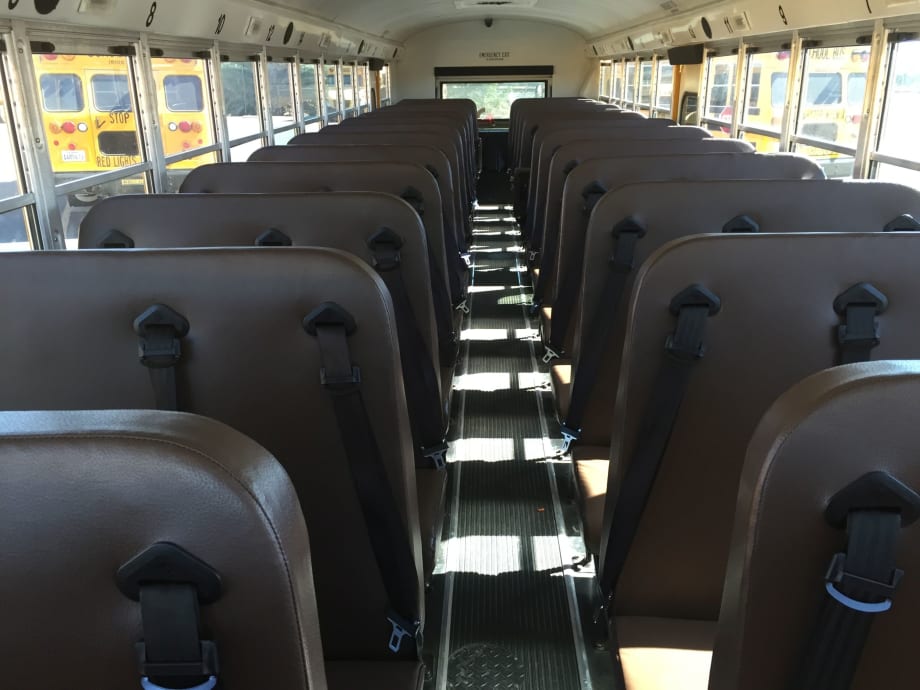
"School buses carry roughly 25 million children to school each day," says Tony Almeida, a member of the Healthy Schools Campaign and manager of custodial service for the Elk Grove (Calif.) Unified School District. "They also transport countless amounts of germs. [This means] a student can contaminate an area as soon as they touch the seat or handrail."
Almeida's comments are supported by a report from the National Education Association (NEA) Information Network, which states, “school buses are mobile environments that are prone to the spread of infectious diseases such as colds and the flu. In addition to the number of students who may introduce bacteria and viruses when they board the bus, surfaces such as the seat backs and handrails can also contribute to the further spread of germs. Keeping these areas clean can help prevent germs and the spread of disease."
Other areas of school buses that can become contaminated, and do so regularly, are stability poles and bars in the bus as well as windows and window ledges. Students often put their hands on these areas.
"This has the potential to spread germs and bacteria from one child to another," says Marc Ferguson, the vice president of global sales with Kaivac, manufacturers of professional cleaning equipment for schools and buses. "These germs and bacteria range from cold and flu viruses to much more serious disease such as MRSA, hepatitis, even Norovirus."
Ferguson adds that recent studies of Coronavirus indicate that not only can the virus spread by inhaling germs or touching contaminated surfaces, but "they [can] also be spread by fecal-oral transmission. We know children are not always careful about washing their hands after using the restroom, so this study is raising alarm bells."*
Ad Loading...
Marc Ferguson, the vice president of global sales with Kaivac, manufacturers of professional cleaning equipment for schools and buses, says that “two-step cleaning” is essential: when manually cleaning the bus, surfaces must be cleaned and then disinfected. Photo courtesy Marc Ferguson
Addressing the Challenge
So, what steps should school administrators and school bus companies now take to help ensure the buses their students ride in are as hygienically clean as possible?
Ferguson suggests the following:
1. Conduct a high-touch audit. Some high-touch areas in buses, such as those mentioned earlier, are obvious.
"But there may be many more we do not realize. Sit in the [bus] seats and look around. Administrators will likely see many surfaces that are touched and can become contaminated each day."
2. Clean floors first. Often when cleaning the floor of a bus, dust and contaminants on the floor become airborne and land on nearby surfaces. By cleaning the floor first, we can remove these pathogens, so this does not happen.
3. Vacuum floors. If possible, school bus floors should be vacuumed with a backpack or canister vacuum. These are more effective at removing dust and soils and they prevent them from becoming airborne.
4. Avoid mops. Mops collect soils and contaminants, but these also build up on the mop.
"When this happens, the mop starts spreading soils. This can be dangerous because this build-up can collect on shoe bottoms and shoelaces that are later touched by children."
5. Consider floor-cleaning alternatives. What ISSA, the worldwide cleaning association, calls "spray-and-vac" (no-touch) cleaning systems or "dispense-and-vac" cleaning systems, eliminates the use of mops.
"Essentially, the way they work is cleaning solution and disinfectants are applied to the floor and other areas [of the bus] needing to be cleaned. The machine rinses the surfaces [and] all soils and moisture are then vacuumed up by the machine."
6. Practice two-step cleaning. If manually cleaning touchable surfaces of the bus, administrators should know that surfaces must be cleaned first, and then the same surfaces must be disinfected.
"It's a two-step process. While it can slow down cleaning, it must be performed. Cleaning removes soils so that the disinfectant can work effectively."
Using Disinfectants Properly
Administrators should know the following about using disinfectants correctly:
• Disinfectants should always be diluted per the manufacturer’s instructions.
• The disinfectant must set or “dwell” on surfaces for as much as five minutes; if it dries, it must be reapplied.
• If manually cleaning, workers should use one set of towels for cleaning and another for disinfecting.
• The Environmental Protection Agency recently listed disinfectants that should be used against Coronavirus. That list can be found here.
7. Always use microfiber towels. Microfiber towels or what are called “smart towels” should always be used when cleaning school bus interiors. Wet the surface first and then use the microfiber. Studies using ATP monitors indicate this is more effective at removing soils. Microfiber towels should be changed frequently; do not use the same microfiber towel on another bus. The smart towels are designed to be folded into eight quadrants. This allows the user to fold the towel and only use one quadrant at a time, helping to reduce the risk of cross-contamination.
What is ATP?
Adenosine triphosphate (ATP) bioluminescence measurement systems are used to help determine the cleanliness of a surface, providing very rapid results. A high ATP reading suggests that a surface may have a high level of microbial contamination. A low level would indicate just the opposite: that the surface is relatively clean, with few contaminants that might harm human health.
8. Be aware: Activated cleaning may be needed. Unless there is an outbreak of Coronavirus at your operation, activated cleaning systems should not be necessary. However, administrators should know about activated cleaning systems. They release a disinfectant mist that kills pathogens on surfaces. But once again, the surface must be cleaned first for them to perform effectively.
Ferguson adds that professional cleaning will never be the same as a result of the Coronavirus, and this applies to bus cleaning as well.
"The industry has been trying to convince people for years that our goal is not to clean just for appearance, but clean for health. I think most administrators realize this now, more than ever before," he says.
Photo courtesy Robert Kravitz
Robert Kravitz is a frequent writer for the professional cleaning industry. He can be reached atrobert.kravitz@outlook.com.
The new name represents a renewed vision for the nonprofit focused on advancing clean, equitable, and affordable transportation solutions that move people and goods.
Choosing the right school bus driver trainer takes more than experience. Learn six keys to selecting and developing trainers and evaluating program effectiveness.
STA's Canadian division acquires Ontario-based G&L Stevenson Transport while Durham School Services adds a new district contract in California, First Student adds a New Jersey contract, and Minnesota Coaches acquires Halo Transportation.
A summer pilot found that AI agents could handle most routine calls, freeing up time for customer service staff to focus on emergencies and complex family concerns.
A Texas transportation supervisor shares lessons on self-awareness, accountability, managing stress and building trust — and why investing in leadership development matters at every stage of your career.
Who earned national recognition for their work in student transportation? This year, NAPT named five recipients of its 2026 awards for service, safety, and leadership, plus its newest Hall of Famer.
Driver shortages. Rising costs. Growing safety expectations. More data, but not enough time to act on it. The 2026 State of Student Transportation Report reveals what transportation leaders say is putting the most pressure on their operations—and where they’re investing next. See how your priorities compare.
What makes emotions run high, and how should you handle an angry colleague or parent? Follow these steps for staying calm, listening, showing empathy, and resolving conflict.
Learn about the challenges shaping the 2026–2027 school year, from persistent driver shortages and budget pressure to technology and readiness gaps. See how school districts are responding and adapting in Zonar’s 2026 Back-to-School Readiness Report.