




Related: Helping School Bus Drivers Turn Downtime Into Uptime
Q&A: Mindy Feldbaum Shares Tips for Managing a Multigenerational Workforce
Mindy Feldbaum, vice president of workforce programs at AARP Foundation, offers guidance on accommodating and retaining employees from a variety of age groups.

Nicole Schlosser・Former Executive Editor

Mindy Feldbaum, VP of workforce programs at AARP Foundation, gave a keynote speech at the NAPT conference on accommodating and retaining employees from a variety of age groups.
Photo courtesy Mindy Feldbaum
4 min to read
Over the last two decades, Mindy Feldbaum, the vice president of workforce programs at AARP Foundation, has dedicated her career to helping boost economic opportunity and mobility for low-income workers. She currently oversees AARP Foundation’s workforce programs, many of which aim to help older adults increase economic opportunity and achieve financial security.
Feldbaum will speak to National Association for Pupil Transportation (NAPT) attendees at the association’s conference in Columbus, Ohio, on Nov. 3 about today’s multigenerational workforce. Here, she shares with School Bus Fleet tips for accommodating and retaining employees from a variety of age groups.
1. Do we have more people from different generations working together than we used to?
For the first time, five generations are participating in the labor market. These include: Greatest Generation/Traditionalists, Baby Boomers, Generation X, Millennials, and Generation Z. The trend of these generations working side by side is here to stay and it provides a great opportunity for workers to reimagine how they can unlock their full potential through work and learning over a lifetime, and for employers to adopt new strategies and approaches to building an age-inclusive, multigenerational workforce.
2. Do Baby Boomers and Millennials tend to get examined so often because they comprise the biggest parts of the U.S. population? How do Gen X, Gen Z, and Greatest Generation/Traditionalists factor into the workplace now?
Yes, there have been many discussions in the media about Baby Boomers and Millennials since they do comprise the biggest parts of the U.S. working population. Millennials also came into the workforce during the Great Recession so unfortunately, some media discussions have pitted the generations against each other, particularly in relation to long term economic security.
Given the need for a highly-skilled workforce and that businesses are fiercely competing for talent in a rapidly changing economy, all five generations will play a critical role in the current and future workplace — bringing a diversity of perspectives, abilities, skills, and knowledge.
The workforce is aging, and according to a study conducted for AARP by Aon Hewitt, the number of Americans over 50 who are working or looking for work has grown significantly and is expected to continue to increase. These older workers are part of the Greatest Generation/Traditionalist, Generation X, or Baby Boomers cohorts and bring valuable experience, expertise, institutional knowledge, emotional intelligence, high levels of engagement, low turnover, and other traits to the workplace.
Many older workers are staying in the labor market longer because they need the income to support living longer or want to remain active and contribute in a meaningful way. Unfortunately, three in five older workers have either seen or experienced age discrimination in the workplace, according to an AARP survey.
Studies have shown that organizations that embrace an age-inclusive, multigenerational workforce remain competitive and have the capacity for innovation and growth. This is due to increased performance, improved employee engagement and productivity, and long-term stability, particularly when older workers, with the institutional knowledge, wisdom, and experience, are retained and tenure is valued in the organization.
3. How does having employees from a variety of generations impact school transportation teams in particular?
Like in many industries and jobs, school transportation teams have been impacted by the demographic changes in the workplace because of the aging workforce. Although having five generations in the workplace may present some challenges, I believe there will be many more opportunities, particularly because the market for talent today is very competitive.
Public and private transportation companies should find ways to invest in age-inclusive policies and practices and deploy these new strategies to attract and retain a highly skilled and multigenerational workforce. A few examples include expanding existing benefits so employees can manage their work-life responsibilities at any life stage; providing flextime, telecommuting, phased retirement, and part-time employment; creating intergenerational mentorship opportunities to promote a positive attitude toward an age-diverse work environment; and investing in work-related training for all current workers to help organizations and workers remain competitive and increase retention.
4. So much is made of generational differences. Is there anything in terms of work or management styles that these generations have in common?
Quite a few studies have shown that there are relatively small differences in generations and those that do exist can be attributed to other factors such as life stages. It may be much more productive for employers to identify similarities across generations, as it can help to increase multigenerational understanding, collaboration, and foster an age-inclusive culture.
Workers across generations want many of the same things, such as financial security, work-life balance, flexible work and benefit options, meaningful work, a respectful, equitable, and inclusive work environment, and learning and growth opportunities.
Subscribe to Our Newsletter
More Management

School Bus Contractors Expand Through New Deals, Acquisitions & Partnerships
STA's Canadian division acquires Ontario-based G&L Stevenson Transport while Durham School Services adds a new district contract in California, First Student adds a New Jersey contract, and Minnesota Coaches acquires Halo Transportation.
Read More →
Logan Bus Company Rolls Out AI Phone System for NYC School Bus Families
A summer pilot found that AI agents could handle most routine calls, freeing up time for customer service staff to focus on emergencies and complex family concerns.
Read More →
From Intent to Impact: What I Learned About Leadership from TAPT
A Texas transportation supervisor shares lessons on self-awareness, accountability, managing stress and building trust — and why investing in leadership development matters at every stage of your career.
Read More →


NAPT Names 2026 Award Recipients, Hall of Fame Inductee
Who earned national recognition for their work in student transportation? This year, NAPT named five recipients of its 2026 awards for service, safety, and leadership, plus its newest Hall of Famer.
Read More →
Sponsored•September 2, 2026
2026 State of Student Transportation Report
Driver shortages. Rising costs. Growing safety expectations. More data, but not enough time to act on it. The 2026 State of Student Transportation Report reveals what transportation leaders say is putting the most pressure on their operations—and where they’re investing next. See how your priorities compare.
Read More →
How to De-Escalate an Angry Person: 5 Steps for Handling Workplace Conflict
What makes emotions run high, and how should you handle an angry colleague or parent? Follow these steps for staying calm, listening, showing empathy, and resolving conflict.
Read More →
Sponsored•September 1, 2026
What Readiness Looks Like This School Year
Learn about the challenges shaping the 2026–2027 school year, from persistent driver shortages and budget pressure to technology and readiness gaps. See how school districts are responding and adapting in Zonar’s 2026 Back-to-School Readiness Report.
Read More →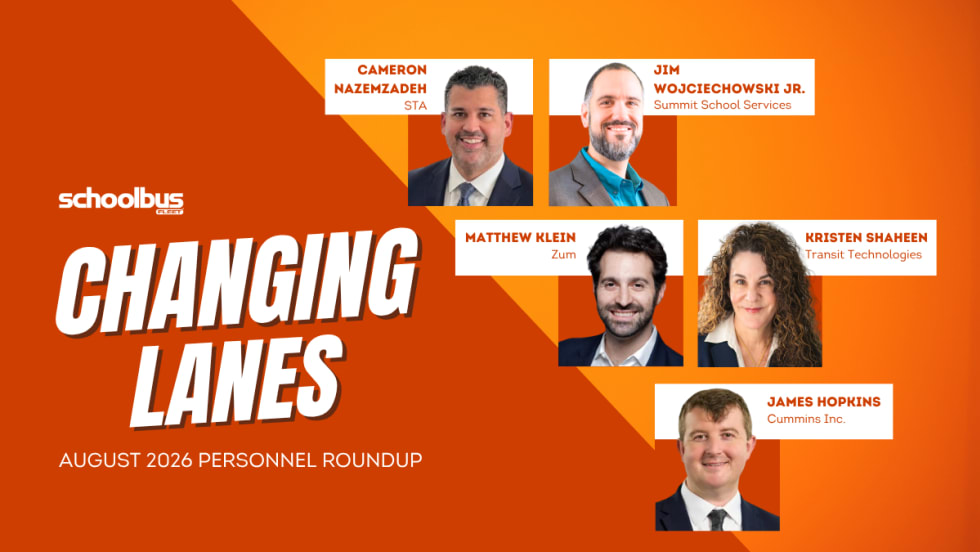
Changing Lanes: Executive Moves at Summit School Services, Zum, STA, Cummins, Transit Technologies, Driventic, & Cadex
See who's been hired, promoted, and appointed to leadership positions at various school transportation industry suppliers and private contractors.
Read More →
Industry Moves: Companies Expand Fleet Service & EV Infrastructure Footprints
The new facilities and regional hubs could mean faster access to shop equipment, charging support, and transportation technology for fleet operators.
Read More →
Sponsored•August 27, 2026
Doing More With Less: How Transportation Directors Can Prioritize Safety Amid Budget Uncertainty
With diesel prices soaring and nearly one-third of transportation directors expecting budget cuts, maintaining student safety has never been more challenging. Download this guide to learn how leading districts are prioritizing risk, funding critical safety technology, and building stronger budget cases with data.
Read More →