




Using Wi-Fi on Wheels to Improve the School Bus Ride
From promoting safe connectivity for students to integrating Internet of Things capabilities, mobile connectivity solutions suppliers discuss how school bus Wi-Fi is changing the course of pupil transportation.

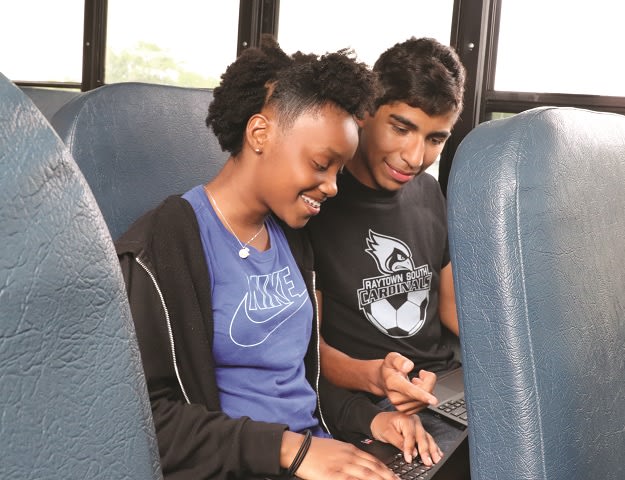
In Missouri, Raytown Quality Schools has implemented a rollout program to provide all its students with Wi-Fi connected devices by the start of the 2019-20 school year. Photo courtesy Raytown Quality Schools
In Missouri, Raytown Quality Schools has implemented a rollout program to provide all its students with Wi-Fi connected devices by the start of the 2019-20 school year. Photo courtesy Raytown Quality Schools
Smartphone, laptop, or tablet — it’s almost impossible to find someone who doesn’t have access to at least one of these devices. But how many people have constant internet access for their device?
Today, more than 77% of Americans reportedly go online on a daily basis. This percentage includes the 26% who go online almost constantly, as well as 43% who say they go online several times a day, and 8% who go online about once a day, according to a 2018 Pew Research Center survey.
While adding Wi-Fi to school buses has become increasingly common over the last few years, more mobile connectivity suppliers are upgrading their solutions to accommodate internet access on the yellow bus. From promoting safe connectivity for students to integrating Internet of Things (IoT) capabilities, these “mobile classrooms” are changing the course of pupil transportation.
“One of the main reasons school districts and students enjoy having Wi-Fi on the school bus is that it extends beyond the normal school day,” says Rob Taylo, CEO and founder of mobile connectivity supplier SinglePoint. “The benefits aren’t limited to providing connectivity to passengers; it’s about having the ability to connect to systems on board that enhance fleet operations — from onboard camera systems to GPS systems.”
Safe, Filtered Access
One key action that school districts should take when planning to implement Wi-Fi on school buses, Taylo says, is to assess how the solution promotes a safe browsing environment for students.
For nearly two decades, school districts have been required to follow the Children’s Internet Protection Act (CIPA), a federal regulation that requires any school or library providing connectivity to minors to implement an internet safety policy.
While CIPA does not set a standard for what’s considered age-appropriate internet content, school districts have the option to set content guidelines based on the offerings of mobile connectivity solutions suppliers.
For example, SinglePoint’s Max Mini Wi-Fi solution features a CIPA-compliant content filtering application that halts any security or safety threats before they reach a student’s device.
Meanwhile, cloud-based wireless networking solutions provider Cradlepoint uses a specific application that grants school administrators the ability to set up categories for acceptable and unacceptable internet use.
“If the school district is trying to control the costs of the data on the buses, then they might block access to video websites like Netflix or YouTube that can chew up a lot of the district’s data plan,” says Ken Hosac, vice president of IoT strategy and business development for Cradlepoint.
Hosac adds that adopting a system with good routing and reliable networking and security features also helps with intrusion prevention and detection, which can ultimately reduce the chances of students downloading malware onto their devices.
Improved Fleet Management
With an influx of data, from vehicle and student tracking to school bus surveillance video, many school transportation departments are relying on Wi-Fi to support their day-to-day operational needs.
Michael Flood, vice president of strategy for Kajeet, says the company’s SmartBus solution can track a bus’s location history, assess engine diagnostics, and connect to the school bus’s video camera system to perform automatic video offload.
“All of these things get integrated together into what we now consider a broader portfolio of SmartBus solutions,” Flood explains. “The Wi-Fi component of the SmartBus router is the core, and all of these additional options leverage the IT network in the school bus so it’s customizable for the district.”
For example, in Missouri, Raytown Quality Schools has added Kajeet’s GPS tracking feature to all 71 of its buses that are equipped with the supplier’s SmartBus solution.
Kevin Easley, the district’s transportation director, says the feature not only allows the district to ensure drivers are practicing safe driving behaviors while out on the road, but also permits the district to connect its GPS data to a tracking app that notifies parents and students of school bus arrival and departure times.
“Of our 6,500 student riders, we have about 3,500 accounts created on our GPS tracking app,” Easley says. “Every person that we can have look at the app for data is one less call we have to answer in our office. In this case, the Wi-Fi really helps with our communication efforts.”

Aside from improved communication, delivering the Wi-Fi experience ultimately turns students’ downtime on the bus into uptime. Photo courtesy Kajeet
Boosting Engagement
Aside from improved communication, delivering the Wi-Fi experience ultimately turns students’ downtime on the bus into uptime.
“If a district knows their average school bus ride is 34 minutes, and the average Wi-Fi session lasted 28 minutes, then you know your Wi-Fi is getting pretty substantial usage,” SinglePoint’s Taylo says, “and tracking student behavior and homework completion rates can attest to that.”
Since rolling out a program to provide all its students with connected devices in 2017, Greenville County (S.C.) Schools has experienced an overall 21% decrease in bus discipline referrals.
While only 75% of students currently have connected devices, Bill Brown, Greenville County’s executive director for education technology services, says the district plans to track students’ homework completion rates once the device rollout is complete at the beginning of the 2019-20 school year.
“We’ve gained at least 19,000 hours of instructional time back that we didn’t have before,” Brown explains. “On average, our routes are about 30 minutes each, so we’ve been able to extend the classroom by giving them another hour or so of class time.”
Today, the district currently transports more than 20,000 students daily on 435 of its “mobile classroom” buses powered by Cradlepoint’s solution.
Increasing Driver Morale
The small victories in student behavior and homework completion, Raytown’s Easley adds, create a domino effect in driver satisfaction.
Around the time when Raytown Quality Schools was conducting its Wi-Fi pilot, Easley says one of his drivers had refused to go back to driving a bus that wasn’t a “mobile classroom.”
“When [the driver’s] Wi-Fi-equipped bus had to be put out of service for maintenance, the driver came in after routes one day and told me ‘I could never do that again,’” Easley says. “The students on the bus were really upset after they had experienced a bus with Wi-Fi and then had to go back to one with none at all.”
For some operations, Flood says, Wi-Fi could make all the difference in boosting driver recruitment and retention.
“We’ve seen dramatic improvements in student behavior on the bus, which has led to higher driver satisfaction and increased retention,” he explains. “If the solution were ever taken back off the bus, some drivers have told us it could change their feelings about driving.”
Getting positive driver and student feedback while also gaining support from the district’s IT department, Brown adds, is essential for a successful school bus Wi-Fi program.
New Features Ahead
The latest buzz right now in the industry, Cradlepoint’s Hosac says, is having IoT capabilities that enhance more than just GPS and student tracking data.
IoT grants transportation operations the flexibility to connect dozens of different types of devices. For example, this may mean installing IoT sensors on the school bus to track how fast the bus is going, whether the bus’s stop arm is deployed at a certain time, or if the temperature on the bus is at a safe level.
A popular IoT sensor for Kajeet SmartBus users, Flood says, is an emergency connection switch. The bus driver can, with one touch, stop all Wi-Fi connectivity on the bus and alert dispatch or other school staff about an emergency.
More recently, Cradlepoint has partnered with Microsoft to establish its new Azure IoT Central platform, which enables school districts to create their own applications for the school bus and managing IoT devices and sensors through a customizable dashboard. Even though the platform is still in its early stages, Hosac says Cradlepoint plans to launch it to the public soon, in addition to rolling out 5G advanced LTE networks over the next year.
Meanwhile, SinglePoint is also working to expand 5G capabilities to the school bus market.
More Management

How to Build a Better Driver Training Program
Ready to boost up your school bus instructor training? Here’s how to pick the right talent and improve recruitment, retention, and safety.
Read More →
CALSTART and Forth Combine to Form Catalyst Mobility
The new name represents a renewed vision for the nonprofit focused on advancing clean, equitable, and affordable transportation solutions that move people and goods.
Read More →
What Makes a Great School Bus Driver Trainer?
Choosing the right school bus driver trainer takes more than experience. Learn six keys to selecting and developing trainers and evaluating program effectiveness.
Read More →


School Bus Contractors Expand Through New Deals, Acquisitions & Partnerships
STA's Canadian division acquires Ontario-based G&L Stevenson Transport while Durham School Services adds a new district contract in California, First Student adds a New Jersey contract, and Minnesota Coaches acquires Halo Transportation.
Read More →
Logan Bus Company Rolls Out AI Phone System for NYC School Bus Families
A summer pilot found that AI agents could handle most routine calls, freeing up time for customer service staff to focus on emergencies and complex family concerns.
Read More →
From Intent to Impact: What I Learned About Leadership from TAPT
A Texas transportation supervisor shares lessons on self-awareness, accountability, managing stress and building trust — and why investing in leadership development matters at every stage of your career.
Read More →
NAPT Names 2026 Award Recipients, Hall of Fame Inductee
Who earned national recognition for their work in student transportation? This year, NAPT named five recipients of its 2026 awards for service, safety, and leadership, plus its newest Hall of Famer.
Read More →
2026 State of Student Transportation Report
Driver shortages. Rising costs. Growing safety expectations. More data, but not enough time to act on it. The 2026 State of Student Transportation Report reveals what transportation leaders say is putting the most pressure on their operations—and where they’re investing next. See how your priorities compare.
Read More →
How to De-Escalate an Angry Person: 5 Steps for Handling Workplace Conflict
What makes emotions run high, and how should you handle an angry colleague or parent? Follow these steps for staying calm, listening, showing empathy, and resolving conflict.
Read More →
What Readiness Looks Like This School Year
Learn about the challenges shaping the 2026–2027 school year, from persistent driver shortages and budget pressure to technology and readiness gaps. See how school districts are responding and adapting in Zonar’s 2026 Back-to-School Readiness Report.
Read More →