




School Bus Fires Highlight Need for Preventive Measures
With a rash of blazes in recent months — one fatal — pupil transportation officials boost inspection and replacement of older buses. Evacuation drills and fire suppression also come into focus.
Getty image © sandsun
Getty image © sandsun
Getty image © sandsun
Getty image © sandsun
There has been no shortage of school bus fires in the news lately. Reports in the past few months have included:
• An empty school bus in Massachusetts caught fire while warming up.
• School buses in Alabama and South Carolina caught fire while students were on board (all were safely evacuated).
• Tragically, a school bus in Iowa caught fire and took the lives of its driver and a student.
In fact, in the U.S., between one and two school bus fires occur every day, according to a 2016 study by the John A. Volpe National Transportation Systems Center, titled “Motorcoach and School Bus Fire Safety Analysis.”
The reasons for the fires seem endless: turbocharger, engine, and mechanical failures occur; wires loosen or rub against engine parts; old parts lose their integrity; tires explode; circuit boards become overloaded; and leaks release inflammatory fluids.
Fortunately, few injuries or fatalities have resulted from the fires. From 2006 to 2010, bus and trackless trolley fires caused an average of 22 injuries a year and less than one fatality a year, according to the National Fire Protection Association.
However, given the prevalence of school bus fires, it’s imperative that pupil transporters take every precaution to keep them to a minimum — a task that requires constant vigilance, updating school bus safety procedures, maintaining equipment, and training.
“There’s no magic bullet to preventing school bus fires,” says Max Christensen, Iowa’s state director of pupil transportation. “Rather, it’s a series of small measures that can lower the number of school bus fires and, when they do happen, ensure no one is hurt.”
Troubleshooting
Inspection and maintenance are the backbone of school bus fire prevention, and that’s the first thing the South Carolina Department of Education (DOE) addressed when its school buses started catching fire more frequently.
“With the uptick in fires and issues, we did a complete review of the fleet immediately,” says Ryan Brown, the South Carolina DOE’s chief communications officer.
Following the top-to-bottom inspections, buses with equipment or mechanical problems were repaired or taken off the road immediately, Brown says.
South Carolina also upped its inspection schedule. While it normally inspects buses five to seven times a year, it made seven inspections a year mandatory for its fire-prone 1995 and 1996 rear-engine buses. The state also brought in an outside automotive engineering company and engineers from the bus manufacturer to review its maintenance and safety procedures.
“You don’t want people grading their own practices,” Brown says. “It was important to have the manufacturers, their engineers, and a third-party opinion validate our practice.”
In North Carolina, the Department of Public Instruction (DPI) also intensified its inspection and maintenance procedures after recent school bus fires. DPI issued a memo directing counties to reinspect every model year 1998 to 2003 bus with a Caterpillar engine and, if needed, repair them.
The North Carolina DPI memo further said that inspectors performing 30-day inspections should pay close attention to the battery wire on a bolt that goes through the fire wall on FS-65 chassis Freightliners, and to be on the lookout for oil and fluid leaks.
Driver inspections are also crucial in preventing school bus fires. After the Iowa fire in December, Christensen stressed that the state’s school bus drivers should conduct thorough inspections of their buses before every trip, checking for leaks; ensuring that all exits operate correctly; and making sure that all emergency equipment is current and close to the driver.
“With the uptick in fires and issues, we did a complete review of the fleet immediately.” Ryan Brown, chief communications officer
South Carolina Department of Education
Taking Pre-Emptive Action
The best way to handle school bus fires is to extinguish them immediately, and that’s where fire suppression systems come in. When the temperature reaches a certain degree, the fire suppression system releases a mist or powder that extinguishes the fire. It also alerts the bus driver that there’s a fire, though in some cases the alert may be an afterthought.
“There may be a bus fire, but it’s put out before the driver’s aware there’s a bus fire,” says Brette Fraley, executive director of transportation for Kanawha County Schools in Charleston, West Virginia.
Kanawha County Schools has already installed Fogmaker fire suppression systems on all its special-needs buses and is currently putting them on its rear-engine buses as well. Fraley says that the systems give students with disabilities the extra time they may need to evacuate a bus. For rear-engine buses, he adds, the systems can put out a fire that the driver might be unaware of.
The fire suppression systems also make economic sense, according to Fraley. The systems that Kanawha County Schools has implemented cost $2,650 per bus, and they are guaranteed for 10 years and are interchangeable between buses. The cost to recharge a canister is $1,500.
“Every time a bus burns, the taxpayers have lost a $100,000 asset,” Fraley says. “Given that, $2,650 is not a big deal. … [Fire suppression systems] are a good insurance policy.”
To prevent school bus fires, the South Carolina DOE, too, took preventive action. It installed heat sensors, which alert the driver anytime a bus overheats, in all the engine compartments of its 1995 and 1996 buses.
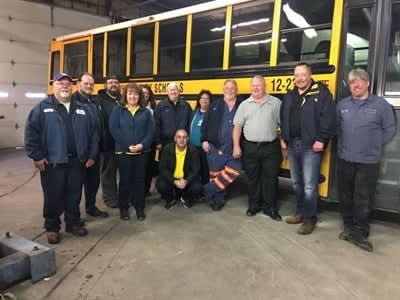
Kanawha County Schools in West Virginia has been equipping buses with Fogmaker fire suppression systems. Seen here, maintenance staff and supervisors went through training during installation.
Replacing Aging Buses
While the South Carolina DOE has taken steps to prevent fires on its older, problematic Type D rear-engine buses, the real solution is replacing them, according to Brown.
“Some design flaws exacerbated other problems in terms of structural and mechanical issues,” he says. “Those are the buses ending up in actual fires. Those are the ones we’re pushing to get off the roads as quickly as possible.”
As replacing buses comes with a hefty price tag, the South Carolina DOE is buying many of its new school buses with a master lease program. Rather than spending at least $20 million upfront for new buses, the DOE buys new buses with a loan secured by the treasurer’s department and makes annual payments on each one for five years. Brown says the bank will secure the loan as long as the DOE gets recurring funding from the South Carolina General Assembly. The DOE hopes to use the lease-to-own model for the majority of its school bus purchases in the future.
“The master lease program allows us to get many more buses, and we can get them on the road as quickly as possible,” Brown says.
He adds that the new buses will have significantly lower maintenance and fuel costs and will be outfitted with state-of-the-art safety features.
Real-World Practice
School bus drivers also play an essential role in ensuring that students safely evacuate the bus in case of a fire or other emergency. Simply put, this is a skill best taught by doing.
Kanawha County Schools provides such training to its school bus drivers. In addition to lectures and videos, the district’s drivers get hands-on experience. After a safety supervisor demonstrates the procedures, the drivers, while videoed, perform the evacuation process on a bus fitted out for safety instruction. Then the drivers watch themselves in action.
“The camera is a good training tool,” Fraley says. “The drivers watch what they did in the training exercise. Then they can discuss the process, what went wrong, and ask questions.”
Also, school bus evacuation drills can make a world of difference in preparing students to safely escape a burning bus. Christensen, the Iowa state director, says that a fully loaded school bus can be evacuated in under a minute if the students have practiced evacuation drills.
During the drills, students should learn:
• When to evacuate a bus.
• The types of evacuations (front, rear door, roof, and side window).
• The importance of evacuating in a calm and orderly fashion.
• How to operate emergency equipment and open the emergency exits.
• Where to go and what to do once the bus has been evacuated.
In addition, older students should be designated to help the young ones in an emergency evacuation. Finally, the students should perform an actual evacuation.
“The speed of the evacuation and the safety of the children involved are directly related to how well they have been trained,” Christensen says. “Performing the drills on a regular basis and educating the students as to how to do it correctly is so very important.”
More Safety
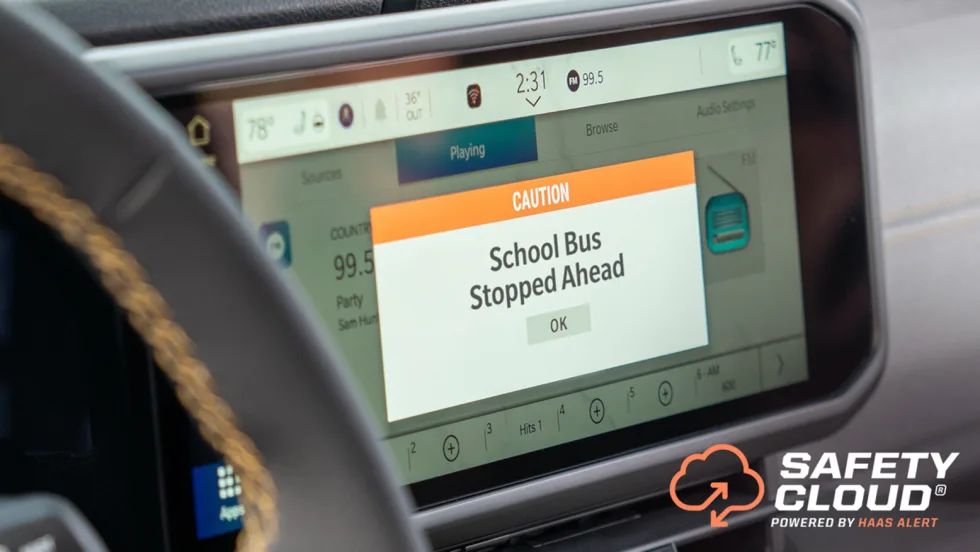
HAAS Alert’s Safety Cloud Warns Motorists of Stopped School Buses
Through a transponder or Samsara connection, the product lets school bus fleets send advance warnings to approaching drivers through in-vehicle alerts.
Read More →
HopSkipDrive Reports Progress on Safety Advisory Council
More than a year after forming the council, independent safety experts have helped shape new rider-safety features and policy progress, with a new goal to address rider behavior.
Read More →
What the 2026 National School Bus Safety Month Resolution Means for Student Transportation
The bipartisan resolution highlights illegal school bus passing, student safety during loading and unloading, and the need for driver training and public education.
Read More →
School Bus Stop-Arm Violations Decline 53% Across Verra Mobility Programs
Verra Mobility shares how school bus stop-arm cameras and school zone safety programs are changing driver behavior, reducing violations, and protecting students.
Read More →
Most Bus Crashes Aren’t Your Fault. Here’s How to Prove It.
A guide for what to do in between a school bus crash and a claim: what to preserve, who to notify, and how to keep the facts available when they matter.
Read More →
National School Bus Safety Week 2026: Tips, Toolkits & Resources to Keep Students Safe
School bus safety takes more than awareness. Explore expert tips, enforcement strategies, and free resources to help protect students on every ride.
Read More →
2 Killed, Dozens Injured in Florida School Bus Crash
A multi-vehicle collision caused a Polk County school bus carrying 37 students to overturn on its way to Winter Haven High School.
Read More →
Illegal School Bus Passing Drops 24% in New York Districts
With fewer than 5% of citations involving repeat offenders, Westchester County officials said enforcement, education, and community partnerships are helping change driver behavior.
Read More →
School's Back. Here's What Happened to Traffic, Speeding & Distraction
What happens to traffic when school resumes? New data analysis examines changes in distracted driving, congestion, and speeding around schools.
Read More →
Geotab Expands Fleet Safety Tools With Video Coaching, Risk Insights
New safety and video capabilities aim to help fleet managers assess risk, support drivers, and take targeted action through video coaching, red-light violation detection, and more.
Read More →