




What’s Next for CDL Holders? Key Updates to FMCSA Rules
Get an update on FMCSA rulemakings here, from what recently happened and is in the pipeline for 2025. Learn the current status of reporting for CDL holders’ drug and alcohol and traffic violations, speed limiters, automated driving systems, safety fitness procedures, ELDT audits, and school bus exemptions.

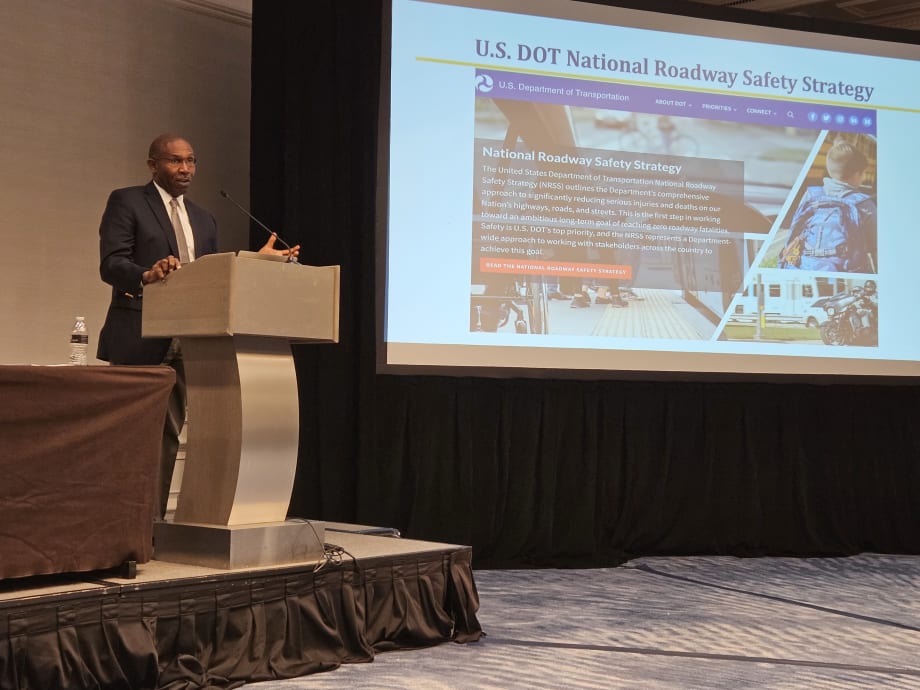
This summer, the electronic medical certification system for CDL holders gets even easier. This system will soon allow certified medical examiners to electronically transmit medical certificates directly to state licensing agencies. Here, Larry Minor presents on this and more at the NASDPTS conference.
Photo: Amanda Huggett
At the 2024 National Association of State Directors of Pupil Transportation Services (NASDPTS) Annual Conference, Larry Minor of the Federal Motor Carrier Safety Administration (FMCSA), presented on the FMCSA’s National Roadway Safety Strategy (NRSS) and updates to various department rules and regulations.
The NRSS follows the Safe System Approach, which outlines strategies around
Safer People
Safer Vehicles
Safer Speeds
Safer Roads
Post-Crash Care
CDL Holder Issues Reporting
CDL holders’ traffic violations will develop a system to report driver history information to state licensing agencies, in an effort to downgrade their license and remove unsafe drivers from the road. This was a June 2021 final rule with an Aug. 22, 2024, compliance date.
The 2021 CDL holders’ drug and alcohol violations rule requires state licensing agencies to access and use info from the Drug and Alcohol Clearinghouse to take action against commercial drivers with drug violations before they return to duty. Established in 2020, the clearinghouse has already caught 267,000 individuals with violations. More than 178,000 of those are in prohibited status, and over 136,000 have not started the return-to-duty process.
“It shouldn't be too much of a surprise, but marijuana is at the very top of that list, followed by cocaine,” Minor said. “There may be some confusion with some of these drugs, but under DoT regulations, if you test positive for marijuana, that counts as a positive in the drug alcohol testing program, and there's going to be no medical excuse that we're going to take.”
The compliance date for the drug and alcohol violations was Nov. 18, 2024. Information on these violations is available on the FMCSA website for up to five years or indefinitely if the return-to-duty process is not completed.
What about CDL holders’ medical conditions? Minor notes the national registry for Certified Medical Examiner program, which has a summer 2025 compliance date. The FMCSA will begin electronically transmitting medical certificates directly to state driver licensing agencies (SDLAs) for CDL holders, removing the process of manual submission.
It’s worth noting that CDL holders will still need to go through the process to self-identify in one of four statuses. “Then there will be the expectation that you have proof of your medical qualifications, and beginning next year, for the interstate subject to FMCSA requirements, the proof would come from FMCSA so the medical examiner would upload results to us, and then we'll transmit it electronically to the FCLA for those interstate drivers, beginning next summer,” Minor explained.
Automated Braking & Driving Systems
A joint rulemaking between the FMCSA and the NHTSA is set to require automatic emergency braking systems on commercial motor vehicles (AEBs were required for passenger vehicles earlier this year).
“This is an important rule making,” Minor said. “For whatever reason, if the driver fails to recognize a crash-imminent situation, the system would kick in and automatically apply the brakes. This is very important lifesaving technology. It will help to prevent a lot of crashes.”
These systems would also kick in if the driver is applying the brakes, but with insufficient force enough to prevent a crash.
And, with all the talk of autonomous vehicles in the passenger vehicle space, the FMCSA has now also developed a proposed rulemaking for safe integration of automated driving systems to put safety guardrails in place for this tech to be used appropriately.
For instance, “if the manufacturer has designed [the vehicle] with certain limitations, like it can only be used on the open highways or in the daytime, then hopefully they would make sure that the fleets understand that and don't go beyond what the designer has developed.”
The rulemaking has been at the Office of Management and Budget since December 2023, and it has target of this December for a unified agenda. And, Minor noted that the FMCSA looks forward to your comments and feedback on that Notice of Proposed Rule Making.
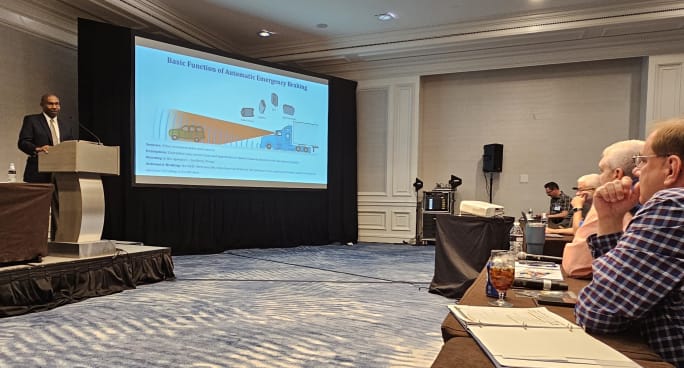
FMCSA is placing an emphasis on enhancing safety through regulatory updates, such as implementing automatic emergency braking (AEB) systems.
Photo: Amanda Huggett
Speed Limiters
One other item in the FMCSA’s unified agenda is speed limiters.
“Now, this is a topic that we've been discussing for the better part of all 20 years, where we received petitions from the American Trucking Associations to require speed limiters on commercial motor vehicles,” Minor said.
The agency took comments on the rulemaking in 2016, and just two years ago, it announced a plan to move forward, with one change. The initial approach was to require manufacturers to install speed limiting technology, but a carrier-based approach is now being considered. This would require motor carriers to set the speed limit on their vehicles.
Minor said speed limiters “still has some signs of life.” The rulemaking is still listed in the unified agenda, and a supplemental Notice of Proposed Rulemaking is expected.
Issues Affecting Contractors: Safety Fitness Procedures & Registration
Minor discussed another rulemaking the department is working on about safety fitness procedures that would affect for-hire school bus contractors. The proposed rule aims to improve safety management controls and ratings for contractors. FMCSA held a listening session already on the topic, and a Notice of Proposed Rule Making is expected in 2025.
Similarly, Minor mentioned unified registration system enhancements. “We've been working out in the inside registration system for a number of years, with a bunch of starts and stops,” Minor said. “And now we hope to move forward with a comprehensive overhaul of the registration system, where it will be a fully online system so that all the filings would be done electronically.”
Minor requested feedback from fleets who use the system to register their DOT numbers and file proof of insurance.
ELDT Training Audits
The FMCSA’s Office of Safety manages the ELDT program. Minor explained that he believes they have begun auditing training providers, especially those who have received complaints. Of those who aren’t, they still must submit information on how many people pass or fail, and track graduates through to CDL testing.
But for those worried that this would slow down the CDL process, “It doesn't look like it's presented a barrier, and we're getting some good feedback that it seems to be working,” Minor said. “And the really, really good part of it, whether they're good, bad or ugly, they have to register with us so we know who they are, where they are, and what they've been doing.”
School Bus Exemptions
The only exemption FMCSA currently allows for school bus drivers is for the under-the-hood portion of the CDL skills test.
NSTA sought for a five-year extension earlier, but just two years were granted in 2022 — making the exemption expire this year. Another renewal has been requested, and the FMCSA expects to issue a decision within the next couple of weeks.
How to Stay on Top of Regulations & Offer Feedback
With much movement in various federal regulations and processes, Minor recommended the website reginfo.gov for information about all the things that are in the unified agenda for the entire government, even beyond just the FMCSA.
Pro tip: If you see a document of interest and it's currently under review at the Office of Management Budget, there's a process by which you can request a meeting to share your thoughts and concerns about the document.
You can also monitor regulations.gov and submit comments for items on the federal register.
“We do have an open process where we strongly encourage everyone to participate in our rulemaking process and to share your thoughts and views, because we don't know for certain how these things are going to impact your operations,” Minor said. “We turn to you as to whether you think we've gone too far, if we haven't gone far enough. This is your chance to go on the record, and we encourage all of you to take advantage of that.”
More Safety

How to Build a Better School Bus Driver Training Program
Is it time to strengthen your driver training? Here’s how to pick the right talent and improve recruitment, retention, and safety. This video is brought to you by IC Bus.
Read More →
Recent School Bus Accidents Leave 2 Dead, 2 Injured
Four school bus crashes in Florida, Illinois, and Georgia highlight risks in transportation lots, at bus stops, and during student loading and unloading.
Read More →
When Every Second Matters, Clarity Keeps Routes Moving
From routine delays to urgent incidents, strong communication practices help drivers, dispatchers, schools, and families respond with confidence.
Read More →

What Happens When a School Bus Catches Fire — and What Can Help
School bus fires are rare but can be devastating. Learn how advances in fire suppression and asset protection help fleets detect fires earlier, reduce damage, and improve safety.
Read More →
Geotab Launches Tool to Help Fleets Investigate Road Incidents
Geotab Investigations combines telematics data, video, documents, and other evidence to help fleets reconstruct incidents, resolve claims, and determine what happened.
Read More →
Texas Sixth Grader Wins 2026 National School Bus Safety Poster Contest
Sai Darshana Yekolu of Moseley Middle School in Prosper, Texas, was named the newest winner for her artwork, bringing the theme of “Safe Rides, Everyday Heroes” to life.
Read More →
Doing More With Less: How Transportation Directors Can Prioritize Safety Amid Budget Uncertainty
With diesel prices soaring and nearly one-third of transportation directors expecting budget cuts, maintaining student safety has never been more challenging. Download this guide to learn how leading districts are prioritizing risk, funding critical safety technology, and building stronger budget cases with data.
Read More →
Walton County Schools Adds Gatekeeper Stop-Arm Enforcement System
The Florida district will deploy Gatekeeper’s updated Student Protector technology, which now incorporates AI to improve video evidence.
Read More →
How To Build a More Secure School Bus Yard During and After Hours
As thefts and overnight security threats continue, school transportation leaders are combining stronger operational practices with AI-enabled surveillance to better protect buses, facilities, and staff.
Read More →
FMCSA Names New Chief Safety Officer: What School Bus Operators Should Know
Steve Dowling is set to lead the federal agency's efforts to advance commercial motor vehicle safety and reduce crashes, fatalities, and injuries on the nation's roadways.
Read More →