





Nationwide: Survey: Illegal School Bus Passing at "Epidemic Level"
Pennsylvania Officials Report Drop in Illegal School Bus Passing
Increased penalties and rising convictions under the state's School Bus Stopping Law may have something to do with the year-over-year drop in Operation Safe Stop violations.
November 10, 2022
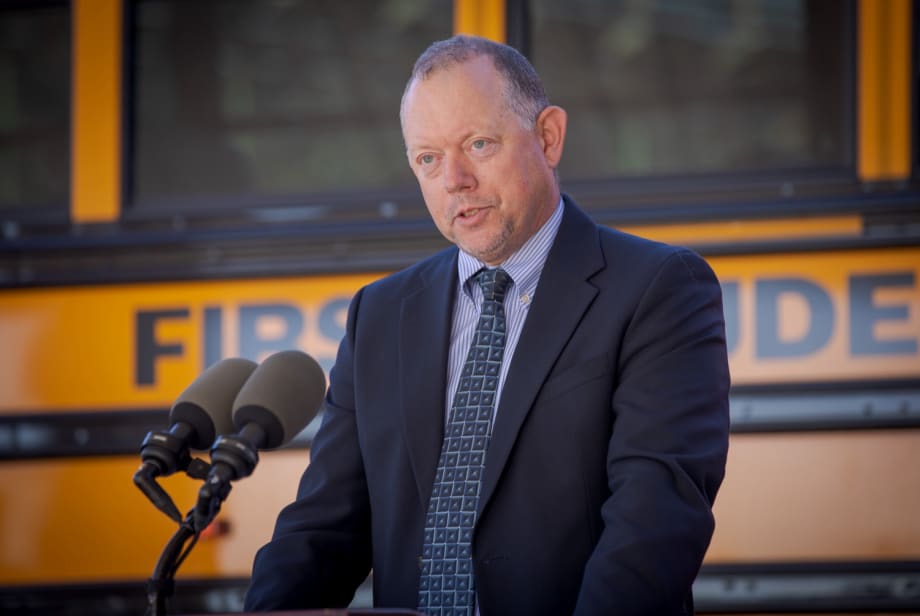
Mike Keiser, Pennsylvania's acting deputy secretary for highway administration, urged motorists to remain vigilant while sharing the road with school buses and students.
Photo: Commonwealth Media Services
3 min to read
The Pennsylvania Department of Transportation reported a drop in illegal school bus passing violations during its Operation Safe Stop activities this year.
Operation Safe Stop data revealed that participating school districts and law enforcement agencies reported witnessing 155 violations of the law, down from the 252 reported in 2021. The initiative is held in conjunction with local and state police departments, school districts, and pupil transportation providers to conduct enforcement, raise public awareness about the consequences of improper passing of school buses, and reduce occurrences. Convictions for breaking the School Bus Stopping Law increased from 314 in 2020 to 348 in 2021.
“The increase in convictions of the School Bus Stopping Law last year is just one reason why we’re reminding motorists of its importance. One incident of passing a school bus is one too many,” said Mike Keiser, Pennsylvania’s acting deputy secretary for highway administration. “With additional challenges such as darkness coinciding with more of our students’ school bus ride times and the distraction of the quickly approaching holiday season, it is important that motorists remain vigilant while sharing the road with school buses and students.”
The School Bus Stopping Law requires motorists to stop at least 10 feet from the bus when approaching a school bus with its red lights flashing and stop arm extended. Motorists approaching from all directions are required to stop. The only exception to this law is when motorists encounter a school bus stopping on the opposite side of a divided highway when lanes of the highway are clearly separated by a divider, such as a concrete barrier or grassy median.
“Drivers might consider the penalties if convicted of disobeying Pennsylvania’s School Bus Stopping law steep – a $250 fine, five points on your driving record, and a 60-day license suspension,” said Corporal Zeina Black, Permits and Bus Safety Unit supervisor with the Pennsylvania State Police. “But even worse than these penalties, a tragedy could occur if either a driver or a student is not paying attention to their surroundings.”
Some safety tips for students to remember while waiting for or loading and unloading the bus include:
Get to the school bus stop five minutes early, so you won´t have to run across the road to catch the bus.
When waiting for the bus, stay away from traffic.
Line up at least five giant steps away from the curb or the roadway to wait for the bus.
Never run after the school bus if it has already left the bus stop.
Never push when getting on or off the school bus.
“Student safety at school bus stops and in school zones is of the utmost importance and requires the undivided attention of all motorists,” said Pennsylvania Department of Education Secretary Eric Hagarty. “Local school districts work hard to identify the safest locations possible for school bus stops and to train their staff. But to ensure that students remain safe, we urge all drivers to watch for the flashing lights of school buses and always stop when students are getting on and off.”
More Safety

How to Build a Better School Bus Driver Training Program
Is it time to strengthen your driver training? Here’s how to pick the right talent and improve recruitment, retention, and safety. This video is brought to you by IC Bus.
Read More →
Recent School Bus Accidents Leave 2 Dead, 2 Injured
Four school bus crashes in Florida, Illinois, and Georgia highlight risks in transportation lots, at bus stops, and during student loading and unloading.
Read More →
Sponsored•September 8, 2026
When Every Second Matters, Clarity Keeps Routes Moving
From routine delays to urgent incidents, strong communication practices help drivers, dispatchers, schools, and families respond with confidence.
Read More →

What Happens When a School Bus Catches Fire — and What Can Help
School bus fires are rare but can be devastating. Learn how advances in fire suppression and asset protection help fleets detect fires earlier, reduce damage, and improve safety.
Read More →
Geotab Launches Tool to Help Fleets Investigate Road Incidents
Geotab Investigations combines telematics data, video, documents, and other evidence to help fleets reconstruct incidents, resolve claims, and determine what happened.
Read More →
Texas Sixth Grader Wins 2026 National School Bus Safety Poster Contest
Sai Darshana Yekolu of Moseley Middle School in Prosper, Texas, was named the newest winner for her artwork, bringing the theme of “Safe Rides, Everyday Heroes” to life.
Read More →
Sponsored•August 27, 2026
Doing More With Less: How Transportation Directors Can Prioritize Safety Amid Budget Uncertainty
With diesel prices soaring and nearly one-third of transportation directors expecting budget cuts, maintaining student safety has never been more challenging. Download this guide to learn how leading districts are prioritizing risk, funding critical safety technology, and building stronger budget cases with data.
Read More →
Walton County Schools Adds Gatekeeper Stop-Arm Enforcement System
The Florida district will deploy Gatekeeper’s updated Student Protector technology, which now incorporates AI to improve video evidence.
Read More →
How To Build a More Secure School Bus Yard During and After Hours
As thefts and overnight security threats continue, school transportation leaders are combining stronger operational practices with AI-enabled surveillance to better protect buses, facilities, and staff.
Read More →
FMCSA Names New Chief Safety Officer: What School Bus Operators Should Know
Steve Dowling is set to lead the federal agency's efforts to advance commercial motor vehicle safety and reduce crashes, fatalities, and injuries on the nation's roadways.
Read More →