




Law Passed After Alabama School Bus Driver Shooting Spurs Security Changes
The Charles “Chuck” Poland Jr. Act allows school districts to prosecute trespassers as a misdemeanor. It has also helped boost school transportation security training.

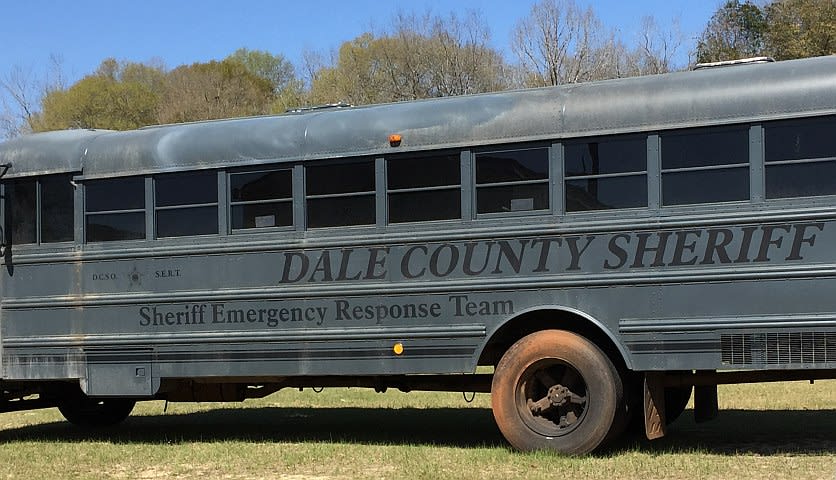
Dale County (Ala.) Schools donated the bus shown here to the Dale County Sheriff's Office for use in safety training exercises. This bus was also used as a tactical headquarters during the hostage crisis.
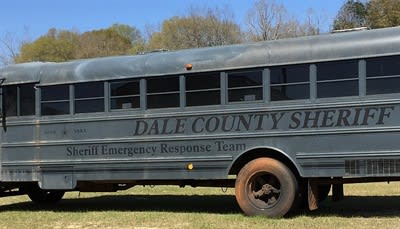
Dale County (Ala.) Schools donated the bus shown here to the Dale County Sheriff's Office for use in safety training exercises. This bus was also used as a tactical headquarters during the hostage crisis.
A law created after the tragic shooting of school bus driver Charles Poland Jr. in 2013 has heightened safety awareness and helped to enhance school transportation security and training practices in Alabama.
Named for the driver, the Charles “Chuck” Poland Jr. Act grants authority to school districts to prosecute as a misdemeanor anyone who boards the bus without the bus driver’s permission, or tries to block the bus. The offenses are punishable by a fine of up to $6,000 or one year in jail. The law was passed in June 2013, a few months after the incident.
On Jan. 29, 2013, Poland was shot by an intruder, Jimmy Lee Dykes, who then took a boy from the bus and held him hostage in an underground bunker for nearly a week. FBI agents entered the bunker, killed Dykes and rescued the boy.
The law is a combination of two previous laws that had been proposed before the shooting: one that was filed weeks before the incident, which would have established trespassing on state school buses as a Class B misdemeanor, and another bill sponsored by state Rep. Alan Baker that required schools to hold drills for active shooters and intruders at least once a semester.
As a result of the law, the fine for trespassing on a school bus was raised from up to $2,000 to up to $6,000. (Trespassers can also still be sentenced to up to one year in jail.) These terms are specified on revised “No trespassing” stickers that are placed on all school buses statewide. The wording on the new stickers was also revised to specifically state “No trespassing on this school bus,” said Kevin Snowden, program coordinator for the Alabama State Department of Education.
Snowden was a supervisor and driver trainer at a nearby school district when the tragedy occurred, and said that at the time, instructors were already telling the drivers to never open their door and let people on the bus.
Now, though, bus driver trainers discuss the shooting as part of the training process.
Donny Bynum, superintendent of Dale County (Ala.) Schools, said that his district’s transportation department has gotten even more proactive on training, working hand in hand with local law enforcement and the state Department of Education on training sessions to enhance security.
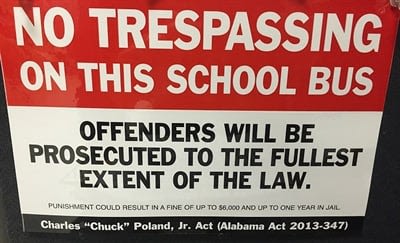
New stickers on school buses include a more specific warning that trespassing on the bus is against the Charles "Chuck" Poland Jr. Act.
“We can’t sit on what we’ve learned about safety,” he added. “We constantly have to look at ourselves and have others look at us to ensure that we’re doing the best we can do to protect our children and our drivers.”
The district works closely with the Dale County Sheriff’s Office on summer safety training sessions for the bus drivers, and has donated a school bus — which was used as a tactical headquarters during the initial stages of the hostage crisis — to the sheriff's office for use in the sessions. During the sessions, drivers ask sheriff personnel for advice on what to do in various scenarios.
The biggest lessons taught in the training are for bus drivers to be mindful of their surroundings, never let their guard down, and always trust their instincts. That means when observing individuals or circumstances that don’t look like they should, do the safest thing, such as keeping students on the bus, or contacting law enforcement, Bynum said.
Dale County Schools no longer allows its bus drivers to carry on conversations on bus routes or while loading and unloading students. That policy change has not only been communicated to the bus drivers, but also to the public.
Mary Janice Poland, the widow of Poland, who is also a substitute teacher at Cottonwood High School in Houston County School District, has noticed that the rules at her school about bus drivers conversing with the general public are much stricter as a result of the incident.
“I hope what comes out of the tragedy is something good,” she said.
Lydia Hancock, who is the daughter of Poland and works at Cottonwood High School as a substitute teacher and co-director of the after-school program, said that the school’s bus drivers tell her that every August since the shooting, they attend a security training session that lasts for about three days and the incident with her father is covered.
Hancock added that her two children ride the school bus, and that the hardest thing she has ever had to do was to put them on the school bus after what had happened to her father.
“It’s not just because of the kidnapping or dad’s life being taken, but the trauma that those kids on the bus had to experience,” she explained. “I don’t want my boys to experience that.”
More Safety

How to Build a Better School Bus Driver Training Program
Is it time to strengthen your driver training? Here’s how to pick the right talent and improve recruitment, retention, and safety. This video is brought to you by IC Bus.
Read More →
Recent School Bus Accidents Leave 2 Dead, 2 Injured
Four school bus crashes in Florida, Illinois, and Georgia highlight risks in transportation lots, at bus stops, and during student loading and unloading.
Read More →
When Every Second Matters, Clarity Keeps Routes Moving
From routine delays to urgent incidents, strong communication practices help drivers, dispatchers, schools, and families respond with confidence.
Read More →

What Happens When a School Bus Catches Fire — and What Can Help
School bus fires are rare but can be devastating. Learn how advances in fire suppression and asset protection help fleets detect fires earlier, reduce damage, and improve safety.
Read More →
Geotab Launches Tool to Help Fleets Investigate Road Incidents
Geotab Investigations combines telematics data, video, documents, and other evidence to help fleets reconstruct incidents, resolve claims, and determine what happened.
Read More →
Texas Sixth Grader Wins 2026 National School Bus Safety Poster Contest
Sai Darshana Yekolu of Moseley Middle School in Prosper, Texas, was named the newest winner for her artwork, bringing the theme of “Safe Rides, Everyday Heroes” to life.
Read More →
Doing More With Less: How Transportation Directors Can Prioritize Safety Amid Budget Uncertainty
With diesel prices soaring and nearly one-third of transportation directors expecting budget cuts, maintaining student safety has never been more challenging. Download this guide to learn how leading districts are prioritizing risk, funding critical safety technology, and building stronger budget cases with data.
Read More →
Walton County Schools Adds Gatekeeper Stop-Arm Enforcement System
The Florida district will deploy Gatekeeper’s updated Student Protector technology, which now incorporates AI to improve video evidence.
Read More →
How To Build a More Secure School Bus Yard During and After Hours
As thefts and overnight security threats continue, school transportation leaders are combining stronger operational practices with AI-enabled surveillance to better protect buses, facilities, and staff.
Read More →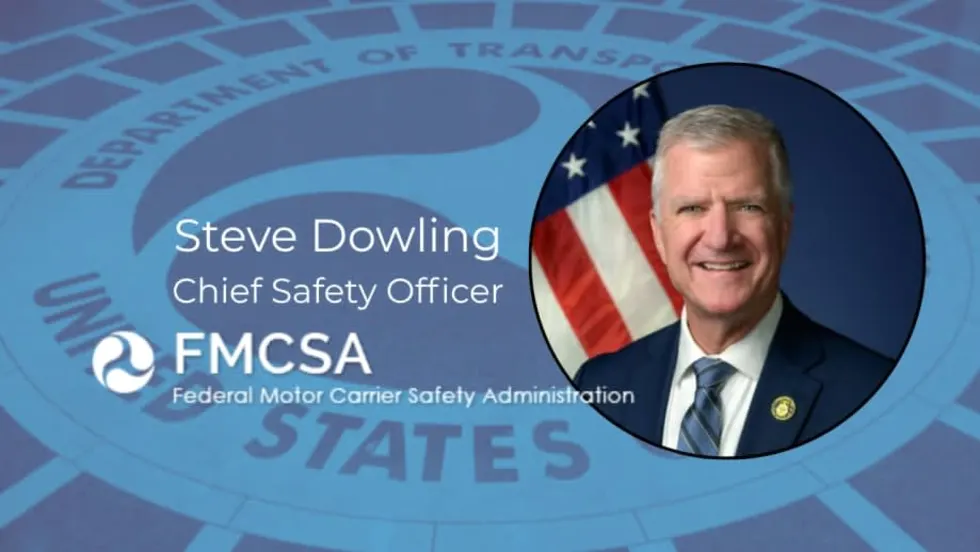
FMCSA Names New Chief Safety Officer: What School Bus Operators Should Know
Steve Dowling is set to lead the federal agency's efforts to advance commercial motor vehicle safety and reduce crashes, fatalities, and injuries on the nation's roadways.
Read More →