




News from the World of Pupil Transportation
Blue Bird closes Iowa plant permanently FORT VALLEY, Ga. — Blue Bird Corp. has closed its school bus manufacturing facility in Mount ...

Blue Bird closes Iowa plant permanently
FORT VALLEY, Ga. — Blue Bird Corp. has closed its school bus manufacturing facility in Mount Pleasant, Iowa, for good.
Although the move will not affect any of Blue Bird's 1,700 employees at bus and recreational vehicle facilities in Fort Valley, about 350 workers in Iowa were laid off. The company had originally announced that the plant would be shut down temporarily, but Blue Bird officials said that a permanent closure was necessary for cutting costs in a sluggish school bus market.
Blue Bird President Richard Maddox said in a prepared statement, "This decision is absolutely no reflection of the performance of our Iowa plant, but with the current market pressures we must seize the economies of scale that are available from consolidating our production into fewer manufacturing sites."
Orders already assigned to the Iowa facility will be re-routed to one of Blue Bird's three other North American facilities in Fort Valley, Lafayette, Ga., and Brantford, Ontario. The company plans to help find idled employees jobs in the local area.
Citing a weakened economy, Blue Bird also laid off several hundred workers in 2001.
Caterpillar inks engine supply deal with Blue Bird Corp.
PEORIA, Ill. — Caterpillar Inc. announced a long-term engine supply agreement with Blue Bird Corp., making Caterpillar the leading engine supplier for Blue Bird school buses.
Caterpillar will provide Blue Bird with 3126E, C9 and C12 diesel engines for school buses. Beginning in early 2003, the engines will be equipped with ACERT technology. ACERT is a clean diesel technology that will meet all Environmental Protection Agency (EPA) engine emissions standards through 2007.
The supply agreement will become effective on Blue Bird Type D, transit-style school buses beginning Nov. 1, 2002. Financial details of the contract between the two companies were not made public.
Said Caterpillar VP James J. Parker, "We are extremely honored to be Blue Bird's new partner in the important North American school bus market."
Blue Bird officials said the ACERT engine technology offered the best low-emission solution for meeting EPA standards. "We have been very impressed with Caterpillar's commitment to and investment toward the development of a viable emissions technology solution," said Richard Maddox, Blue Bird's president.
Who says field trips are only for kids?
CAVE CREEK, Ariz. — As transportation director at Cave Creek Unified School District, I'm always looking for innovative ways to provide refresher training for my drivers. This year I decided to look beyond the usual classroom presentations, videos and lectures.
With the assistance of my trainers and behind-the-wheel instructors, I was able to offer my drivers a daylong field trip that included learning and hands-on training.
The drivers were divided into five groups with a trainer or instructor assigned to each. The role of instructors and trainers was to oversee the trip and their group by playing host. They were to direct the group along their path of travel, maintain the time schedule, critique driving skills, take photos, offer advice and have fun.
The day started at 6:45 a.m. with the drivers drawing for placement on the leg of the trip they would be driving. The day would include approximately 160 miles of diverse travel (with each driver driving a portion of the trip), including downtown Phoenix rush-hour traffic, freeway and mountain driving.
The buses rolled out at 7 a.m. and returned at 4 p.m. The field trip took them to the following places, with a 30-minute presentation at each stop.
I-10 International — a school bus vendor for International Truck and Engine Corp. The drivers viewed the latest features of the International school bus.
Auto Safety House LLC — a school bus vendor for Blue Bird Corp. The drivers were treated to hands-on demonstration of a brake board designed to offer a unique and simple understanding of how the brakes work on a school bus.
Coach & Transit Inc. — a school bus vendor for Thomas Built Buses. The drivers were shown a new bus and were briefed on the procedures that must be followed in order for a new bus to pass state requirements.
Arizona's Department of Public Safety, Pupil Transportation — the state agency that oversees driver certifications and renewals, among other things.
The day offered the drivers an opportunity to hone in on their driving skills as well as network with fellow staff members and build camaraderie. It was a real treat for the bus drivers to go on a field trip for a change, and it made learning fun. Who says field trips are only for kids?
-By Cathy ErwinNew York adopts drawstring ban
ALBANY, N.Y. — Concerned about the dangers of snagging accidents, New York lawmakers have passed a ban on the sale of children's clothing with drawstrings. The measure, which was signed on Sept. 17, prohibits the sale of clothing from toddler size up to children's size 16 that includes a waist, hood or neck drawstring.
In the 1990s, several serious injuries and fatalities were attributed to children's drawstrings catching in the handrails of school buses. Some children were killed when the bus drove away with their drawstrings still snagged, causing them to fall under the rear wheels.
In 1993, the federal government began a recall campaign to modify handrails so that drawstrings could not snag. Thousands of buses were affected by the recall, which also prompted bus manufacturers to redesign the handrail to preclude snag-and-drag accidents.
Thomas breaks ground on new school bus plant
HIGH POINT, N.C. — Thomas Built Buses held a groundbreaking ceremony this week for its new $39.7 million school bus manufacturing plant, slated for completion in 2004.
The state-of-the-art facility in High Point, N.C., is being built adjacent to the company's current site for pre-delivery bus inspection and storage. The new plant, which will manufacture conventional-style school buses, will generate approximately 178 new jobs.
"This new plant is just one of many exciting developments yet ahead of us as we continue to carry out our plans to extend our lead in the North American school bus industry," said Rainer Schmueckle, president and CEO of Freightliner LLC, parent company of Thomas.
High Point Mayor Arnold Koonce attended the ceremony, along with state and local elected officials. A third-grade class from a local elementary school also participated, leading the audience in the pledge of allegiance.
"You can expect to see a manufacturing facility that will enable us to provide our customers with even higher quality school buses, as well as provide the flexibility to build the exciting new products currently in development," said John O'Leary, president of Thomas Built Buses.
Some facts about the new manufacturing plant:
275,000 square feet of production space on an existing 90-acre site.
Three-quarter-mile assembly line will have 75 workstations.
Initially capable of producing 22 buses per shift.
National champion sings praises of roadeo events
TORRANCE, Calif. — Two-time national school bus roadeo champion Brent Carman, a 17-year driver with the Morgan Hill (Calif.) Unified School District, discussed with SBF his success in roadeo competitions and their benefits.
SBF: What is the competition like in the national roadeo? Fierce? Supportive?
Carman: It's pretty intense at the national level because a lot of people are going there simply to win the title.
SBF: Is it too competitive?
Carman: No, because everyone intermingles and has a good time. But for me, my goal has always been to get to nationals and win it. After I won this year [at the School Bus Driver International Safety Competition in Chicago], competitors came up and congratulated me, so it is a very positive environment.
SBF: Does the roadeo give you a chance to learn and network with others?
Carman: I think that anyone who goes to roadeos will better their driving skills, whether it is at the national level or local. It all depends on the individual.
SBF: How do you prepare for the national competition?
Carman: I spend a lot of time practicing and focusing on what I need to get done. I try to go to at least two or three roadeos each year, and the first one is always to get the butterflies out of my stomach. Then, after I do the first one, I look at what I did to see what I want to change or improve. I look at what I am accomplishing and what I am weak at, then I will practice more on my weak spots. This year at nationals, I hit a flag where I normally don't hit flags, so I know that next year I am going to have to look at that and spend more time working on it.
SBF: How would you say a roadeo competition makes you a better driver?
Carman: It is set up with events, where, for instance, you will go through a tight alley marked off by frames with flags sticking out, and you have to go through with the width of your bus plus two feet. So basically you are running an obstacle course. It helps you in your day-to-day driving because it's a lot like going in between cars and making lane changes. You become more in tune with your mirrors and your peripheral vision after practice and competition. By doing these events, you get your eyes in tune to look for all types of things on the road, things you won't see if you are not accustomed to using a larger range of vision.
SBF: Do you have any complaints about the competition?
Carman: It would be nice if they showed everyone's scores at the end so that people could see how much they need to improve to win.
SBF: What would be your best advice to someone entering a roadeo for the first time?
Carman: I would suggest going to some roadeos to find out who the top dogs are and then trying to get acquainted with them. If they aren't willing to help you out, you should at least watch them a little bit to learn from them.
KinderCare expands fleet with Thomas Minotours
HIGH POINT, N.C. — KinderCare Learning Centers, based in Portland, Ore., purchased 60 Thomas Built Type A Minotour school buses for its operations in Michigan.
KinderCare, one of the largest providers of childcare services in the U.S., has 1,300 operations in 39 states and transports more than 36,000 students to and from school daily. Of the operator's approximately 2,500 vehicles, 1,200 are school buses, and approximately half of those are Thomas Minotours.
"We have been working with Thomas Built Buses since 1999 because of its strong reputation for quality products and services," said Darrell Lyons, manager of the KinderCare vehicle fleet. He said that parents of childcare students will feel safer knowing their children are transported in Thomas Built school buses.
The Thomas Minotour features one-piece, 14-gauge steel bow frames for added strength and durability. The bumpers are double-profile, 12-gauge steel, and the bus uses welded construction for additional structural integrity.
12th special-needs show information released
ARLINGTON, Va. — The 12th National Conference and Exhibition on Transporting Students with Disabilities and Preschoolers will be held at the Westin Hotel and the Indiana Convention Center in Indianapolis from Feb. 28 to March 5, 2003.
Complete information has been released about the conference, including a tentative schedule of events for the trade show, companion workshop and special-needs team safety roadeo. Listings of conference presenters, exhibitor information, session topics and meeting times have also been released.
Serif Press, the Arlington-based printing company that sponsors the conference, has made the information available on its Website, which can be accessed at www.eduprogroup.com. For more information about the conference, send e-mail to conference@serifpress.com.
PTSI offers new Head Start training package
SYRACUSE, N.Y. — The Pupil Transportation Safety Institute (PTSI) announced the release of its latest manual, the "PRESERVICE Training Package for New Head Start Drivers and Monitors." This 30-hour training package, the third in a series of training resources produced jointly by PTSI and the National Head Start Association, focuses on fulfilling requirements of the Head Start Transportation Regulations for new drivers and monitors.
The new package gives driver- and monitor-trainers an entire curriculum from which to prepare new employees for Head Start transportation operations. The package includes a 175-page trainer's guide with a class introduction, lesson plans and overhead transparencies. A CD with more than 200 PowerPoint slides, 10 trainee workbooks and award certificates are also included.
Topics covered in the program comply with federal regulations on Head Start transportation, federal drug and alcohol requirements for bus drivers and OSHA's "Right to Know" hazardous materials training. For more information, visit www.ptsi.org.
NHTSA announces school bus recalls
AMERICAN TRANSPORTATION
Models: IC (Integrated Conventional)
Year: 2002
Number involved: 123
Dates of manufacture: August 2001-May 2002
Noncompliance: Certain school buses equipped with an optional between-the-frame mounted fuel tank fail to comply with the requirements of FMVSS 301, "Fuel System Integrity." These buses were built with the wrong crossmember. The crossmember installed was not of the same strength as originally intended. Failure of the crossmember during a crash could reduce the integrity of the fuel system, allowing fuel leakage that could result in a fire.
Remedy: Dealers will install a new crossmember. The manufacturer has reported that owner notification began July 29. Owners who do not receive the free remedy within a reasonable time should call (800) 843-5615.
NHTSA Recall No. 02V173
American Transportation Recall No. 02-301BLUE BIRD BODY CO.
Models Affected: Commercial Series Transit buses (2001-03)
TC2000 School and Transit buses (2001-03)
All American School and Transit buses (2001-03)
Number involved: 3,249
Dates of manufacture: January 2001 through June 2002
Defect: On certain school buses and transit buses equipped with Allison 2000 Series transmissions, the "Range Inhibited" indicator light on the dash was not activated and does not function. The indicator light alerts the driver that transmission operation is being inhibited and that range shifts being requested by the operator may not occur. The manufacturer has reported that owner notification began in August. Owners who do not receive the free remedy within a reasonable time should contact Blue Bird at (478) 822-2242.
NHTSA Recall No. 02V-177
Blue Bird Recall No. R02GCQuestion of the Month
In the wake of recent child abductions, do you think bus stop safety should be improved? If so, how?
From the Forum at schoolbusfleet.com
Children are helpless against the strength of adults
I think bus stops need to be more secure, with an adult or two present (parents or guardians of the children, obviously). And I agree that drivers need to watch more closely that kids get to their correct homes, and safely at that.In reality, children, especially young ones, aren't going to be able to tell the difference between a friend and someone who is about to abduct them. Toys and candy have a heck of an effect on a child. Just because parents try to teach their child not to talk to strangers, it doesn't mean they will listen when faced with a lollipop or whatever.
And what about children who are just simply whisked away? Sure, they can try to fight back, but some might panic and forget, and we all know that an adult is stronger than a child. I think bus stop safety should be upgraded and maintained at the highest level possible.
RYAN DALLESANDRO
School Bus Driver
Orrville, OhioParent or trusted neighbor should always be present
I think that it's very important for a parent to be present at the bus stop in both the morning and the afternoon. When I was in elementary school, my mother was at my bus stop with me and my friends every morning, and she was waiting for us every afternoon. Not every child's parent needs to be present, but at least one parent should be there with the group of children to see them off to school in the mornings and to meet them in the afternoons. I realize that this isn't a perfect world and a lot of kids' parents work nowadays, but when at all possible, there should be a parent (or a trusted neighbor, friend, etc.) at the bus stop.TRINA FALK
School Bus Driver
Carmel, Ind.It is our total responsibility to protect children at bus stops
It is inherent that everyone take a role in protecting children, since many of them can't protect themselves. The parent, the motorist, the bus driver, the gardener, the senior citizen sitting on the porch....everyone must be aware of activity at the bus stop.Yes, I agree that children should be taught early to be aware of their surroundings. Yet, they may not be able or mature enough to defend themselves adequately — and a younger child certainly can't at all. Remember that these are children.
Quite simply, we need adult supervision of children at the bus stop. We need adults waiting with them to board in the morning and waiting for them to return in the afternoon.
DARNESE NICHOLSON
Transportation Manager
Gallaudet University
Washington, D.C.Defense skills, parental responsibility will increase bus stop safety
Our first line of defense in my Cub and Boy Scout units against a predator was and is to "know" everyone. Our second line is having two-deep leadership. If you have at least one parent at the bus stop or even a couple of parents who rotate, the driver will know who is who, and who is "not."The kids, for sure, should be made more attune to keeping their eyes open. I have taught my kids various "locks and blocks" to defend themselves from people grabbing them. My kids call it wrestling, but I call it teaching them survival skills.
I was gone from the lower 48 states for a long time and I'm still not sure how it became the government's responsibility to raise our kids. It's our responsibility as parents and concerned adults to do the watching or somebody else will.
KEN WELLS
School Bus Equipment Inventor
Milwaukie, Ore.
More Management

HopSkipDrive’s CareEngine Targets the ‘Exceptions’ in Student Transportation
The new platform works alongside districts’ existing transportation management systems to coordinate specialized rides, automate last-minute changes, and turn ride data into operational improvements.
Read More →
The Right Ride for Every Student: Navigating the New Student Transportation Ecosystem
How should districts blend school buses with small-vehicle transportation and other options? EverDriven CEO Mitch Bowling discusses safety, costs, partnerships, and strategy.
Read More →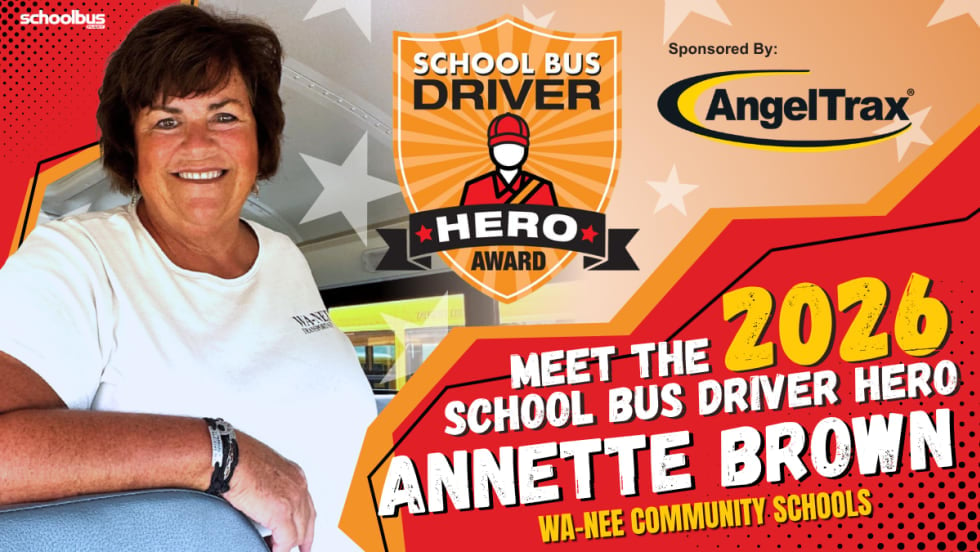
Annette Brown Always Takes the Extra Time: Meet Our 2026 School Bus Driver Hero
For more than 30 years, the Wa-Nee Community Schools driver has treated students like family, combining safety, compassion, and servant leadership to make a lasting difference on and beyond the school bus.
Read More →


How to Build a Better Driver Training Program
Ready to boost up your school bus instructor training? Here’s how to pick the right talent and improve recruitment, retention, and safety.
Read More →
CALSTART and Forth Combine to Form Catalyst Mobility
The new name represents a renewed vision for the nonprofit focused on advancing clean, equitable, and affordable transportation solutions that move people and goods.
Read More →
What Makes a Great School Bus Driver Trainer?
Choosing the right school bus driver trainer takes more than experience. Learn six keys to selecting and developing trainers and evaluating program effectiveness.
Read More →
School Bus Contractors Expand Through New Deals, Acquisitions & Partnerships
STA's Canadian division acquires Ontario-based G&L Stevenson Transport; Durham School Services adds a new district in California; First Student expands in New Jersey; and Minnesota Coaches rebrands and acquires Halo Transportation.
Read More →
Logan Bus Company Rolls Out AI Phone System for NYC School Bus Families
A summer pilot found that AI agents could handle most routine calls, freeing up time for customer service staff to focus on emergencies and complex family concerns.
Read More →
From Intent to Impact: What I Learned About Leadership from TAPT
A Texas transportation supervisor shares lessons on self-awareness, accountability, managing stress and building trust — and why investing in leadership development matters at every stage of your career.
Read More →
NAPT Names 2026 Award Recipients, Hall of Fame Inductee
Who earned national recognition for their work in student transportation? This year, NAPT named five recipients of its 2026 awards for service, safety, and leadership, plus its newest Hall of Famer.
Read More →