


SBF 70 years logo
MenuMENU
SearchSEARCH

Tips and tools to select safe stops

Pupil transporters recommend considering everything from whether to use mid-block stops or corner stops to avoiding situations where students must cross a busy street to ensuring that the bus has enough room to maneuver in the area. Staff input and routing software can assist in this task.

Kelly Aguinaldo
Kelly AguinaldoManaging Editor
July 23, 2013
Tips and tools to select safe stops

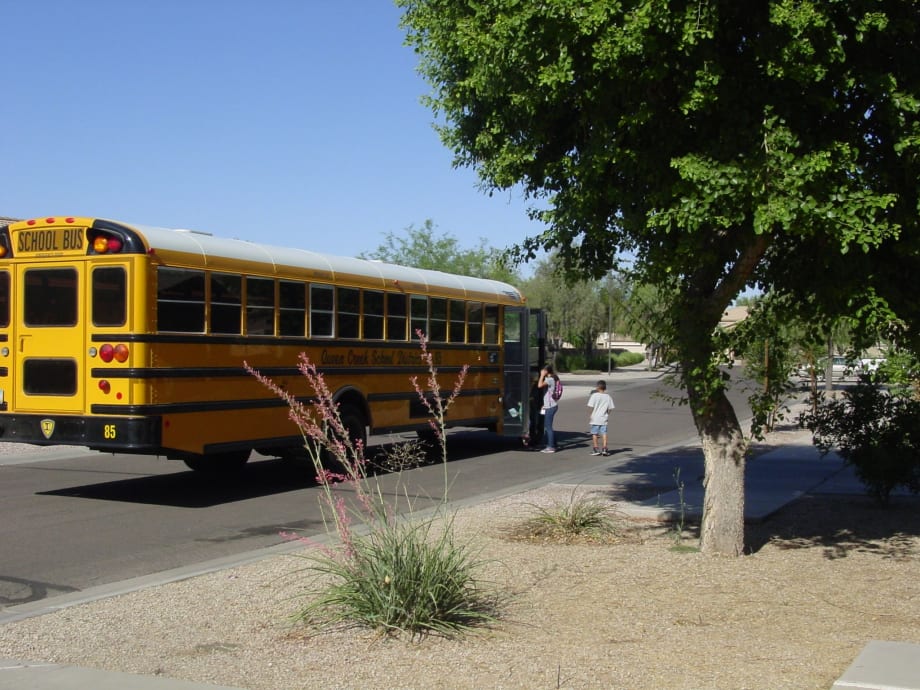
Queen Creek (Ariz.) Unified School District #95 strives to put its bus stops in residential neighborhoods, away from busy thoroughfares. Photo courtesy of Queen Creek (Ariz.) Unified School District #95.

7 min to read


Kerry Somerville says a day he’ll never forget is when he received a call that two students had been killed near one of his operation’s school bus stops. At the time, Somerville was the assistant transportation director at a school district in Alaska.  

“[Following the accident], I got calls almost daily from one of the students’ parents asking me why I killed her child,” he says. “It was her contention that if the stop was in a different location, the accident never would have happened.”  
       
Now involved in the supplier segment of the pupil transportation industry as director of business development at U.S. Computing Inc., Somerville says he is adamant with the transportation personnel at school districts and bus companies that he works with about how important bus stop location is in ensuring student safety.

What to consider with bus stop placement
Where possible, many operations try to situate their school bus stops in residential neighborhoods, off of major thoroughfares and as close to students’ houses as possible. Such is the case at Queen Creek (Ariz.) Unified School District #95.

Director of Transportation Edd Hennerley says that the routing software his operation uses — Routefinder Pro from Transfinder — helps in these efforts. The software identifies where each student lives, and then Hennerley and his team can identify that a stop needs to be established where there is, for example, a cluster of 10 students.

“We can specify what roads we don’t want the stop to be on,” Hennerley adds. “The software will then show us the closest location for a stop that’s not on those roads. We also have the option to place students at a stop other than what the program suggests.”

Joseph Rossi, director of global sales at Transfinder, adds that the company’s software keeps a table of all the bus stops that the user can edit, and the user can keep specific notes about each stop. In Transfinder’s newest version, the user can also include documents, such as a discipline report from students fighting or parent complaints of vandalism, for each bus stop.
[PAGEBREAK]• Corner stops versus mid-block stops. The range of environments in which a district or bus company provides service will often dictate whether a stop is placed in the middle of a block (mid-block) or on the corner. John Fahey, senior consultant at Tyler Technologies and past assistant superintendent of service center operations at Buffalo (N.Y.) Public Schools, says that since Buffalo is an urban environment, Buffalo Public Schools used corner stops, explaining that students would wait as the bus stopped at the beginning of the intersection.

He notes, however, that mid-block stops have advantages. “You don’t have an intersection there, so you might have less traffic to worry about.”

Carol Karl, safety coordinator at Illinois Central School Bus in Bloomington, Ill., is in favor of mid-block stops, and it is a practice that Illinois Central School Bus upholds.

“If you’re at a mid-block location, the bus, by virtue of its stop arm and lights, can control the traffic,” she reasons. “If you’re doing corner stops, you’re only controlling one street of traffic — you can’t control the other street.”

With Trapeze Group’s routing software, VEO Transportation, users can create a corner stop or an address stop, according to Steven McKinley, operations manager, school division. Users then have access to alternate stops that are turned on and off automatically based on safety parameters that the users have set.

“They’re turned on and off based on whether the street has sidewalks, if the students can cross at intersections and other safety policies and parameters that have been set,” McKinley explains. “It helps establish the options for traveling to or from that bus stop safely.”

U.S. Computing’s program has tools that allow the user to do analysis to see how far students are walking to stops, and the software can create safe walking paths for students to get to and from the stops.  

EDULOG President Jason Corbally says that with mapping technology becoming so widely used, from a county’s GIS agency EDULOG can get data on high-crash corridors, and that data can be incorporated into the company’s routing software, which can help operations in deciding bus stops’ placement.

“They also carry data of where pedestrians most often get hit by cars,” Corbally says of a county’s GIS agency.

 • Avoid proximity to sex offenders’/predators’ houses. This is common sense, and officials say they strive to stay abreast of these people who reside in their areas of service. They typically have access to this information from their sheriff’s office, and Hennerley says that his operation regularly updates a bulletin board with details about the predators and offenders.
 
In addition, routing software from Transfinder, Tyler Technologies, EDULOG, U.S. Computing and Trapeze Group all offer the ability to store information about sexual predators and sex offenders in the system so that notifications will appear if bus stops or students are in the vicinity of these individuals’ homes.

With Trapeze Group’s VEO Transportation software, users can create a corner or an address stop. They then have access to alternate stops that are turned on and off automatically based on safety parameters that the users have set.

Minimize cross-over, and don’t overload stops. Fahey says students should approach a bus stop with the least amount of cross-over possible (i.e., students crossing the street to reach the stop) to reduce the potential of getting struck by a vehicle.   

“Routing software should recognize the ability to minimize cross-overs and allow you to put in that restriction,” he adds.

Karl, whose company uses Tyler Technologies’ Versatrans routing software, says that it enables her routers to see where the majority of the students they transport are coming from, so they can make right-side stops to cut down on the number of students crossing the street to get to a stop.  

Another item to consider, Fahey says, is the number of students at each stop, noting that having too many at one stop could create a hazardous environment. Karl says that with the Versatrans software, the user can enter the maximum number of students desired at a specific stop, and stops will be created based on that information.

[PAGEBREAK]

Ad Loading...
At First Student’s terminal in Wichita, Kan., drivers are not allowed to back up their buses unless the situation is extreme, but even then, they must have a spotter. Senior Location Manager John Billigmeier says the routes are designed so that drivers don’t have to back up at a stop.

 Is there room for the bus?  
Making sure that your school buses have enough space to maneuver at their stops is essential in planning their locations on a route.
 
At First Student’s terminal in Wichita, Kan., the drivers are not allowed to back up their buses on a route unless the situation is extreme, and even then, the drivers must have a spotter, according to Senior Location Manager John Billigmeier.

Taking that into account, Billigmeier says, “We design our routes so that buses will not have to back up at any time. You don’t want a bus going down a cul-de-sac and not being able to get out.”

Adequate turnaround area for buses is also a consideration for the School District of Maple (Wis.).   

David Korhonen, director of buildings, grounds and transportation, says almost every student for which transportation is provided is picked up or dropped off at their rural home addresses.

“Determining safe locations to turn around on rural roadways is of highest priority,” he says. “Because visibility at private driveways is an issue, we most always back into driveways. We always pick up students prior to backing up and drop off students after we have backed up at turnaround locations.  We also get great cooperation with townships and villages to create turnaround areas at dead-end roadways when private driveways are inadequate.”

Rely on feedback
Pupil transporters say they often rely on their drivers to tell them if they believe a bus stop is in an unsafe location, and some also welcome feedback from parents.  

“We tell parents that if they see bus stops that they think are unsafe, they can contact us and we’ll go down and look at the stops,” Hennerley says.

“In Wichita, we have over 2,400 runs a day between 505 routes, so input from the drivers is extremely important,” Billigmeier says. “We make numerous changes during our dry runs and the first couple of days of school. We have a safety team that also helps to go out to high-interest stops to ensure that we are operating in those areas as safely as possible.”   

Somerville also emphasizes the importance of going out to look at stops’ locations as opposed to solely relying on the satellite view of stops through a routing software program.

He adds that at one school district that U.S. Computing worked with, the transportation department staff took photos of their bus stop locations and then stored the pictures in the company’s routing software program for future reference.   

Subscribe to Our Newsletter

More Safety

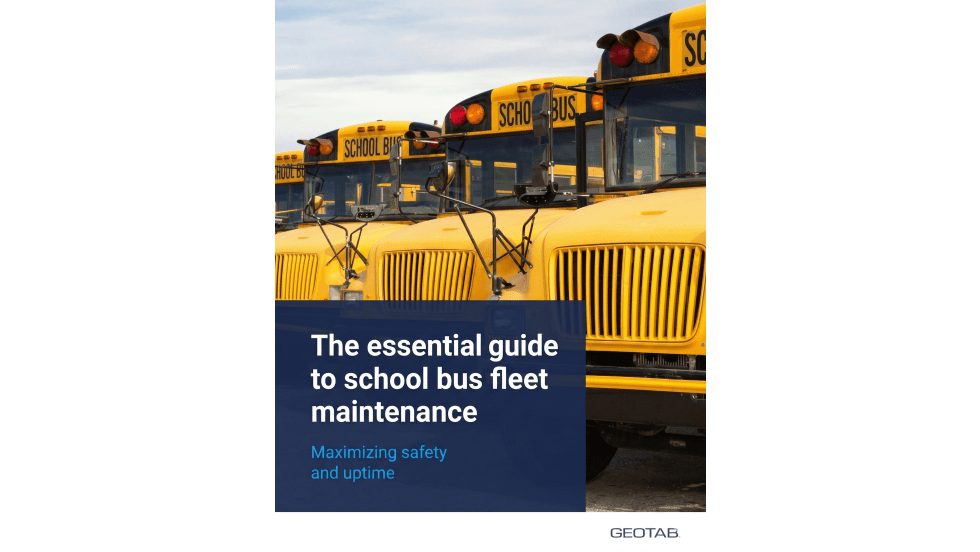
Row of yellow school buses with overlay text reading “The essential guide to school bus fleet maintenance: Maximizing safety and uptime” and the Geotab logo.
SponsoredApril 1, 2026

The Essential Guide to School Bus Maintenance: Maximizing Safety and Uptime

Stop reacting to engine lights and start predicting them. This guide reveals how transitioning from a "break-fix" model to a data-driven maintenance strategy can drastically reduce fleet downtime and protect your district's budget. Learn how to transform your garage operations from a cost center into a reliability powerhouse.

Read More →
A close-up view of the top of a yellow school bus with “School Bus” signage and red lights, overlaid with a cracked-glass effect. Text on the image reads, “Multi-Vehicle Crash in TN Takes 2 Lives” and “March 27, 2026,” with the School Bus Fleet logo in the corner.
Safetyby Staff and News ReportsMarch 31, 2026

2 Students Die in Tennessee School Bus Crash with Dump Truck

A Carroll County accident claimed the lives of two students and injured over a dozen others on a March 27 field trip for eighth graders at Clarksville-Montgomery County.

Read More →
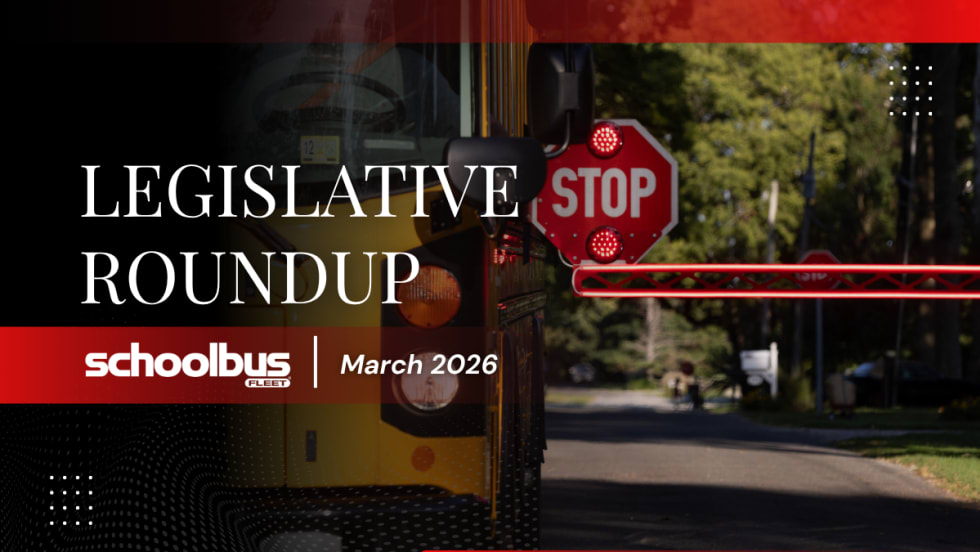
A black, white, and red graphic with an image of a stop-arm gate and text reading "Legislative Roundup March 2026."
Safetyby Elora HaynesMarch 30, 2026

School Bus Laws to Watch: Stop-Arm Enforcement, EV Mandates & Seat Belts

From North Dakota public charter school regulations, tracking illegal school bus passing consequences in multiple states, and the continued debate on New York’s electric school bus mandate, here’s the latest in school bus legislation across the U.S.

Read More →
Ad Loading...
hopskipdrive whitepaper
SponsoredMarch 30, 2026

Boosting K-12 Attendance With Innovative Transportation Solutions

While the yellow school bus remains the backbone of student transit, 75% of administrators identify limited transportation access as a major driver of chronic absenteeism. This guide explores how districts are strengthening their fleets by integrating flexible, supplemental solutions to serve students with the most complex needs. Learn how a multimodal approach can bridge service gaps, restore attendance, and support your most vulnerable populations.

Read More →
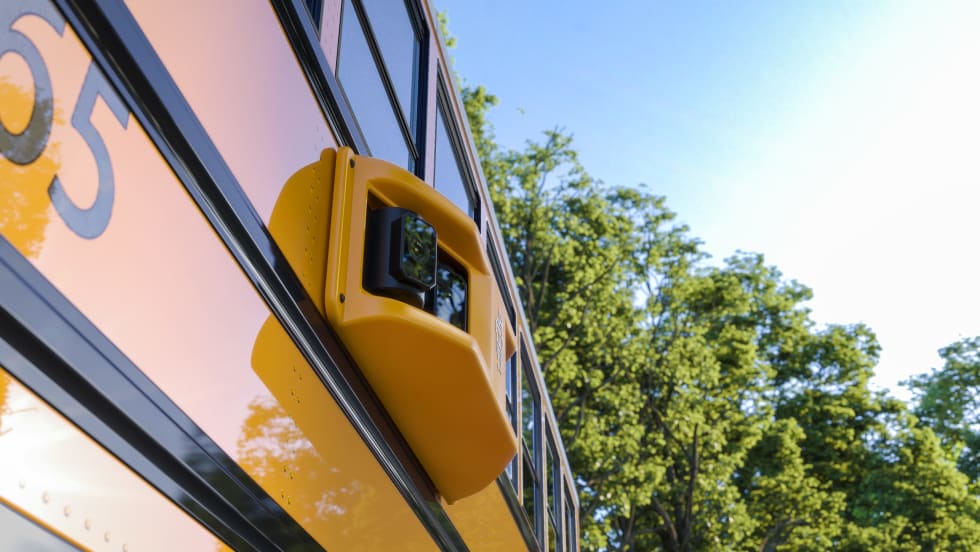
Close-up of a school bus stop-arm camera mounted on the side of a yellow bus, used to record drivers who illegally pass while students board or exit.
Safetyby News/Media ReleaseMarch 27, 2026

Michigan District Rolls Out New Stop-Arm Program

Grand Rapids Public Schools is partnering up with BusPatrol and Dean Transportation to outfit the entire bus fleet with cameras.

Read More →
An orange and white graphic with Safety Vision's logo and text reading "Report Shows Growing Impact of AI-Powered Video."
Safetyby Staff and News ReportsMarch 26, 2026

Safety Vision Report Highlights Growing Impact of AI-Powered Video on Fleet Safety

New research finds intelligent video systems are reducing crashes, lowering insurance costs, and reshaping safety strategies across school transportation fleets.

Read More →
Ad Loading...
zonar system image
SponsoredMarch 24, 2026

12 Ways To Do More Without Blowing Your Fleet’s Budget

Driver shortages and rising costs are straining already stretched school transportation budgets. Learn 12 practical strategies that help school bus fleets be more efficient, control costs, strengthen compliance, and protect student riders…all by using fleet technology that could pay for itself within a year.

Read More →
Automated external defibrillator (AED) mounted on a wall inside a manufacturing facility, highlighting workplace emergency preparedness and safety equipment availability.
Safetyby Nicole DamronMarch 24, 2026

Should School Buses Have AEDs? OEM’s New Safety Investment Sparks Discussion

A growing push to expand AED access is raising a key question for the school bus industry.

Read More →
An aerial image showing the final resting positions of a 2024 Illinois school bus crash with a tractor trailer.
Safetyby Elora HaynesMarch 24, 2026

New NTSB Investigation Report Highlights Driver Impairment and Medical Requirements

The recent investigative report found driver impairment and fatigue from prescription medications led to a fatal school bus crash in 2024.

Read More →
Ad Loading...
An orange and white graphic with the cover of HopSkipDrive's 2025 Safety Report and text reading "Seventh Annual Safety Report."
Safetyby StaffMarch 18, 2026

What’s Behind HopSkipDrive’s Near-Perfect Safety Record in 2025?

The alternative transportation provider’s 2025 Safety Report highlights 99.7% incident-free rides, 130 million safe miles, and more.

Read More →