




6 Ways to Instill Safety Culture Among Drivers
Making sure drivers commit to preventive behaviors and that they understand how to eliminate risk are key. Discussing near-miss incidents as a group has also proved to be effective.

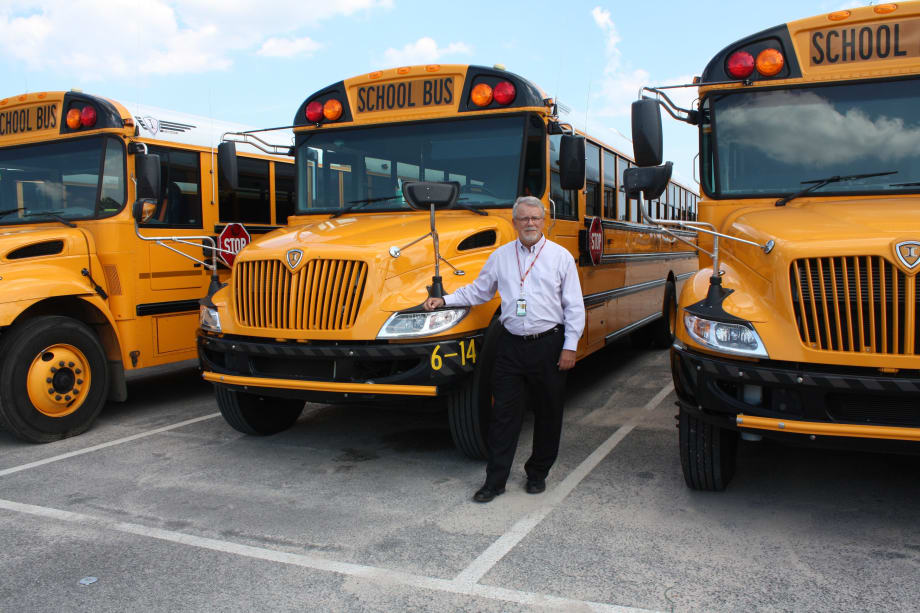
The School District of Escambia County (Fla.) has seen a decline in the number of minor school bus driver at-fault accidents due to training drivers to use a more proactive driving approach. Shown here is Robert Doss, director of transportation for the district.
As he was driving to Atlantic City, New Jersey, to give a safety presentation recently, Ted Finlayson-Schueler, president of pupil transportation safety organization Safety Rules!, spotted a decidedly unsafe practice: a school bus filled with students, and coolers and baggage stacked against the back door.
“We learned in the Carrollton [Kentucky] crash in the 1980s about the danger of fire on school buses and the importance of keeping emergency exits clear,” he says.
Finlayson-Schueler points out that an unfortunate consequence of belt-tightening at many school districts has been to extend bus routes and cut stops to save money, which, on a subtle level, can encourage drivers to rush, and isn’t very conducive to an attitude of “safety first, schedule second.”
“If we get in our minds that the most important thing is to get to school on time, then we rush through intersections, to and from bus stops, and don’t see what’s in our mirrors,” he says.
However, “It doesn’t cost anything to keep an emergency exit clear,” he points out.
Employing simple practices that are free of cost is essential to promoting an effective safety culture among drivers. Additionally, making sure drivers understand what safety means, and how to eliminate risk and prioritize and commit to preventive behaviors are key.
1. Define what safety means.
What is safety? Turns out, that can be a hard question to answer, notes Jeff Cassell, president of safety training provider School Bus Safety Co. However, the first step in promoting an effective safety culture is making sure drivers know the definition of safety, where risk comes from, which behaviors are involved, and how to change them, he says.
The dictionary definition, Cassell says, is “freedom from risk.” Therefore, creating an effective safety culture requires reducing risk, defined by the dictionary as “the possibility of bodily injury or damage to property,” he adds. That means drivers need to identify behaviors involving risk that can be removed or reduced.
Risk comes from potentially unsafe conditions with vehicle parts, such as tires or brakes, but many rules and regulations for school bus operations relieve much of that risk — so much so that less than 1% of accidents come from unsafe conditions, Cassell says. That remaining 99% comes from the unsafe behaviors of drivers.
For example, getting enough sleep prevents fatigue-related accidents, avoiding drugs and alcohol prevents driver-impaired accidents, and avoiding texting or focusing on the students while driving prevents distracted driving accidents.
Additionally, one example of reducing risk is taking action to prevent rear-end collisions by keeping a safe following distance, he adds. “Thirty percent of all accidents in the U.S. are rear-end collisions, [but] if you stay back four seconds, it’s extremely unlikely you’ll have a rear-end collision.”
2. Agree on safety vision, mission and values statements.
Cassell promotes vision, mission and values statements that stress preventive behaviors in his training. The vision: do it right the first time, every time. The mission: to remove or reduce risk. The values: no unsafe behaviors.
To get drivers on board, directors need to address what’s called the WIIFM (“What’s in it for me?”).
“[The idea is] I can only get you to do something for me if you buy into it and accept what’s in it for you,” Cassell explains.
Cassell often shares stories of three fatal incidents with drivers: a school bus rear-ending a pickup truck that suddenly braked hard; a driver who was in a hurry and ran over a child who was standing in front of the bus as she pulled away from the curb; and a left-hand turn that resulted in the death of a pedestrian. “We say, ‘Drivers, you don’t want this to be you. Do it right the first time, every time. That’s the WIIFM for you,’” he says.

Bus drivers for Honeoye Falls (N.Y.) – Lima Central School District share details of near-miss incidents and lessons learned in meetings with other drivers so they all can benefit from their experience. District drivers are shown here viewing safety training material from the New York State Education Department.
3. Set norms.
Just as conventional wisdom says it takes 30 days to form a habit, if you do something consistently for 30 days, it becomes a norm; you start doing it automatically without thinking about it, Cassell says. For example, get drivers to establish norms such as not following another vehicle for less than four seconds, always counting students as they exit, and rocking and rolling for turns.
“Having a strong safety culture in place means drivers have a norm of doing things right the first time, every time, with no unsafe behaviors,” he says.
4. Hold near-miss reviews.
Finlayson-Schueler suggests taking near-miss incidents that happen to drivers and using them as a learning opportunity.
“Instead of just saying, ‘Thank God it didn’t happen to me,’ bring that incident into the training room. [Ask] ‘How did I get to that point?’ and ‘What do I need to do? Is it something in our procedure, or our training?’”
And that is exactly what Honeoye Falls (N.Y.) – Lima Central School District (HFL) began doing a few years ago.
“My motto is, ‘Safety is no accident. We plan for it,’” says Bill Harvey, director of transportation and security at the district. “This is one of the only jobs in the school district where if not done right, a student can be injured or killed.”
Thankfully, the past school year was accident-free for HFL, he adds.
Recognizing that near-miss and actual accidents present learning opportunities that can help prevent future incidents and foster a sense among drivers that they’re working as a team to be safer, Harvey started holding the reviews a couple years ago.
The first discussion centered on a bus driver who pulled out in front of a car, driven by a parent who had just pulled out of a school parking lot, Harvey said.
“His error may have been not stopping long enough, not rocking before he rolled,” he explains. “He thought he looked. He never even saw the car. The car would have hit him right behind the fuel tank on a full-size bus, but the mom, who had a couple students in the car, took evasive action, went to the right and ended up going into a ditch, but [no one was] hurt.”
Harvey asked the driver if he would be willing to share the experience and his reflections on what he could have done differently with the team. He stood up in front of the other drivers, explained what happened, shared his takeaways, and agreed to have video shown of the incident. Afterward, all the drivers had a group discussion on how that could happen to any one of them and how to prevent future similar incidents.
Several other drivers have spoken since and have received support from their peers, Harvey says.
Harvey adds that the key to success with this practice was getting buy-in from the staff. That involved making the drivers feel safe in participating and ensuring that they wouldn’t be judged or punished.
Drivers don’t judge the speaker because it could be any of them up there, he notes, and the practice has brought the team together.
“Instead of me standing up there telling them what they need to do better, there’s a fellow driver telling them what happened to them and what they feel they did wrong. It’s been a very healthy dialogue.”
Additionally, Harvey put together a steering committee comprised of office staff members, mechanics and drivers, to conduct reviews of accident details. As with the group discussions, the reviews are not designed to punish the driver, but to find learning opportunities, he explains. The committee then meets with the driver involved to review its findings on contributing factors and what could have been done to avoid the incident and uses that information in training.
“You don’t know what drivers using their phones are going to do next. They don’t even know what they’re going to do next.”
– Robert Doss, director of transportation for The School District of Escambia County (Fla.)
5. Emphasize proactive practices.
One Florida school district has made great strides in cutting its accident record down considerably by instilling a safety culture that makes the defensive driving concept more proactive.
The School District of Escambia County’s transportation department recently reported a record low of three minor school bus driver at-fault accidents for the 2014-15 school year. Robert Doss, the director of transportation at the district, says that the district reported 25 accidents six years ago, but that number has since declined significantly; over the last three years, the number of those accidents has been below 10.
He attributes the drop in at-fault accidents to the department focusing staff training on anticipating what other drivers may do that could cause an accident and taking proactive actions.
“The idea is not simply to avoid causing an accident. It’s not just, ‘Don’t run a red light. Don’t speed.’ Go beyond that,” he says. “Put yourself in a frame of mind that anticipates the many things that can happen that you’re not causing, but that you may be in a position to observe developing and prevent from progressing to an accident.”
For example, that means expecting that drivers who are texting or are otherwise distracted and driving erratically may drift outside their lane, he explains. Or, at a four-way stop, assuming the other driver may run the stop sign because they’re not paying attention.
In a training session last spring, drivers and trainers discussed how drivers on their phones in particular are an issue, Doss says.
“I said, ‘You don’t know what drivers using their phones are going to do next. They don’t even know what they’re going to do next.’”
Like Harvey, the challenge Doss faced in implementing the proactive practice was dispelling the drivers’ assumption that they were automatically at fault.
“We had to let them know that it’s about making sure they do everything they can to anticipate what can happen and understand that as a professional driver they [act] to avoid these situations,” he says.
6. Stress safety for the staff members themselves.
HFL’s Harvey is encouraging drivers to voluntarily wear reflective or fluorescent clothing when they’re on duty in the parking lot. He set an example by wearing a reflective vest, even though he was the only one doing so. However, little by little, trainers, safety department staff and some others soon followed suit, and now about half the drivers are doing the same.
“I always tell my staff the most dangerous part of your day is in that parking lot,” he says. “There are 20,000-pound vehicles pulling in and backing out while you’re pre-tripping one [nearby].”
Quick Answers
Committing to preventive behaviors is crucial because it helps drivers actively avoid risky situations, reducing the likelihood of accidents and enhancing overall road safety.
*Summarized by AI
More Safety

How to Build a Better School Bus Driver Training Program
Is it time to strengthen your driver training? Here’s how to pick the right talent and improve recruitment, retention, and safety. This video is brought to you by IC Bus.
Read More →
Recent School Bus Accidents Leave 2 Dead, 2 Injured
Four school bus crashes in Florida, Illinois, and Georgia highlight risks in transportation lots, at bus stops, and during student loading and unloading.
Read More →
When Every Second Matters, Clarity Keeps Routes Moving
From routine delays to urgent incidents, strong communication practices help drivers, dispatchers, schools, and families respond with confidence.
Read More →

What Happens When a School Bus Catches Fire — and What Can Help
School bus fires are rare but can be devastating. Learn how advances in fire suppression and asset protection help fleets detect fires earlier, reduce damage, and improve safety.
Read More →
Geotab Launches Tool to Help Fleets Investigate Road Incidents
Geotab Investigations combines telematics data, video, documents, and other evidence to help fleets reconstruct incidents, resolve claims, and determine what happened.
Read More →
Texas Sixth Grader Wins 2026 National School Bus Safety Poster Contest
Sai Darshana Yekolu of Moseley Middle School in Prosper, Texas, was named the newest winner for her artwork, bringing the theme of “Safe Rides, Everyday Heroes” to life.
Read More →
Doing More With Less: How Transportation Directors Can Prioritize Safety Amid Budget Uncertainty
With diesel prices soaring and nearly one-third of transportation directors expecting budget cuts, maintaining student safety has never been more challenging. Download this guide to learn how leading districts are prioritizing risk, funding critical safety technology, and building stronger budget cases with data.
Read More →
Walton County Schools Adds Gatekeeper Stop-Arm Enforcement System
The Florida district will deploy Gatekeeper’s updated Student Protector technology, which now incorporates AI to improve video evidence.
Read More →
How To Build a More Secure School Bus Yard During and After Hours
As thefts and overnight security threats continue, school transportation leaders are combining stronger operational practices with AI-enabled surveillance to better protect buses, facilities, and staff.
Read More →
FMCSA Names New Chief Safety Officer: What School Bus Operators Should Know
Steve Dowling is set to lead the federal agency's efforts to advance commercial motor vehicle safety and reduce crashes, fatalities, and injuries on the nation's roadways.
Read More →