




Solar Arrays Deliver Energy and Reduce Emissions at Bendix
Bendix branch in Mexico notes positive effects after adopting green policies.
May 26, 2023

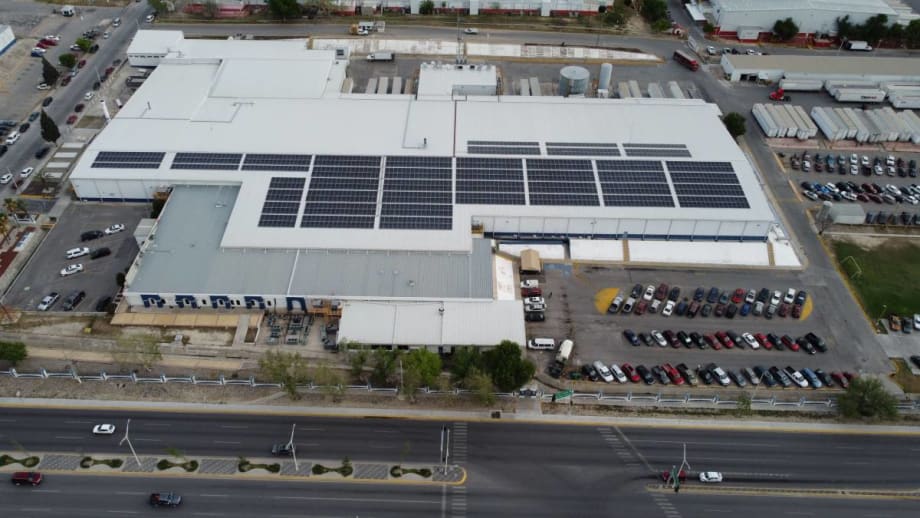
Solar array of Plant 1 of 2 at Bendix Acuña, which went online at the end of 2022.
Photo: Bendix
3 min to read
Atop two Bendix Commercial Vehicle Systems (Bendix) plants in Acuña, Mexico, a pair of solar arrays convert sunlight into electricity, producing more than 2.1 million kilowatt-hours (kWh) of energy annually for the manufacturing operation. The arrays consist of nearly 2,600 photovoltaic panels that generate about 11% of each plant’s required energy and are expected to reduce CO2 emissions by more than 850 tons per year (about 13%), decreasing reliance on the local power grid and reducing Bendix’s carbon footprint.
Bendix is a subsidiary of a company based in Munich, Germany, called Knorr-Bremse. Over the past decade, Bendix has pursued and adopted the sustainability strategies of its parent company. Solar projects are a key element of Bendix’s overall climate strategy: The Acuña arrays are the company’s second solar installation, following one completed in Huntington, Indiana, in 2021.
The $1-million project is also the first solar installation of its kind among the region’s numerous manufacturers, which came online on Dec. 15, 2022.
The 2.1 million kWh of electricity produced annually is about the same amount of energy needed to power 100 homes for a full year. And the 850-ton yearly reduction of CO2 is roughly equivalent to the greenhouse gas emissions from more than 2 million miles driven by an average gasoline-powered passenger vehicle, according to the United States Environmental Protection Agency.
“Since the release of our Climate Strategy 2030, we have put an intense focus on cutting carbon dioxide emissions in our largest manufacturing campus, located in Acuña, Mexico,” said Bill Schubert, environmental and sustainability director at Bendix. “These solar panels are among several climate action projects furthering that goal.”
Environmental Impacts, Today and Tomorrow
The size and scope of Bendix Acuña – which opened in 1987 and now encompasses three manufacturing facilities, a logistics center, and a new site under construction – make it one of Knorr-Bremse’s largest consumers of electricity and generators of carbon emissions. Through their climate strategy, Bendix and Knorr-Bremse are committed to cutting CO2 emissions in half by 2030 from the 2018 baseline, setting the stage for significant sustainability efforts in Acuña.
“As soon as it came online, the Acuña solar array started making a difference,” said Maria Gutierrez, Bendix senior director of environmental, social, and governance (ESG). “It will contribute a 2.4% decrease to our North American carbon footprint, and that’s important progress. We’ve also made operational changes to improve energy efficiency and implemented more effective control of our energy consumption. Every step forward matters.”
The State of Coahuila, of which Acuña is a part, recognized Bendix Acuña’s progress during the April 27 ribbon-cutting for the solar project. Each of the site’s three current manufacturing plants earned Industria Verde (Green Industry) certification from the state environmental protection office, recognizing efforts to increase energy efficiency, utilize green energy sources, reduce the site’s carbon footprint, and be a sustainable consumer. Certification, valid for two years, is based on a compliance audit of processes and equipment, as well as the evaluation of environmental risk and impact.
These efforts fall in line with the United Nations’ (UN) Sustainable Development Goals (SDGs), a set of 17 overarching objectives providing guidance on how to make business activities compatible with sustainable development. Five key SDGs have been at the core of Bendix’s longtime sustainability efforts, among them Responsible Consumption and Production (encompassed within SDG 12) and Climate Action (the focus of SDG 13).
Bendix’s 2021 sustainability efforts led to a reduction in energy consumption of more than 16 million kWh over the most recent seven-year period.
Bendix’s 412,000-square-foot Acuña campus employs approximately 1,800 people in manufacturing, remanufacturing, and assembly across a wide range of products – actuators, air dryers, antilock braking systems (ABS), compressors, integrated vehicle modules, and valves.
More Alternative Fuels

CALSTART and Forth Combine to Form Catalyst Mobility
The new name represents a renewed vision for the nonprofit focused on advancing clean, equitable, and affordable transportation solutions that move people and goods.
Read More →
Alt-Fuel Moves: New Buses, Charging Hubs & Real-World EV Testing
Propane and electric school bus deployments continue to grow as districts add new vehicles, expand charging infrastructure, and gather more real-world operating data.
Read More →
Fewer Electric School Bus Models Reshape the U.S. Market
WRI’s latest buyer’s guide points to a consolidating electric school bus market, but fewer options may reflect a maturing industry rather than fewer meaningful choices for school bus operators.
Read More →
The Fuel Budget You Can Actually Predict: How Propane Autogas Keeps Money in the Classroom
Learn how propane autogas helps school districts manage fuel costs with predictable pricing, lower maintenance, and reduced emissions from former transportation director Joel Stutheit.
Read More →
Hendrickson, Driventic Introduce New Electric Powertrain for School Buses
ELECTRAAX, the electrified, lightweight drive axle offers integrated ePowertrain efficiency and modular flexibility for Class 6–7 school bus use.
Read More →
The Mobility House Joins PowerFlex in Fleet Electrification Deal
The acquisition combines intelligent charging software, bidirectional charging expertise, and fleet electrification services to support the growing adoption of electric school buses across North America.
Read More →
Alt-Fuel Moves: Electric School Bus Investments Hit the Road
See which districts across the U.S. are putting electric school buses into service, expanding charging infrastructure, and planning the next phase of fleet electrification.
Read More →
With Fuel Volatility Ahead, School Districts Turn to Propane
While diesel prices peaked above $5 this spring, districts with propane autogas-powered fleets paid under $2 per gallon, according to PERC.
Read More →
EPA Unveils Proposed Changes to 2027 Heavy-Duty Engine Rules
The federal agency has proposed changes to next year’s targets that would eliminate DEF derates, ease warranty requirements, and retain current NOx emissions standards.
Read More →
Alt-Fuel Moves: EV Charging & Infrastructure Projects Gain Momentum
The latest developments include new funding, charging infrastructure, utility investments, and fleet technologies designed to support the transition to electric school buses nationwide.
Read More →