




Lion, Adomani Demonstrate Electric School Bus in Arizona
The electric bus manufacturers and partners hosted an event in Phoenix to share information about the eLion and funding opportunities, and let local school transportation staff check out the bus up close.

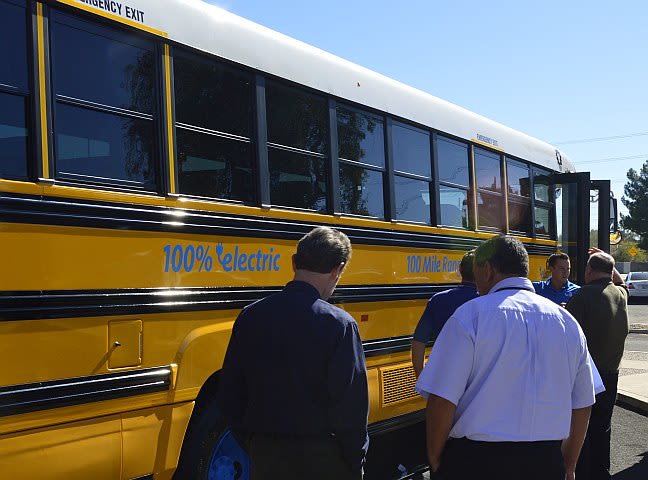
Lion Bus and Adomani hosted an event in Phoenix, Arizona, on Jan. 31 to share information about the eLion and funding opportunities. Local school transportation directors also got to see the bus up close.
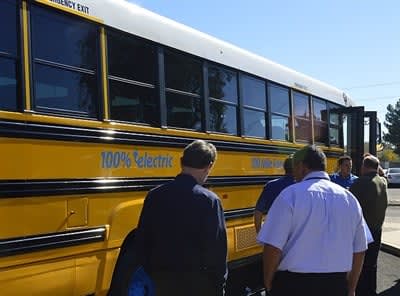
Lion Bus and Adomani hosted an event in Phoenix, Arizona, on Jan. 31 to share information about the eLion and funding opportunities. Local school transportation directors also got to see the bus up close.
PHOENIX, Ariz. — School transportation officials here were able to learn more about and view Lion Bus’ new electric bus, as well as find out more about related funding programs.
On Jan. 31, Lion Bus and Adomani representatives hosted an event to share information about the eLion Type C electric bus and let the 20 school transportation directors and other staff check out the bus up close. Representatives from Congress, the local Clean Cities coalition, and a local utility were on hand to discuss the benefits of electric buses and field questions.
Lion Bus' Business Development Manager, Marc-Andre Page, kicked off the event by discussing the company and its partnership with electric vehicle manufacturer Adomani: the two manufacturers have an exclusive arrangement that allows Adomani to sell the eLion in Arizona, Idaho, Nevada, Oregon, Utah, and Washington.
Lion Bus has built over 1,100 buses since 2011 and has deployed over 80 eLions across Canada and the U.S. The manufacturer built the all-electric bus two years ago, and commercialized it in early 2016. Page said that in addition to offering three options for battery packs — 50, 75, and 100 miles — the bus includes a stepwell and battery box that are made of polyethylene plastic, which can last for up to 20 years, and standard regenerative braking. Additionally, the batteries are climate controlled.
As with Lion’s conventional school buses, the eLion includes a one-piece composite roof that is designed to be leak-free, and non-rusting body skirts that are created to be easily replaceable, composite side panels designed for easier repainting, and an option for a wheelchair lift. The ergonomic driver compartment and driver seat have also been repositioned closer to the left wall for enhanced visibility.
With the average daily route coming out to about 70 miles, school buses are one of the best applications for electric buses, Page explained. There are also fewer moving parts with an electric motor, requiring little maintenance, he added.
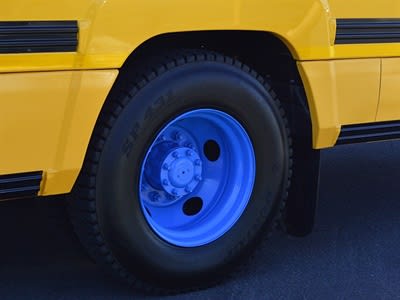
The eLion is wider than average, at 102 inches, and also features a wider wheel well.
Lion is deploying vehicle-to-grid technology, which can raise revenue for school districts that sell the energy generated by the electric buses’ batteries back to the grid, in 2017, Page said.
Lion offers an air conditioning option for the eLion that will be necessary in Arizona, according to Lion Bus. Steve Gardner, national accounts/OE manager for American Cooling Technology, gave an overview to attendees of the onboard 160 kilowatt Btu/hr system for the demonstration bus. The technology necessary to minimize the energy draw for the bus includes a constant power electrically driven scroll compressor. The parasitic draw of “full-on” air conditioning of the bus is estimated at 5% - 7% of the range potential of the vehicle, he said.
Page addressed questions from transportation directors about batteries. He explained that battery packs have a warranty of eight years and a life expectancy for 4,000 full cycles, and that the entire pack doesn’t need to be charged for most trips. Additionally, he said that charging the bus for a few hours between routes would allow the bus to be completely recharged before the afternoon route, and Lion provides support to help select the right size battery pack for an operation.
Page also explained that the charging infrastructure can be customized for recharging time, such as if only 10% power is needed to run the afternoon route. Regarding battery packs, he said that one costs $30,000 today, but that costs are coming down. He also told attendees that battery leasing programs are available and Lion will look at making arrangements for those with its partners.
Bill Sheaffer, executive director of Valley of the Sun Clean Cities Coalition in Scottsdale, Arizona, gave attendees an overview of the Volkswagen (VW) mitigation trust fund and FAST Act programs. He broke down the three major program components: the consumer refunds; the mitigation phase; and the zero-emissions vehicle (ZEV) placement and polluting vehicle retirement aspects that are expected with the 10-year program.
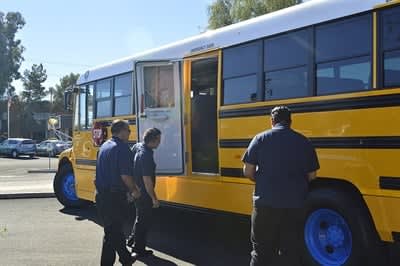
School transportation staff check out the composite side panels and bus interior.
There is a total of $2.7 billion in the zero-emissions fund and Arizona gets 2% of that amount, since the state makes up 2% of the U.S. population, Sheaffer said. Within the $2 billion electric vehicle program, about $24 million is available for the state.
Jim O’Connell, director of bus sales at Adomani, added that some state trustees may ask districts to pay for the equivalent cost of a diesel bus and then they will pay the difference.
Another advantage of electric vehicles is that they are quiet outside and inside, reducing noise pollution and enabling students and the driver to not have to shout to hear each other, Sheaffer said. Page noted that when the eLions run at 20 mph or less, an mp3 file plays a tune that he described as ice cream truck music in response to feedback that a completely quiet vehicle is dangerous because pedestrians can’t hear it coming.
Kevin Knight, district director for Congressional Rep. David Schweikert’s office, told attendees that the current administration is continuing to look for ways to get better mileage and a more sustainable carbon footprint.
In the afternoon, attendees walked around the 38-foot, 65-passenger demonstration eLion bus and see the features discussed in the morning. Page pointed out the composite side panel construction, under-hood controllers, cooling and hydraulic reservoirs, and the auxiliary 12-volt electrical system.
With viewing mirrors, he showed attendees the battery packs, motor, and drive line without transmission located between the frame rail.
Page also pointed out features in the bus interior, such as the free-blow air conditioning units and the dashboard air unit, ergonomics in the driver area, and the main telematics screen on the dashboard, to show the driver’s ability to gauge energy (or fuel) consumption and remaining distance or range, component operation and functionality, battery condition, and other component functions or possible defects on board. The bus is equipped with HSM seats, Rosco mirrors, and an integrated trash can molded into the dashboard area.
Wider than average, at 102 inches, Page noted that the bus offers an 18-inch center aisle, and the 78-inch ceiling height for taller passenger comfort.
Attendees went on a test ride and drive, with the tight turning radius of over 50% on display as the vehicle maneuvered out of a tight parking lot.
More Alternative Fuels
Alt-Fuel Moves: Electric Bus Rollouts, Bidirectional Charging & Propane Growth
See which fleets are adding electric and propane school buses as districts and operators invest in charging infrastructure, bidirectional technology, and alternative-fuel expansion.
Read More →
Nobody Told Diesel Prices They Were Supposed to Come Down
With diesel prices surging, school bus fleets have new reason to stress-test fuel costs, consider diversification, and calculate what each route really costs to operate.
Read More →
Why Gasoline School Buses Are Making a Comeback
Gasoline is gaining ground in full-size school buses. See how today’s options stack up against diesel on cost, maintenance, emissions, performance, and more.
Read More →
EPA Opens $180M DERA Funding Round for Diesel Upgrades
The 2026 Diesel Emissions Reduction Act program seeks applications from eligible organizations to accelerate the retirement of legacy diesel vehicles.
Read More →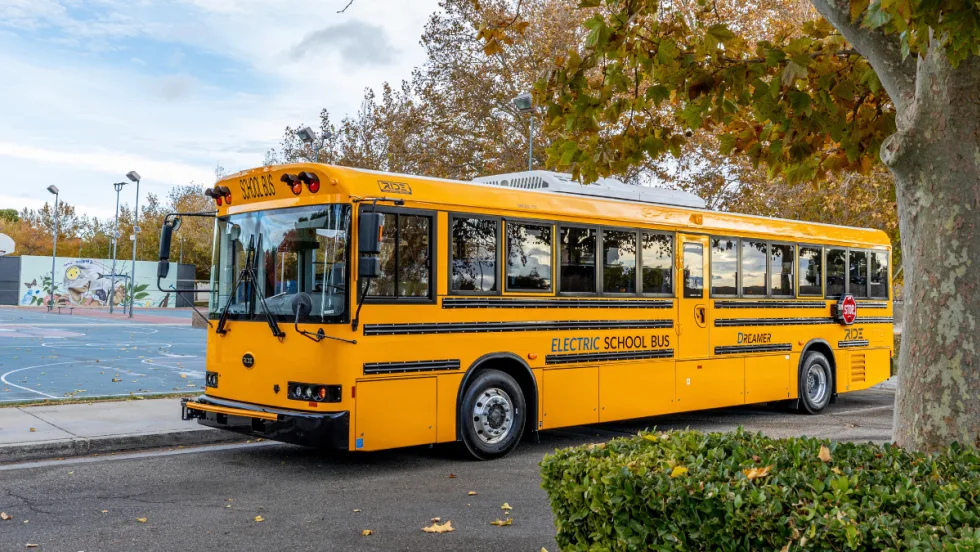
The Secret Life of an Electric School Bus Battery
Batteries change throughout years of daily routes, but degradation doesn’t necessarily mean the end. Here’s what operators should know about performance, safety, and second life.
Read More →
CALSTART and Forth Combine to Form Catalyst Mobility
The new name represents a renewed vision for the nonprofit focused on advancing clean, equitable, and affordable transportation solutions that move people and goods.
Read More →
Alt-Fuel Moves: New Buses, Charging Hubs & Real-World EV Testing
Propane and electric school bus deployments continue to grow as districts add new vehicles, expand charging infrastructure, and gather more real-world operating data.
Read More →
Fewer Electric School Bus Models Reshape the U.S. Market
WRI’s latest buyer’s guide points to a consolidating electric school bus market, but fewer options may reflect a maturing industry rather than fewer meaningful choices for school bus operators.
Read More →
The Fuel Budget You Can Actually Predict: How Propane Autogas Keeps Money in the Classroom
Learn how propane autogas helps school districts manage fuel costs with predictable pricing, lower maintenance, and reduced emissions from former transportation director Joel Stutheit.
Read More →
Hendrickson, Driventic Introduce New Electric Powertrain for School Buses
ELECTRAAX, the electrified, lightweight drive axle offers integrated ePowertrain efficiency and modular flexibility for Class 6–7 school bus use.
Read More →