




Why We Equipped a School Bus With Motorcoach Amenities
Jericho (N.Y.) School District's director of transportation explains how a school bus with upgraded features has fit the bill for safe and economical activity trips.

Jericho (N.Y.) School District’s amenity-equipped school bus is seen here with (from left) Bob Blaisdell and Susan Boyle of the New York Schools Insurance Reciprocal, Lori-Ann Savino of Jericho School District, and John Clare of Thomas Built Buses dealership Nesco.
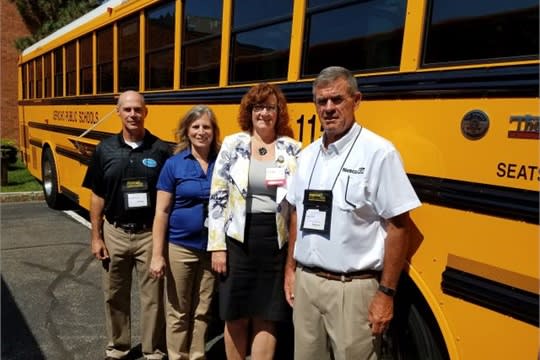
Jericho (N.Y.) School District’s amenity-equipped school bus is seen here with (from left) Bob Blaisdell and Susan Boyle of the New York Schools Insurance Reciprocal, Lori-Ann Savino of Jericho School District, and John Clare of Thomas Built Buses dealership Nesco.
At Jericho (N.Y.) School District, we work closely with our insurance group, the New York Schools Insurance Reciprocal (NYSIR), to be sure that our students are safe and our school district is protected. That includes student travel for activity trips.
In the Long Island area, there has been a decrease in the number of motorcoach carriers, and some of the remaining companies do not meet the insurance requirements recommended by NYSIR. Last year, we lost several local motorcoach carriers that we have worked with for many years, leaving school districts to look for services outside of our area. This drives the costs even higher and adds hours to the driver’s log book.
At Jericho School District, we have both a mechanic who conducts motorcoach inspections and a dispatcher who reviews driver abstracts for every motorcoach trip we secure. In several instances, a trip was delayed or canceled because either the motorcoach or the driver did not meet our safety requirements.
Fueled with frustration, we decided to take matters into our own hands. We worked with Thomas Built Buses to design a safe school bus equipped with amenities found on a motorcoach vehicle.
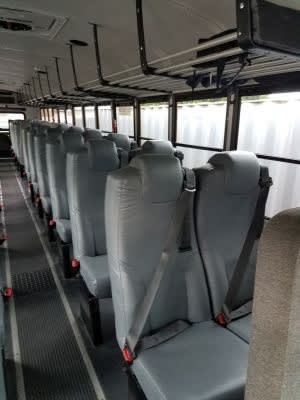
Upgrades on Jericho's bus include air-ride suspension, driver seat air ride, drop-down screens for DVDs or CDs, overhead racks, tinted windows, and school-approved passenger bucket seats with three-point belts.
The upgraded bus, which we received in May 2016, features four-wheel air-ride suspension, driver seat air ride, five drop-down screens for DVDs or CDs, overhead racks, undercarriage storage, acoustic interior panels, tinted windows, school-approved passenger bucket seats with three-point seat belts, a backup camera integrated into the driver’s rearview mirror, and front and rear air conditioning. At just over $170,000, the bus cost about $30,000 more than our regular school bus purchases. Our first and foremost motive for doing this is that our students are safest on a school bus, for numerous reasons. One is that a school bus is painted National School Bus Yellow, which is identified by all motorists as a vehicle carrying students. Also, a school bus has to meet many federal motor vehicle safety standards (FMVSS). Some examples:
• FMVSS 220 specifies minimum standards for school bus structural strength in a rollover.
• FMVSS 221 deals with school bus body joint strength.
• FMVSS 222 sets stringent standards for school bus passenger seating and crash protection.
• FMVSS 111 requires greater visibility from mirrors.
• FMVSS 217 mandates additional emergency exits.
• FMVSS 301 requires greater fuel system integrity.
We believe that building a school bus with motorcoach amenities was the perfect solution for our activity trips. Not only is this the safest ride in town, it has also proven to be very economical. We no longer need to call staff in early for motorcoach inspections or driver abstract reviews, because we own the bus and provide the driver.
In July, during the New York Association for Pupil Transportation’s 2017 conference in Albany, I had a chance to show off the bus. I was delighted when representation from NYSIR took a few minutes to check out the bus, and they applauded our effort to provide safe transportation for our student activity trips.
We schedule this bus for trips almost every day. It can also deliver students to school and home again.
In my estimation, this bus will have paid for itself in less than three years. This was our perfect solution to an extremely frustrating situation.
Lori-Ann Savino is director of transportation for Jericho School District and president of the New York Association for Pupil Transportation.
More Blog Posts
The Sound of Summer Starting [Guest Editorial]
That unmistakable school bus rumble? It carries childhood memories, community routines, and a whole lot of unseen work behind the scenes.
Read More →
The Technology Power Combo That Enables EV Charging on Difficult Sites
As the pace of fleet electrification increases and charging infrastructure continues to pose challenges, many fleets find themselves puzzling over the question: how do I install charging infrastructure faster and more cost-efficiently?
Read More →
Trip Sheet: Farewell, Faithful Readers – Keep on Rolling
Executive Editor Wes Platt offers parting thoughts as he parks the School Bus Fleet bus to focus on ultra-local community journalism, making way for someone else to take the wheel as the pupil transportation industry continues to evolve.
Read More →
Trip Sheet: School Transportation Pros Can Champion Children's Mental Health
Children's Mental Health Awareness Day underscores the significance of school bus drivers in fostering supportive environments during students' journeys. SAMHSA's initiatives, including stigma reduction and access to resources, complement the Biden-Harris administration's funding efforts to enhance youth mental health services and workforce development.
Read More →
Trip Sheet: Is It Time for Daylight Saving Time to Clock Out?
How do you think the potential shift to permanent Daylight Saving Time or standard time would impact our daily lives and routines, especially considering the divided approach across various states?
Read More →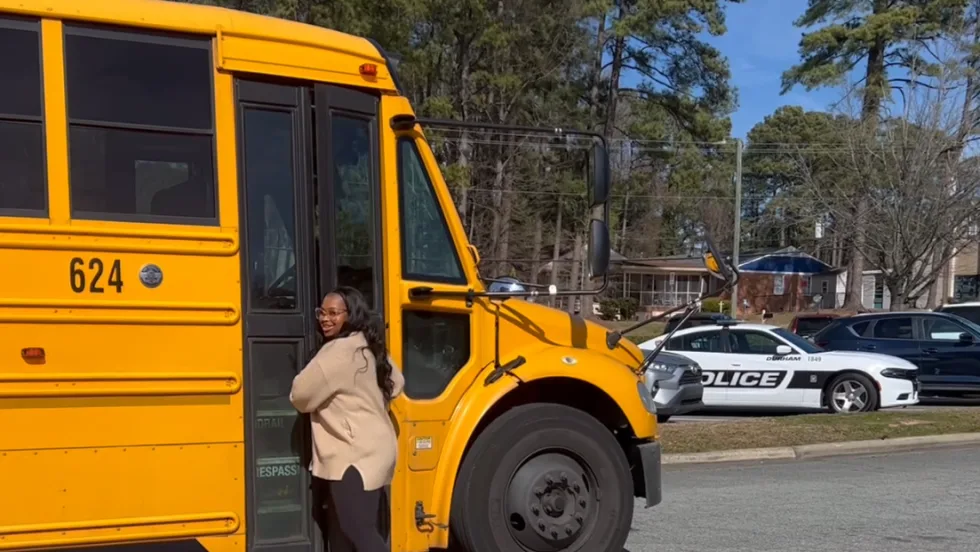
Trip Sheet: Meeting a Hero in My Own Back Yard
I remain impressed by the matter-of-fact heroism that’s often demonstrated by school bus drivers like Deona Washington who are caught in these situations where the best of us might lose our cool and panic. But, then again, bus drivers are a unique breed.
Read More →
Trip Sheet: 3 Takeaways from the EPA Clean School Bus Grant Program
Most applicants sought grant funding to acquire electric school buses, with propane coming in a distant second. No one indicated plans to purchase compressed natural gas (CNG) buses in this round. That’s not terribly surprising, I suppose, given how few school districts listed the inclusion of CNG buses in their fleets for our 2023 top district fleets survey.
Read More →
Trip Sheet: Let's Get Rolling: What's Coming in 2024?
Calendar pages keep flipping toward the mandates set in states like New York and California to transition their school bus fleets from diesel to zero-emission, but there’s plenty of reluctance and pushback.
Read More →
California School Children Ride in Green School Buses
Today, California prides itself on utilizing the most zero-emission (ZE) school buses in the country with over 1,689 being used by California school districts; and while the state is on a positive health trajectory thanks to a decree to eliminate gas and diesel vehicles, more work needs to be done to improve children’s well-being.
Read More →
Behind The Wheel of Childrens’ Safety Aboard the School Bus
Bus drivers are the primary caretakers of children during their commute and thus bear responsibility for their safety. By prioritizing proper operating procedures, maintenance checks, and additional precautions, drivers can help avoid the loss of precious young lives under their care.
Read More →