




How Brevard Public Schools Handled Hurricane Irma
The Florida district’s transportation team quickly secured 500 school buses to brace for the forecast 100 mph winds. Director Arby Creach gives a detailed account of the prep work — and how it paid off.
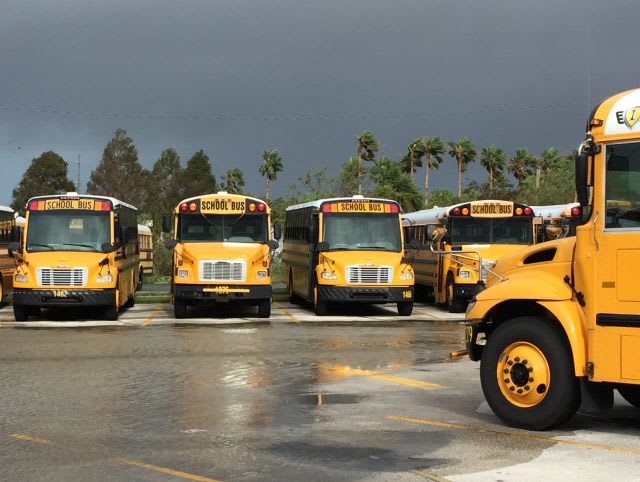
Brevard Public Schools' transportation team quickly secured 500 school buses to brace for the forecast 100 mph winds of Hurricane Irma.
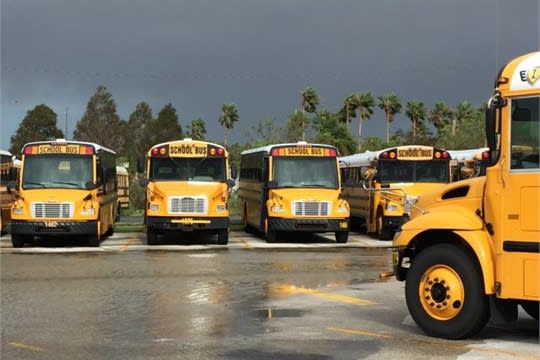
Brevard Public Schools' transportation team quickly secured 500 school buses to brace for the forecast 100 mph winds of Hurricane Irma.
On Wednesday, Sept. 6, Brevard Public Schools employees were told that the district would cease operations and close all 82 schools the next day. This decision was made in response to a forecast of a direct strike on Florida by Hurricane Irma — the largest, most intense category 5 Atlantic storm ever recorded.
The original projection for landfall of this monster storm was Saturday, Sept. 9, somewhere between Naples and Miami. The storm was then forecast to slowly turn north by northeast as a category 4 and travel directly through the heart of Brevard County, exiting Florida and heading back into the Atlantic just south of the Kennedy Space Center.
On Wednesday evening, a quick survey of our district workforce revealed that we were faced with about half of the entire 9,000 employees of Brevard Public Schools already evacuating from their homes or planning to immediately evacuate to other “sheltered” parts of Florida, or to leave the state entirely. The decision to cease operations and close schools beginning Thursday was immediate.
The transportation department was watching the progress of the storm and communicating with the Brevard emergency operations and leadership staff intently. We originally thought that school would still be open on Thursday the 7th and that at the earliest we would close schools on Friday the 8th.
Our original plan was that we would have an entire day to install hurricane storm locks on our 500 buses’ pupil service doors and secure the roof hatches, windows, stop arms, and crossing arms so that they would not be severely damaged or blown completely away. We also planned to position the buses as much as possible so that the forecast 100 mph wind force would be parallel to the bus bodies. A sustained 100 mph wind with higher gusts hitting a bus directly from the side can easily roll it over.
As it turned out, because of the order to shut down, we suddenly had to make all the preparations on Wednesday evening after school when all the buses returned to their parking areas. We have an incredibly hard-working and highly dedicated staff. Our transportation employees did not even blink when asked to stay over and all pitch in to expedite getting the job done in only a few hours rather than the full planned day.
We knew that if we did not prepare on Wednesday evening, we would not be able to do so, as about half of our drivers and mechanical technicians were planning to leave the area. Those staying would be very busy shuttering, sandbagging, and “hardening” their own homes to protect their property and families.
On Friday, Sept. 8, the day before the forecast arrival of Hurricane Irma, our shelters opened to the public. For storm evacuation purposes, our buses are used in conjunction with the local Space Coast Area Transit authority. Our school buses have the responsibility of evacuating certain very low-lying areas in the southern part of our county. Our buses transported refugees to our shelters on Friday the 8th and about half the morning on Saturday the 9th, ceasing at noon before the storm made landfall on Saturday evening.
After Hurricane Irma hammered the Florida Keys and devastated Monroe County, the storm did not make the projected right turn exactly when forecast and actually made landfall again south of Naples and well to the west of Miami. The track changed to a direct northerly course, taking it directly over the heart of Florida with the eye wall winds hitting Hardee County and Polk County very hard.
It’s my opinion that the western Gulf side of our state may not have prepared at the very highest level as the east side, because all computer modeling predicted the storm’s path to be primarily along the east Atlantic Coast.
Once the eye of the storm traveled over land, it lost its energy source (the Gulf and Atlantic waters) and quickly began to decline in strength. Unfortunately, as the storm traveled along its northward path, Brevard was caught in the worst position possible: the northeast side of the storm. That is where the highest wind speeds and most tornadoes occur.
During the long hours that the storm was ravaging our county, I counted at least 13 local tornado warnings on my emergency weather radio and saw wind speeds exceeding 100 mph on my home weather station. At one point, we were experiencing more than 8 inches of rain per hour.
I personally lost a portion of my home roof. I now belong to the “blue tarp” club. Even so, I was lucky — there were many homes and structures directly hit and destroyed by some of the tornadoes all across our 72-mile-long county.
Power and water service was lost for about 85% of Brevard County and about 60% of the state. There was a lot of standing water and some flooding on our properties. Our garages and nine school bus parking compounds suffered only minor damage. We had some damage to several 14-foot garage doors, but for the most part we were very, very lucky.

Arby Creach is transportation director for Brevard Public Schools in Cocoa, Florida.
Our buses made it through without any apparent damage. We will know more as our staff members return to their homes and we begin the preparation to start school on Monday the 18th. I am convinced that the extra staff effort and long hours of preparation made the difference.
After eight horrific days of uncertainty, frustration, and anxiety, we have finally begun our journey back to educating students.
Still, we are keeping an eye on Hurricane Jose. I am a native Floridian, and I have seen back-to-back storms many times. The most recent was in 2004, when we had three in a row hit Florida.
Hurricane season ends Nov. 30. It cannot be too soon.
More Blog Posts
The Sound of Summer Starting [Guest Editorial]
That unmistakable school bus rumble? It carries childhood memories, community routines, and a whole lot of unseen work behind the scenes.
Read More →
The Technology Power Combo That Enables EV Charging on Difficult Sites
As the pace of fleet electrification increases and charging infrastructure continues to pose challenges, many fleets find themselves puzzling over the question: how do I install charging infrastructure faster and more cost-efficiently?
Read More →
Trip Sheet: Farewell, Faithful Readers – Keep on Rolling
Executive Editor Wes Platt offers parting thoughts as he parks the School Bus Fleet bus to focus on ultra-local community journalism, making way for someone else to take the wheel as the pupil transportation industry continues to evolve.
Read More →
Trip Sheet: School Transportation Pros Can Champion Children's Mental Health
Children's Mental Health Awareness Day underscores the significance of school bus drivers in fostering supportive environments during students' journeys. SAMHSA's initiatives, including stigma reduction and access to resources, complement the Biden-Harris administration's funding efforts to enhance youth mental health services and workforce development.
Read More →
Trip Sheet: Is It Time for Daylight Saving Time to Clock Out?
How do you think the potential shift to permanent Daylight Saving Time or standard time would impact our daily lives and routines, especially considering the divided approach across various states?
Read More →
Trip Sheet: Meeting a Hero in My Own Back Yard
I remain impressed by the matter-of-fact heroism that’s often demonstrated by school bus drivers like Deona Washington who are caught in these situations where the best of us might lose our cool and panic. But, then again, bus drivers are a unique breed.
Read More →
Trip Sheet: 3 Takeaways from the EPA Clean School Bus Grant Program
Most applicants sought grant funding to acquire electric school buses, with propane coming in a distant second. No one indicated plans to purchase compressed natural gas (CNG) buses in this round. That’s not terribly surprising, I suppose, given how few school districts listed the inclusion of CNG buses in their fleets for our 2023 top district fleets survey.
Read More →
Trip Sheet: Let's Get Rolling: What's Coming in 2024?
Calendar pages keep flipping toward the mandates set in states like New York and California to transition their school bus fleets from diesel to zero-emission, but there’s plenty of reluctance and pushback.
Read More →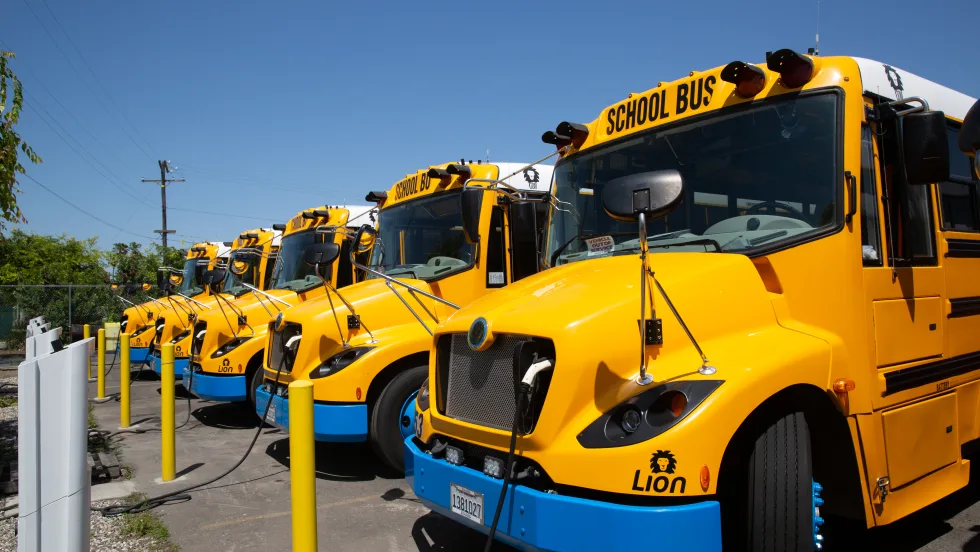
California School Children Ride in Green School Buses
Today, California prides itself on utilizing the most zero-emission (ZE) school buses in the country with over 1,689 being used by California school districts; and while the state is on a positive health trajectory thanks to a decree to eliminate gas and diesel vehicles, more work needs to be done to improve children’s well-being.
Read More →
Behind The Wheel of Childrens’ Safety Aboard the School Bus
Bus drivers are the primary caretakers of children during their commute and thus bear responsibility for their safety. By prioritizing proper operating procedures, maintenance checks, and additional precautions, drivers can help avoid the loss of precious young lives under their care.
Read More →