





Trip Sheet: How Did School Transportation Work in Ancient Rome?
A Ride Through School Bus History: Observations from a Newbie
Still new in the role but learning the ins and outs of the pupil transportation landscape, SBF’s editor reflects on the earliest school bus innovations, how we got to the exponential growth we’re seeing today, and how we can tackle challenges together.
November 11, 2024
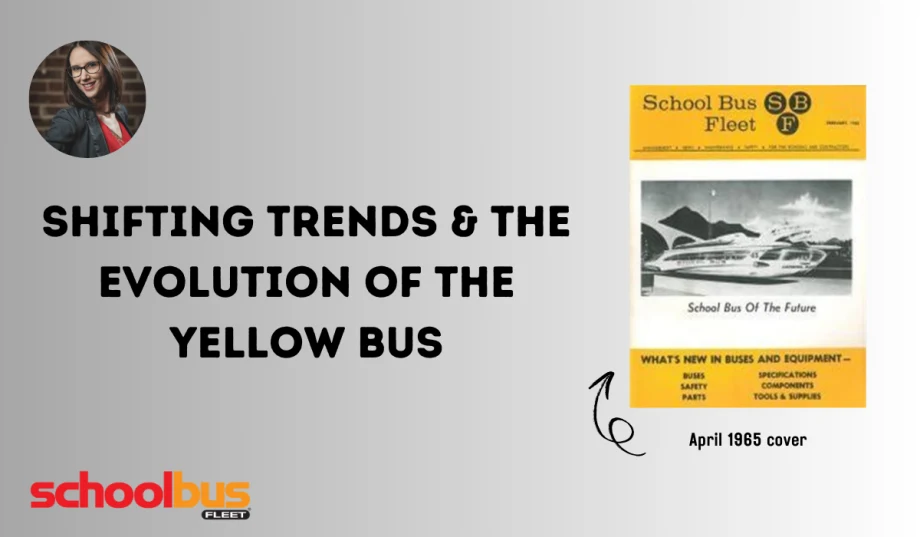
The past shapes the present, as is evident when we look back at the earliest school bus and how it's evolved a hundred years later.
Photo: SBF
6 min to read
Looking back as a school bus rider in the early ‘90s, I can't help but wonder what the earliest school buses were like in comparison. My own experiences include most of what is standard today — warning lights, crossing arms, stop arms, roof hatches, and a radio system. And yet I’m the first person in my small family to ride the bus: my parents walked to school; my grandfather rode his horse.
As I settle more into this role, I’m struck by the vibrancy and strength of the pupil transportation community. Maybe it’s because School Bus Fleet ConneX (SBFX) was my first industry event and my newbie eyes have not been jaded. Still, I couldn’t have been more impressed by the kindness of attendees, the wealth of knowledge in the rooms, and the openness everyone had to the experience.
To learn what you all already know, I’ve immersed myself in research and conversations about others’ school bus early experiences. I’ve even heard insights from Bobit’s new CEO and owner Colin Sutherland, who has some knowledge of the earlier days through Bob Moran and the Child Check Mate system.
Browsing SBF’s archives, Publisher George Brennan and I noticed the April 1965 cover featuring a chalk maintenance control board in the shop. George chuckled at this, as in his visits to maintenance facilities, laptops, handheld devices, and monitors have replaced the physical recordkeeping shown in this image.
Pam McDonald, a retired transportation director, remembers most drivers being women working part-time in the ’80s, and when most buses had standard transmissions; now they’re automatic.
Tim Flood, EVP at The Trans Group for 37 years, says there used to be much continuity and longevity for administrative positions in schools, and the younger generations now tend to have more turnover. He also echoes McDonald's comments, adding that drivers were nearly always part-time positions, but today folks can and are making their living from it.
Max Christensen, former Iowa state director and First Light’s safety advocate, thinks back to 1987 when buses were simple and “quite frankly, crude.” In those days, he was running pre-1977 buses, including one 1973 Chevy with a Carpenter body, both of which have long since vanished from the scene. And computerized routing? He recalls using a plat map with stick pins and yarn to plot routes — a pain when it inevitably changed.
What else has changed since the days of the first school buses? A few notable milestones:
After the earliest wagons known as “kid hacks” brought children to school, in 1892, Wayne Works developed a horse-drawn “school car” for a district in Ohio. It had a single entrance in the back and wooden benches on the sides. By 1914, they produced a motorized car.
Thomas Built’s founder, Perley Thomas, got his start building streetcars in 1923; in 1936, he pivoted to school buses.
Albert Luce Sr., a Ford dealership owner, attached a wooden body to a truck frame in 1925, later adding a steel frame underneath for better stability. His work became Blue Bird today, now completely steel and with glass windows (wow!).
Dr. Frank Cyr was a big name and 1939 was a big year for school buses. The first-ever National Congress on School Transportation (NCST) formulated 44 recommended standards. At that time, nearly 4 million children rode 86,099 school buses.
A specific shade of yellow became the agreed-upon color for all buses in 1939.
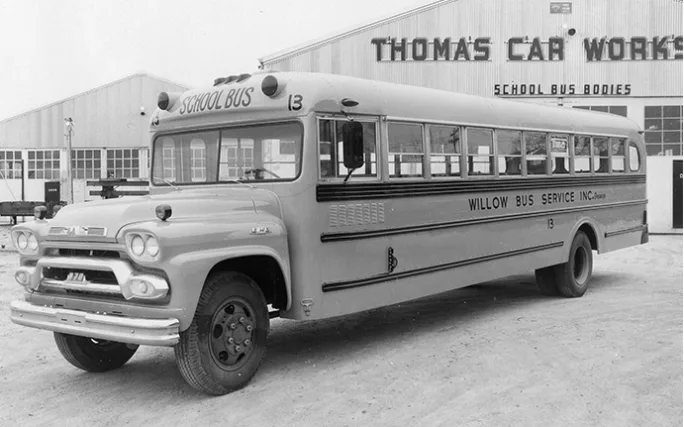
By 1950, Thomas offered conventional body styles that could be mounted on the chassis of major auto brands such as Ford and Dodge.
Photo: Thomas Built Buses
In 1956, the first edition of School Bus Fleet magazine was published.
Safety features took off in the '70s, with flashing lights and crash tests. In 1977, the NHTSA required new safety features, including compartmentalization, that helped make cars the safest vehicles on the road today. 1992 saw the next biggest round of safety improvements, with more emergency exits, more efficient stop arms, and improved mirrors.
The 1980 NCST updated the standards for school bus chassis and bodies, rewrote the specially equipped school bus standards, and included definitions for Types A, B, C, and D buses.
Engines have completely shifted away from natural gas.
There have been countless OEM shakeups. Since I joined SBF in 2021, Forest River bought Collins Bus and Trans Tech, Titan Bus is now Endera, Pegasus has completely disappeared, and BYD launched its U.S. counterpart, RIDE. Before this, we said goodbye to AmTran, Carpenter, Superior and Mid Bus, Ward, Wayne, and more.
Horse-drawn school hack full of children on their way to school near Westphalia, Indiana, 1915.
byu/WorldHub995 inOldSchoolCool
Reflecting on all of this, it’s fascinating to see the shifts over time. The earliest advancements in school buses were so simple but crucial for safety. Now, it’s hard to keep up with the rapid acceleration.
The most recent exponential shift probably started with GPS tracking, which evolved into telematics. Today, we have motion sensors, on-board WiFi, driver tablets, stop-arm cameras, interior cameras, fire suppression systems, ID badges for students to check in and out, parent apps, and AI-powered maintenance and routing.
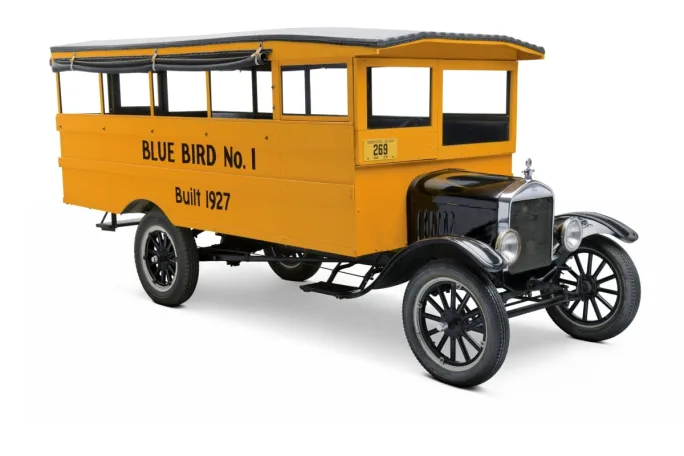
1927 Blue Bird School Bus
Image from the Collections of The Henry Ford
Oh, and now the yellow buses are going green as diesel usage slowly decreases and all-electric, propane, and CNG-powered buses gain popularity. Add to that fancy charging capabilities and V2G and V2X, exciting technologies that could stabilize the grid as we await infrastructure that meets the expectations of EV mandates.
But while we’re all here because we’re invested in K-12 students getting to and from school safely, the fact is that ridership on the yellow bus is declining. Private vehicles have become the most common mode of transportation for children, whether through family rides, carpools, self-driving, or emerging transportation services like HopSkipDrive and EverDriven. According to Washington Post data, in 2022, 53% used a private vehicle while 33% boarded the yellow bus. And HopSkipDrive’s 2024 State of School Transportation Report states that just 31% of children use the bus.
I assume most of SBF’s readers would prefer to see that latter number increase. After all, we know that riding the school bus is the safest mode of transportation.
While it’s not clear if or when that trend may change, what we can do now is focus on increasing student safety and finding efficiencies for our teams. I am thankful for the work of associations like the NAPT, NSTA, and NASDPTS who work tirelessly to support the advancement of K-12 transportation on both local and national levels.
With the next NCST in May, new recommendations will soon come for state delegations to adopt. This will be the Congress’ first meeting in 10 years (2020 was skipped due to COVID), and much has changed since then. Ronna Weber, national director, expects a focus on the school bus driver and mechanic shortage, the vastly changing technological landscape with respect to illegal passing of stopped school buses, the transition to electric and alt-fuel school buses, and the continued growth of alternative transportation. “Our industry has seen much change in recent years, and NCST will allow our best practices to catch up and better equip all of us to ensure the continued safety of the nation’s school children,” she said.
So, what is next to revolutionize pupil transportation? I’m not sure just yet, but I am eager to see what makes us chuckle looking back in a few more decades.
Do you remember what early school buses were like? Reach out and share your insights and stories: amanda.huggett@bobit.com.
Subscribe to Our Newsletter
More Blog Posts

5 Video Interviews That Stuck With Me
After more than 100 episodes of The Route, SBF’s editor looks back at the unforgettable conversations and the school transportation lessons that we won’t forget.
Read More →
Leading with Compassion & Curiosity
What if the story you're telling yourself isn't true? Learning about emotional intelligence can improve communication and culture in school transportation and beyond.
Read More →
Key Trends Shaping The Future of School Transportation: ACT Expo Analysis
What’s next for the school bus market? We walked the show floor in Vegas to find out. From AI and V2G to battery breakthroughs and cutting-edge software, here’s what stood out.
Read More →
Suffering from Imposter Syndrome? You’re Not the Only One
Tips on fearing less instead of being fearless, and a powerful lesson from a group activity inspired by the 2025 NAPT keynote.
Read More →
My Own Trailblazers (and Why We Need More Women in Leadership)
From family influences to industry leaders, SBF’s editor reflects on the women who shaped her path and why representation in school transportation leadership matters.
Read More →
18 Ways to Support Your Transportation Team Beyond Thank-You Notes
Love the Bus Month is about more than thank-you notes. Learn how supporting the entire transportation team builds trust, culture, and retention year-round.
Read More →
When Home Is the Headline: Finding Our Way Forward in Minneapolis [Op/Ed]
In this season of uncertainty, leadership means empathy, critical thinking, and showing up. Here, our editor’s personal reflection on what matters most when times are tough.
Read More →
Seventy Years on the Road Together
School Bus Fleet’s editor reflects on the magazine and the industry’s legacy, change, and what endures.
Read More →
Through Change and Choice: Key Insights from 2025 and the Road Ahead
The school bus industry navigated big changes in 2025. Here’s how we adapted, what the data reveals, and what lies ahead in 2026.
Read More →
The Hidden Risks on the Road
Even the best school bus drivers can’t prevent every danger. As technology races and tempers rise behind the wheel, transportation pros face new challenges beyond the driver’s control.
Read More →