




Weigh Your Options When Spec’ing a Suspension System
Finding the right balance between ride, handling and longevity requires planning and research.
When school bus drivers transport students to and from school, they should focus on the well-being of their passengers, not bumps and potholes in the road. By driving a bus with a good suspension system — which combines road-holding ability and control with a smooth, quiet ride — drivers can more easily concentrate on the task at hand. This article explains how to select a suspension system that best meets your needs. Note: You need to make sure that your suspension system meets state specifications. These design and capacity requirements should be reviewed carefully before selecting a suspension system.
Find the right balance
Today, several design options are available. Selecting a good suspension system involves finding an acceptable balance of durability, stability, cost and ride comfort. Too often, decisions on the selection of suspension systems are made with a focus on durability. High-capacity systems don’t always provide increased durability or longer life; however, they usually do provide a poor ride for the passengers and the driver. We categorize suspension systems as “soft” or “firm.” For the best performance, these systems should not be mixed. For example, a soft front suspension system should not be matched with a firm rear suspension. The weight of the vehicle is another key consideration. It can vary dramatically depending upon the number of passengers and equipment options, such as wheelchair lifts and air conditioning. The location of the fuel tanks also can affect weight. These variances can influence the quality of the ride. If the bus is not equipped with a suspension system designed to accommodate load variances, unusually light or heavy loads could lead to a bumpy ride.
Load analysis helps
An analysis should be done to determine the maximum load that the bus can be expected to carry. The suspension system must be adequate to support this maximum load, but it should not exceed that capacity. For example, if the anticipated maximum load at the rear axle is 17,500 pounds, the bus must have a suspension system rated to carry that load. It is not necessary to select a suspension of a higher capacity, such as 19,000 pounds. Overspec’ing the suspension system can lead to a poorer ride because, in general, as the capacity increases, so does the spring rate. The best ride comes from the lowest possible spring rate. (Spring rate refers to the load-deflection characteristic of the spring. It is usually expressed as pounds per inch of deflection, i.e., how many pounds of force are required to move the spring one inch.) Once the full load capability is determined, the partial load conditions must be addressed. If the bus is expected to operate frequently with light or intermediate loads, a suspension system providing a good ride over a wide range, such as a two-stage suspension, may be needed.
Seek expert advice
An important part of selecting the best suspension system is working closely with the body manufacturer. It can help you determine the suspension system’s capacity based on the weight of the body, anticipated number of passengers, interior configuration, number of seats and options selected. Although the suspension system hasn’t always been considered the most important option on a school bus, new types of systems have been developed in recent years that provide more choices and benefits. Several options are available for both front and rear suspension systems, depending upon needs. Here is a rundown of the basic systems offered:
Front suspension systems
Flat-leaf springs (firm ride) — The multileaf spring is the oldest option for front suspension systems. It is a stack of flat leaves of constant thickness along the entire length of each leaf. The leaves are fastened tightly together, and the metal-to-metal contact creates leaf-to-leaf sliding friction. Friction restricts the movement of the spring, adversely affecting the ride quality. So, although this system is inexpensive and provides good stability and vehicle control, it does not offer the best ride. Parabolic (tapered-leaf) springs (soft ride) — A newer option on the leaf spring suspension system is one with parabolic (tapered-leaf) springs, which are thicker in the middle than at the ends (see illustration). These suspension systems use fewer spring leaves, which reduces leaf-to-leaf friction and produces a smoother ride than flat-leaf springs.
Rear suspension systems
Multileaf variable rate springs (firm ride) — This flat-leaf spring design offers a variable deflection rate by changing the effective length of the spring with the use of a cam-type frame mounting bracket. As the spring deflects, due to increased load, the point of spring contact on the bracket moves toward the center of the spring, making it stiffer as the load increases. This is the most popular type of rear suspension today, providing good stability and control, but not the best ride. Parabolic (tapered-leaf) springs (soft ride) — This option is also available on rear suspension systems and provides a smoother ride than flat, multileaf springs because of the low-friction design. When considering the combination of a tapered-leaf rear suspension with a tapered-leaf front suspension, reduced stability can occur and anti-sway bar systems may be needed. Multiple (two-stage) springs (soft ride) — The multiple (two-stage) spring is designed to provide the stability of a multileaf system and good ride when the bus is either loaded or empty. This design provides a lower spring rate when the bus is lightly loaded and a higher rate when it is heavily loaded. The package of spring leaves is divided into two sections. At light load conditions, only the long leaves of the upper section are active in carrying the load, and the spring rate is relatively low. As the load increases and the upper section is compressed, it gradually comes into contact with the shorter leaves of the lower section. At the higher load conditions, both sections of the spring package are active, and the spring rate is higher. This design is an excellent option if the bus will be running frequently at lighter loads.
Air-ride suspension
With a variable rate and low friction, this option is known for excellent ride quality coupled with a lightweight design. The suspension height remains constant and the effective spring rate changes as the air cushions are automatically adjusted to different load conditions. This option provides a smooth ride over a wide range of light to heavy load conditions. It is a good choice when transporting special-needs students, and for a small additional cost, flat-floor configuration for versatile seating plans can be provided.
Flat-floor flexibility
Flat-floor configurations are available with leaf spring suspensions and 19.5-inch wheels or air ride with 22.5-inch wheels. When combined with track seating, the flat-floor configuration provides the greatest seating flexibility. With this design, there are no wheelwells protruding from the floor and no step between the passenger and driver area. The flat-floor configuration has become very popular in the last few years.
Summary
It’s clear that the suspension system is an important factor in achieving the best combination of stability, control and ride. By setting goals and assessing the various designs, the best system will be selected to meet the specific needs of school bus drivers and passengers.
Author John Fay is manager of school bus marketing for International Truck and Engine Corp. in Chicago.
More Maintenance
The essential guide to school bus maintenance and student safety
Reactive maintenance puts students at risk of breakdowns, delays and roadside emergencies. This guide gives transportation directors a data-driven framework to predict failures, extend bus lifespans and improve fleet reliability across every route.
Read More →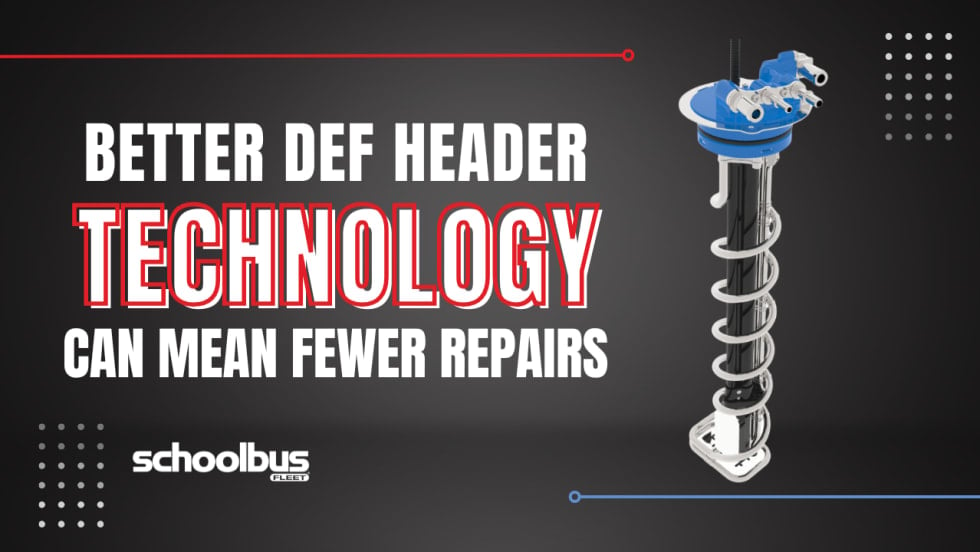
The Evolution of DEF Header Technology: What School Bus Operations Should Know at Replacement Time
See what school bus fleets should consider when replacing DEF headers to improve reliability, reduce repeat repairs, and control maintenance costs.
Read More →
Kerry Brothers Grows Michigan School Bus Repair Network
The acquisition of Downriver Truck and Bus expands Kerry Brothers’ school bus maintenance footprint across southeast Michigan, adding repair capacity, diagnostic resources, and state inspection support.
Read More →
Noregon Introduces CAN Bus Diagnostic Tool, Expands JPRO Features
CAN Mentor and the latest JPRO update aim to simplify vehicle network diagnostics and improve repair efficiency for technicians of all experience levels.
Read More →
Cummins on Smarter, Simpler Engine Innovation
Cummins discusses its first-ever gasoline engine for school buses, EPA 2027, and why bus fleets still want durable, simpler internal combustion options.
Read More →
Report: 72% of Diesel School Buses Now Use Advanced Low-Emission Engines
New data shows advanced low-emission diesel technology continues expanding across school bus fleets, even as electric bus adoption gains momentum.
Read More →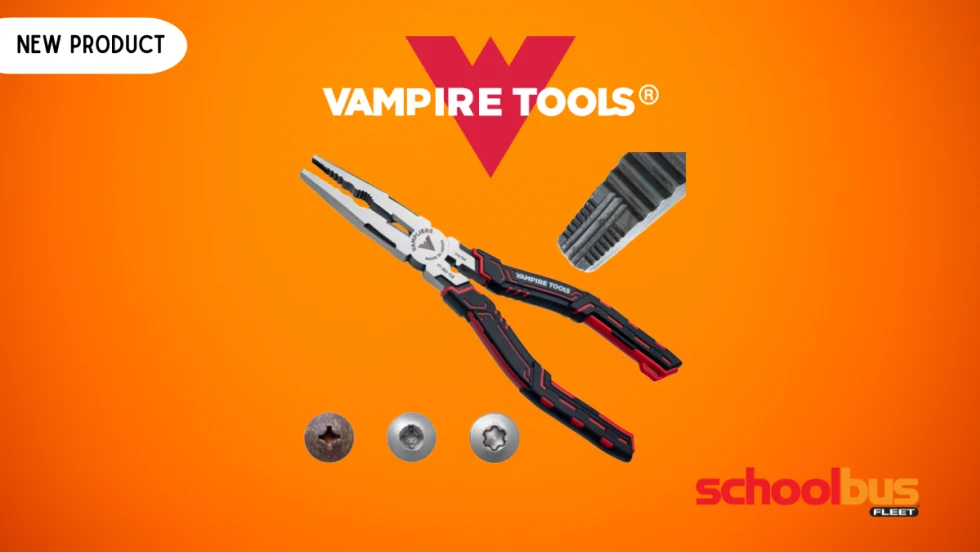
Vampire Tools' CAIMAN 7.5-Inch Multi-Purpose Screw Extractor Long-Nose Pliers with Crimper
Vampire Tools introduced the VAMPLIERS Caiman 7.5-inch multi-purpose pliers, combining screw extraction, cutting, crimping, and gripping functions into a single tool designed for fleet maintenance professionals.
Read More →
How Advanced Diagnostics Helps Bus Fleets Stay Ahead of Repairs
Chat with Noregon’s Kevin Smallhorn at ACT Expo about bus diagnostic tools, telematics integration, CNG maintenance support, and strategies to help reduce downtime and improve uptime.
Read More →
How School Bus Fleets are Getting Ahead of Breakdowns
Don’t let bus downtime wear you down. Here’s how bus operators are shifting from manual processes to AI-powered, data-driven maintenance systems for improved reliability and safety.
Read More →
Pennsylvania School Bus Maintenance Team Praised for Dedication to Safety
Matthews Bus Company’s West Jefferson received a letter of commendation from the Pennsylvania State Police for their fleet inspections.
Read More →