




We give a hoot
It’s hard to go anywhere or do anything these days without coming across some sort of “go green” message. On TV, you might see a Good Morni...

It’s hard to go anywhere or do anything these days without coming across some sort of “go green” message.
On TV, you might see a Good Morning America segment on which light bulb or refrigerator you should buy to reduce power usage.
At your local grocery store, maybe you’ve seen a display offering reusable canvas shopping totes to replace paper and plastic bags.
And on the road, you’ve certainly followed a car whose bumper sticker politely asked that you “Save the Planet!” or, better yet, “Give a Hoot — Don’t Pollute!”
SCHOOL BUS FLEET hasn’t shied away from this topic. As you may have already noticed, we have coverage in this issue of alternative fuels that are increasingly being embraced by the school bus industry — including biodiesel, propane, CNG and hybrid-electric technology.
The green crusade appears to be more widespread than ever, and the school bus industry is in a good position to benefit from it.
Yellow and green
Earlier this spring, industry officials took an interesting angle in the ongoing quest to promote pupil transportation.
In conjunction with Earth Week, the American School Bus Council (ASBC) distributed a press release that touted the green benefits of using school buses.
The council pointed out that model year 2007 school buses are 60 times cleaner than those built before 1990. Also, school bus operators have retrofitted more than 12,000 school buses with emissions-reduction technology since 2003 through the EPA’s Clean School Bus USA grant program.
NAPT and the ASBC also issued three public service announcements (PSAs) to be aired by radio stations during Earth Week. The spots target high school students who drive themselves to school.
“If you’re concerned about the environment and you’re in high school, listen up,” one of the PSAs urges. “Want to make a real difference? Leave your car at home and take the school bus. You’ll save gas, reduce pollution and traffic congestion, and save money, too.”
Teen appeal
School buses haven’t traditionally been associated with environmentalism. Nor have most teens considered the school bus a “cool” way to get to and from school. But those perspectives could change, and the ASBC has identified a promising approach.
Concern for the environment seems to be growing among youths today. Celebrity-fueled campaigns such as last year’s Live Earth, which staged worldwide concerts that were as much calls to action as they were entertainment, have surely won many young converts to the green movement.
That’s not to say that teens just do whatever their favorite pop stars tell them to do. Young people can recognize an important cause. But it does show how much is being invested in reaching out to the next generation.
After all, today’s children will be tomorrow’s leaders. Let’s do what we can to ensure that, a few decades from now, they’ll start putting their own children on the school bus. And that when those kids are old enough to drive themselves, they’ll choose to go green by going yellow.
More Alternative Fuels
Alt-Fuel Moves: Electric Bus Rollouts, Bidirectional Charging & Propane Growth
See which fleets are adding electric and propane school buses as districts and operators invest in charging infrastructure, bidirectional technology, and alternative-fuel expansion.
Read More →
Nobody Told Diesel Prices They Were Supposed to Come Down
With diesel prices surging, school bus fleets have new reason to stress-test fuel costs, consider diversification, and calculate what each route really costs to operate.
Read More →
Why Gasoline School Buses Are Making a Comeback
Gasoline is gaining ground in full-size school buses. See how today’s options stack up against diesel on cost, maintenance, emissions, performance, and more.
Read More →
EPA Opens $180M DERA Funding Round for Diesel Upgrades
The 2026 Diesel Emissions Reduction Act program seeks applications from eligible organizations to accelerate the retirement of legacy diesel vehicles.
Read More →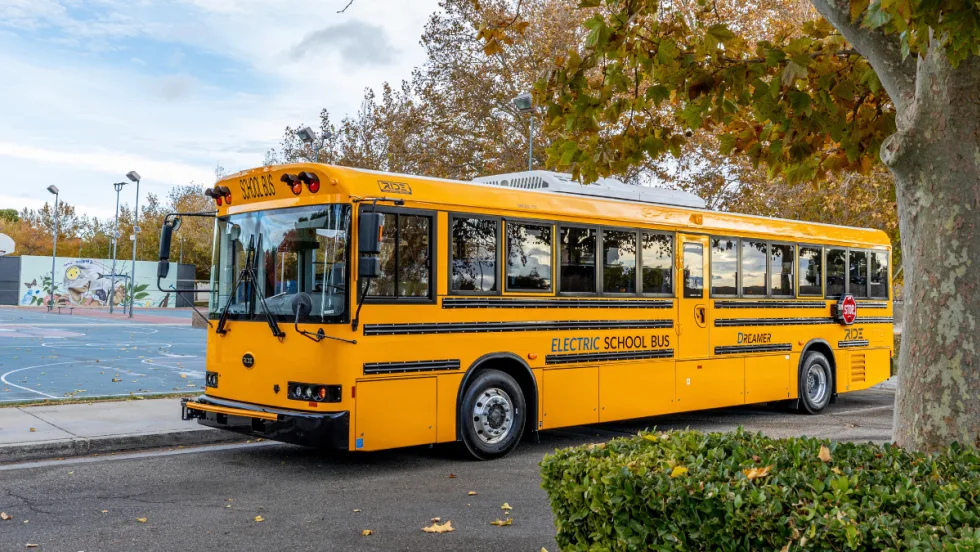
The Secret Life of an Electric School Bus Battery
Batteries change throughout years of daily routes, but degradation doesn’t necessarily mean the end. Here’s what operators should know about performance, safety, and second life.
Read More →
CALSTART and Forth Combine to Form Catalyst Mobility
The new name represents a renewed vision for the nonprofit focused on advancing clean, equitable, and affordable transportation solutions that move people and goods.
Read More →
Alt-Fuel Moves: New Buses, Charging Hubs & Real-World EV Testing
Propane and electric school bus deployments continue to grow as districts add new vehicles, expand charging infrastructure, and gather more real-world operating data.
Read More →
Fewer Electric School Bus Models Reshape the U.S. Market
WRI’s latest buyer’s guide points to a consolidating electric school bus market, but fewer options may reflect a maturing industry rather than fewer meaningful choices for school bus operators.
Read More →
The Fuel Budget You Can Actually Predict: How Propane Autogas Keeps Money in the Classroom
Learn how propane autogas helps school districts manage fuel costs with predictable pricing, lower maintenance, and reduced emissions from former transportation director Joel Stutheit.
Read More →
Hendrickson, Driventic Introduce New Electric Powertrain for School Buses
ELECTRAAX, the electrified, lightweight drive axle offers integrated ePowertrain efficiency and modular flexibility for Class 6–7 school bus use.
Read More →