




Tips to Protect Employees From Exposure to Bloodborne Pathogens
Imagine receiving a call that a child has been injured while boarding one of your school buses. The driver stated that a young girl has fallen on t...
Imagine receiving a call that a child has been injured while boarding one of your school buses. The driver stated that a young girl has fallen on the steps and her head is bleeding. The dispatcher has called 911, but you are requested at the scene.
You arrive just as firefighters and paramedics take over caring for the victim. These rescuers do their job well — the victim is stabilized, wrapped up for transport to the hospital and gently placed on the stretcher.
As you watch, you can’t help but notice that the firefighters and paramedics are wearing medical gloves and goggles. As EMS (emergency medical services) personnel leave the area, you approach your driver, who is talking with a police officer. Almost immediately you become aware of a very frightening sight — your driver has fairly large spots of blood on her clothing and, even more upsetting, she is using a hand towel to wipe the blood off of her hands. It is obvious that this driver did nothing to protect herself from disease transmission and has been contaminated with the victim’s blood.
Wearing PPE (personal protective equipment) is an important part of professional rescuers’ equipment. They know that protecting themselves from bloodborne pathogens is, in some ways, just as important as caring for the victim. But what about your people — your drivers, mechanics and even your office personnel — do they know this and know the risks associated with not wearing protective equipment?
If your company provides first aid kits for employee use or if your employees are required to respond to a medical emergency, they should have access to protective equipment and receive training on bloodborne pathogens.
Assess your operation’s risk for exposure
I was recently asked to evaluate exposure risks for an association of tow truck operators, body shop technicians and auto mechanics. These people lacked training on bloodborne pathogens.
Tow truck operators wear thick, leather work gloves and routinely pick up bloodstained windshields or wrap contaminated airbags around steering columns. Body shop technicians pull contaminated seats from wrecked vehicles and then sit on them during their breaks or at lunchtime. Mechanics have a tendency to cut their knuckles or foreheads while repairing vehicles. They also share tools with fellow employees — tools that are contaminated with blood from their last injury.
I know you’re not in the automobile repair business. The examples above are intended to get you thinking about your own operation’s risks of exposure to potentially dangerous body fluids. Do you have a first responder team or people assigned to respond to an emergency? Are first aid kits available to employees? Do employees share equipment or tools that could become contaminated? Who is responsible for cleaning up body fluids after an accident or injury?
Without proper communication policies and training in preventing disease transmission, your employees could find themselves exposed to the same dangers paramedics and firefighters face while coming to their aid.
So what can you do to reduce the risk of exposure? Let’s start with defining bloodborne pathogens and the impact that exposure to them can have on employees and employers.
Contamination prevention guidelines
Bloodborne pathogens are pathogenic microorganisms that are transmitted via human blood and cause disease in humans. They include — but are not limited to — hepatitis B and human immunodeficiency virus (HIV).
I know for many people (myself included) words like microorganisms, immunodeficiency and pathogens bring back thoughts of high school and health classes — the last places in the world most of us want to revisit. So before we go any further, let me put it in my terms: There’s a lot of junk out there that can make us very sick, or even kill us if we become contaminated.
We need to constantly be on guard and be very careful so that we don’t become contaminated. I’ve been teaching CPR and first aid training for over 25 years, and I’m often asked if I would do rescue breathing without a barrier on someone I do not know. I respond without hesitation: If I found someone unresponsive and not breathing, I would immediately call for help and begin chest compressions on the victim, but there is no way I would do mouth-to-mouth on the individual without a breathing barrier.
Emergency responders know the risks associated with coming in contact with bloodborne pathogens, and they know how to protect themselves. Unfortunately, far too many people in the workplace or good Samaritans on the street do little, if anything, to take the necessary precautions. Too often they realize they’ve been exposed to body fluids after the emergency, when it’s too late to do anything about it.
Here are a few simple rules to follow when faced with the possibility of exposure to bloodborne pathogens, or any body fluids for that matter. This information is presented as guidelines for both employees and employers. The American Heart Association calls it “Making a PACT, Know How to Act.”
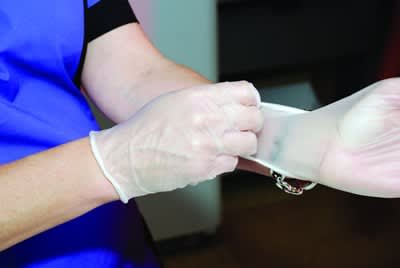
PROTECT — Protect yourself from blood or blood-containing materials. This includes wearing protective equipment such as gloves and goggles and using a breathing barrier if you are performing CPR. Consider your options if you find yourself with no protective equipment.
ACT — If you find you have come into contact with another person’s blood or other body fluids, act quickly and safely. Wash the area immediately with hot, soapy water for up to a minute before rinsing. If your eyes have been contaminated, flush them with clean water for up to five minutes. If a flushing agent is not available at the scene, have someone get water for you. Firefighters or paramedics can assist you if they are still at the scene.
CLEAN — After an emergency, especially in the shop area or office, clean any areas contaminated with blood or body fluids. Wear protective equipment. Clean the area with a solution of one part Clorox and eight parts water. Completely flush the area and let the solution stand for at least three minutes. Be careful when wiping up the area, especially if you are dealing with broken glass or wood or metal splinters. Put all soiled items, including soiled cleaning materials, in a plastic bag and take it to the dumpster as soon as you are finished. If there is an injection device (such as a needle) involved, try to give it to the medics or firefighters before they leave; otherwise, get it in the dumpster and use extreme caution while doing so.
{+PAGEBREAK+} TELL — Report the incident immediately to your supervisor or human resources department. Ask for a dated copy of the report (even if it is only handwritten).
Employers’ responsibilities
Employers have a responsibility to protect their employees from exposure to bloodborne pathogens. Here are the specifics of this responsibility.
PERSONAL PROTECTIVE EQUIPMENT — Any employee at risk of being exposed to bloodborne pathogens must be provided with the protective equipment necessary to keep them safe from exposure. This equipment includes gloves, goggles and, if required, breathing masks or barriers for CPR.
EDUCATION — Not all professions require bloodborne pathogen education and prevention training.
A call to OSHA (Occupational Safety & Health Administration) may or may not give you the answer you are looking for. It appears as though OSHA looks at a number of factors when determining whether an employer does or does not have to comply. For example, if you offer voluntary CPR/first aid training to your employees, they may not be required to take bloodborne pathogen training. If you have designated first aid responders within your organization, you probably fall under the training requirements.
Many of you know your employees’ occupational exposure risk. If you have personnel who are routinely or even occasionally exposed to blood or body fluids in the execution of their duties, you may want to consider offering protective equipment and training to these employees.
ENGINEERING CONTROLS — Engineering controls help to protect employees from bloodborne pathogen contamination and prevent the spread of pathogens in the workplace. Here’s an example of engineering controls:
An employee using his leather work gloves realizes he has come in contact with body fluids and the gloves are contaminated. Two controls should be in place to protect the employee. First, knowing his exposure risk, the employer should have a spare set of gloves on hand so that the operator can complete his job. Second, the company should have a procedure for disposing of or cleaning the soiled gloves.
WORK PRACTICES — Setting standard practices for preventing disease transmission is a very important part of an employer’s responsibility in protecting employees.
In the case of the body shop previously mentioned, good work practices would include establishing a policy requiring workers to wrap plastic around seats pulled from a wrecked vehicle and prohibiting them from sitting on the seats, even with the plastic cover in place.
Providing employees with their own toolboxes is another good practice. If they share tools, have a policy in place for cleaning and decontaminating tools, especially after an accident or injury. Moreover, make sure employees know the importance of disposing of or cleaning contaminated personal protective equipment.
Finally, offer a course in bloodborne pathogen training. It is an excellent way to communicate the importance of preventing disease transmission and protecting your company from a huge liability/workers compensation claim.
HAVE A WRITTEN POLICY AND REPORTING PROCEDURES IN PLACE — As I previously mentioned, implement policies related to bloodborne pathogens at your operation. Start small, then expand on the policies as new issues surface. Communicate with your people. Make sure they know the reporting procedures and the importance of reporting any possible contamination.
OSHA has templates for creating your own company bloodborne pathogens policy and/or procedure. Simply download the forms, fill in the blanks with your company name, etc., print them out and you’re good to go. The information can be obtained by calling the regional OSHA office in Philadelphia at (215) 861-4900.
Training, policies are worthwhile investments
I am a business of one, but if I did have employees, I can assure you — they would be trained on bloodborne pathogen risks and contamination prevention, and my company would have a policy in place. It’s the right thing to do for a business, its employees and the employer. And just imagine how good it would feel to know that your operation is in compliance should OSHA officials decide to visit.
Invest an hour for setting up your program, distribute the information to your employees and arrange for a 30-minute bloodborne pathogen education and prevention class. The investment is small, but the dividends to you and your employees will be huge.
John Schmidt owns Safety Outsourcing. He offers courses in CPR, first aid, AED (automated external defibrillator) and highway safety training and the American Heart Association’s course in bloodborne pathogen training throughout central and southeastern Pennsylvania. For more information on Safety Outsourcing, visit www.safetyoutsourcing.net. Prior to starting his own business, Schmidt was supervisor of instruction for the American Red Cross in Philadelphia, safety manager for Krapf Bus Companies and a professional EMT and firefighter for over 20 years.
More Management

How to Build a Better Driver Training Program
Ready to boost up your school bus instructor training? Here’s how to pick the right talent and improve recruitment, retention, and safety.
Read More →
CALSTART and Forth Combine to Form Catalyst Mobility
The new name represents a renewed vision for the nonprofit focused on advancing clean, equitable, and affordable transportation solutions that move people and goods.
Read More →
What Makes a Great School Bus Driver Trainer?
Choosing the right school bus driver trainer takes more than experience. Learn six keys to selecting and developing trainers and evaluating program effectiveness.
Read More →

School Bus Contractors Expand Through New Deals, Acquisitions & Partnerships
STA's Canadian division acquires Ontario-based G&L Stevenson Transport; Durham School Services adds a new district in California; First Student expands in New Jersey; and Minnesota Coaches rebrands and acquires Halo Transportation.
Read More →
Logan Bus Company Rolls Out AI Phone System for NYC School Bus Families
A summer pilot found that AI agents could handle most routine calls, freeing up time for customer service staff to focus on emergencies and complex family concerns.
Read More →
From Intent to Impact: What I Learned About Leadership from TAPT
A Texas transportation supervisor shares lessons on self-awareness, accountability, managing stress and building trust — and why investing in leadership development matters at every stage of your career.
Read More →
NAPT Names 2026 Award Recipients, Hall of Fame Inductee
Who earned national recognition for their work in student transportation? This year, NAPT named five recipients of its 2026 awards for service, safety, and leadership, plus its newest Hall of Famer.
Read More →
2026 State of Student Transportation Report
Driver shortages. Rising costs. Growing safety expectations. More data, but not enough time to act on it. The 2026 State of Student Transportation Report reveals what transportation leaders say is putting the most pressure on their operations—and where they’re investing next. See how your priorities compare.
Read More →
How to De-Escalate an Angry Person: 5 Steps for Handling Workplace Conflict
What makes emotions run high, and how should you handle an angry colleague or parent? Follow these steps for staying calm, listening, showing empathy, and resolving conflict.
Read More →
What Readiness Looks Like This School Year
Learn about the challenges shaping the 2026–2027 school year, from persistent driver shortages and budget pressure to technology and readiness gaps. See how school districts are responding and adapting in Zonar’s 2026 Back-to-School Readiness Report.
Read More →