




Special-needs collaboration streamlines service
By establishing policies on which students can receive special-needs bus transportation and providing those students with the exact services they need, transportation departments can operate buses efficiently, creating cost savings for districts. Communication and teamwork between school and transportation personnel are essential to achieving this.
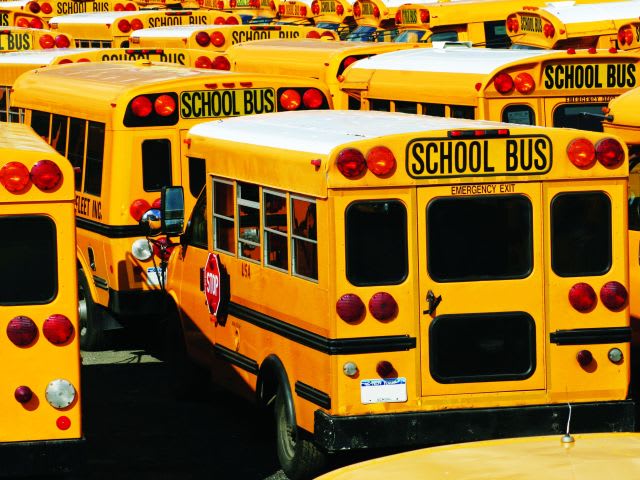
istockimage@Christopher Steer
Special-needs transportation covers a wide variety of unique scenarios. It takes logistics, medical knowledge, and expert time management and organizational skills to provide exact services for each student, all while complying with the complex federal and state laws and individual school districts’ rules.
Special-needs buses must be individually tailored but roll like it is just another day on any other school bus. To accomplish this balancing act, transportation departments and school staff responsible for these students must work as a team to ensure that all the needs for special-education students are being met. It requires flawless communication among all parties and clear standards. When there are not smooth communication venues and clear policies, special-needs transportation can be a funnel where school funds flow out at an alarming rate. When the school staff responsible for special-needs students works as a team with the transportation staff that provides those services, the result is cost savings to the school district.
Many times, the school staff instructs the transportation department on which students will require special transportation and how they should be transported. The result is often a crippling transportation budget, overcrowded buses or too many buses on the road. When schools work in conjunction with transportation personnel, making certain that only special-needs students receive the special transportation services and that the students are receiving exactly what they need, school transportation departments can be confident that they are providing efficient service.
Establish comprehensible policies
There are a few simple steps that school districts can take to establish effective special-needs transportation collaboration between schools and transportation departments. First, transportation departments must develop clear policies that mirror federal IDEA laws and state laws that govern special-needs student transportation.
Districts can provide valid services without providing services that are more of a convenience than an actual need. By maintaining clear rules that follow the idea of the least restrictive environment rather than convenience for the district or parents, and by keeping the needs of the students at the forefront of all decisions, transportation crews can inventively transport students while providing for every individual need.
Once the policies are in place, schools and transportation staff must agree that only under extreme, unusual circumstances should those policies be violated. Once an exception is made, it is very easy to repeat the exception. After time, the exceptions become past practice and policies are nothing more than old ideas. Keeping policies current and following them provides consistency among special-needs school staff and transportation, which results in less frustration for parents, bus drivers who can be confident about the policies they follow during day-to-day operations, and one less avenue for loss of funds.
[PAGEBREAK]

Author Lori Riddles says that by providing special-needs students with the exact services they need and maintaining control of
the factors involved in transporting these students, it’s possible to achieve cost-effective service.
Special-needs students only, please
Second, the special-needs staff should clearly identify which students will receive special transportation, and they should not make a habit of allowing non-special-needs students to utilize special transportation.
One reason that special-needs transportation budgets are larger than general-education transportation budgets is that students who are not qualified for services end up on special-needs school buses.
For example, students with behavior issues are placed on a special-needs bus since there is usually a second adult on board. Rather than correcting the behavior through other methods, an expensive special-needs bus is used as a remedy. The extra bus stops for unqualified students add to the expense of running that special-needs bus. By creating clear rules on what it means to qualify for a special-needs bus, transportation teams can control the expense.
Only exact services provided
Next, schools and transportation staff must agree that only the services needed for students will be provided. Offering services that the student may not actually need is another misuse of special-needs transportation that causes extra expenditure for districts.
For example, it is a common misconception that all students with disabilities should receive a front-door pickup rather than a bus stop pickup. If a student is physically able to walk to the bus stop, the student has no mental disability, or there is no safety concern that would prevent the student from catching the bus at a bus stop, then the bus stop should be assigned for that student. When teams provide just what is needed, there is little room for a waste of resources. School and transportation staff should work together to create a screening process for all students whom school staff requests for placement on a special-needs bus route.
To protect the confidentiality of student records, the staffs at schools have a propensity to tell transportation personnel the bare minimum about the students. Sometimes all that is communicated is the need for a wheelchair lift-equipped bus or an aide to monitor the student. If transportation teams have a screening process for these requests, important data about the student can remain confidential and only the necessary services will be provided.
Teamwork is essential
By creating a team of school personnel and transportation personnel to monitor the factors outlined above (i.e., what students are assigned to special-needs bus services, why they are assigned and how they are transported), school districts can find ways to improve efficiencies and save money.
By extension, the best way to ensure that students are at the forefront of special-needs transportation budget planning is to provide what those students need in the most efficient way possible. If the transportation department allows other departments to dictate how it handles the method in which it provides services, it is essentially giving up control of not only the services provided, but the budget that pays for the services as well.
This opens the door for inefficiencies to creep in, and the quality of services will suffer. With a collaborative atmosphere, school staff and transportation staff can monitor together the students who need services and ensure that only those students get the services. It would be interesting to use a case study to collect data from a special-needs transportation collaboration team to gauge just how cost-effective this process can be.
It can be done
With diligence and teamwork, special-needs transportation can be a streamlined, efficient process. As was previously mentioned, by focusing on the students who truly need special transportation and giving them the services they need, maintaining control of the factors that revolve around transporting our most fragile cargo is doable.
Keeping clear rules in place and following them is the key to calculating the outflow of the special-needs transportation budget. Teams of knowledgeable special-education staff and veteran transportation staff are a valuable asset that must be utilized. By creating a comprehensive plan and following through, special-needs transportation can be special and cost-effective.
Lori Riddles is special-needs route manager for Escambia County School District in Pensacola, Fla. The district is using the ideas presented in this article to guide special-needs transportation. Riddles says that as a result of these ideas, teamwork and other factors, the district has one of the most efficient transportation departments in the state.
More Special Needs Transportation
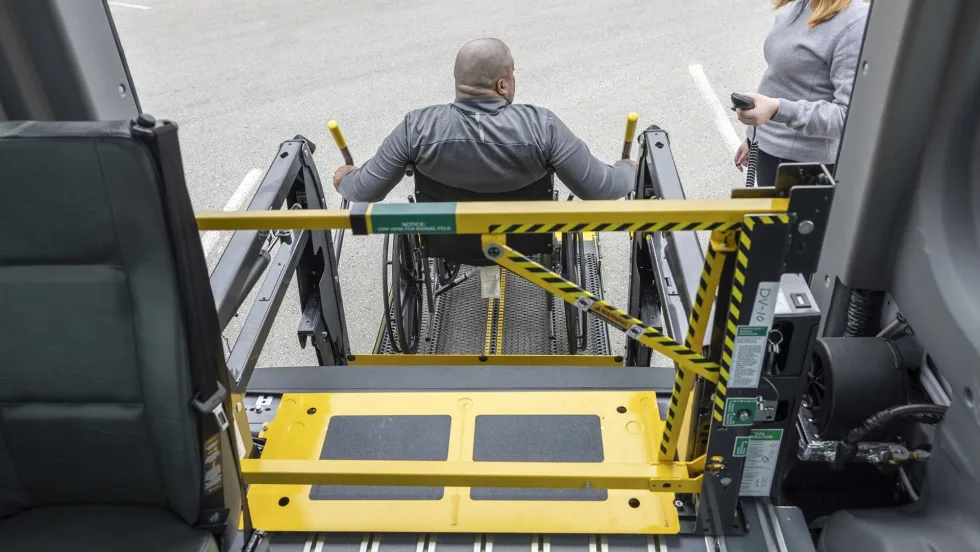
BraunAbility Introduces New Safety Barrier for Wheelchair Lifts
LiftSentinel is designed to add another layer of protection during wheelchair loading and unloading and can be retrofitted to many existing commercial lift installations.
Read More →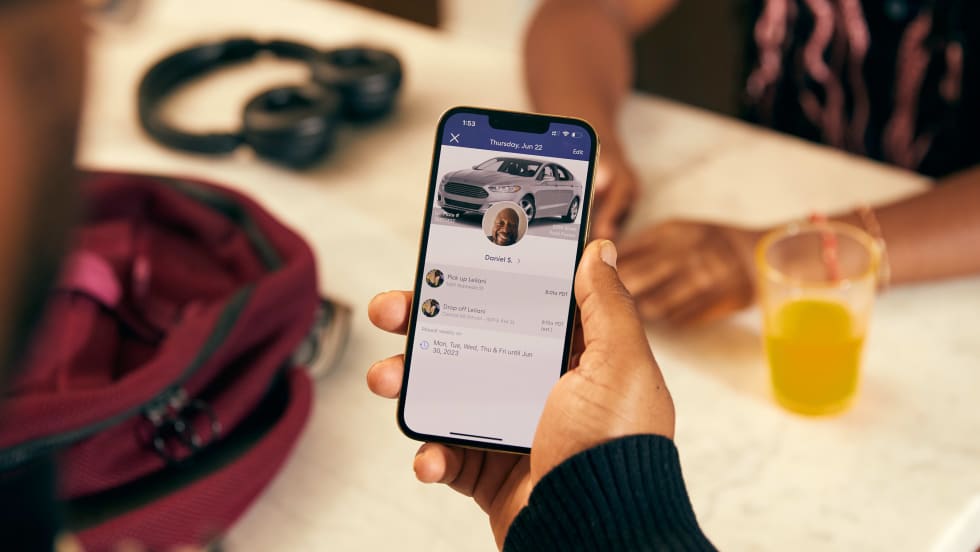
HopSkipDrive Launches New Safety, Driver Consistency Features for 2026-27 School Year
The company’s free ride recording, live ride tracking, and consistent driver assignments aim to improve safety and continuity for diverse student transportation needs.
Read More →
The Most Common Wheelchair Securement Mistakes on School Buses (and How to Fix Them)
Small missteps in wheelchair securement can have serious consequences. Here are 32 tips from experts to reduce risk and increase student safety on the bus.
Read More →
Inside AMF Bruns’ New Showroom: School Bus Securement Solutions Explained
Go inside AMF Bruns America’s new Ohio showroom with Maritza Valentin to see its FutureSafe technology, driver training tools, securement systems, and seating innovations.
Read More →
What AMF Bruns’ New Facility Means for Customers [Video]
Inside AMF Bruns’ new Stow, Ohio, operations: See how expanded space and innovation will enhance customer support and operations.
Read More →
AMF Bruns Expands in Ohio, Investing in Growth and Community
With expanded production space, local investment, and a growing workforce, AMF Bruns is scaling its U.S. presence. Here’s an exclusive first look inside the new Stow, Ohio, HQ.
Read More →
Inside AMF Bruns of America’s New Ohio Manufacturing Facility [Photos]
Take a behind-the-scenes look at AMF Bruns of America’s new 41,000-square-foot Stow, Ohio, headquarters, featuring advanced manufacturing, expanded space, and future-ready mobility solutions.
Read More →
First Student Boosts Student Support in Wichita & Texas
First Student and Wichita Public Schools are using behavioral support strategies to improve student ride experiences, while a separate initiative expands access to after-school programs through a bus donation.
Read More →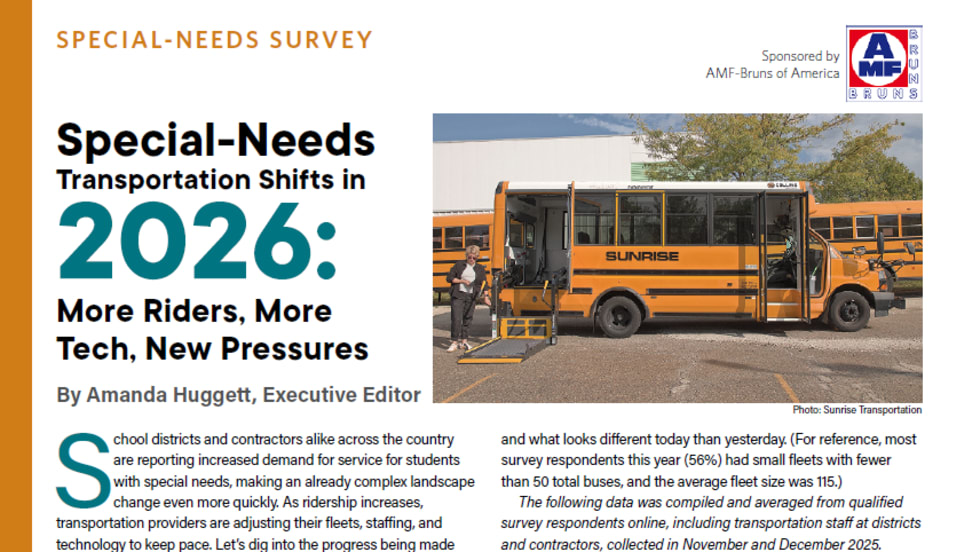
2026 Special-Needs Transportation Survey
What’s changing in special-needs transportation? This year, student transportation operators report a rising need, easing driver shortages, growing tech adoption, and evolving challenges. Sponsored by AMF Bruns of America.
Read More →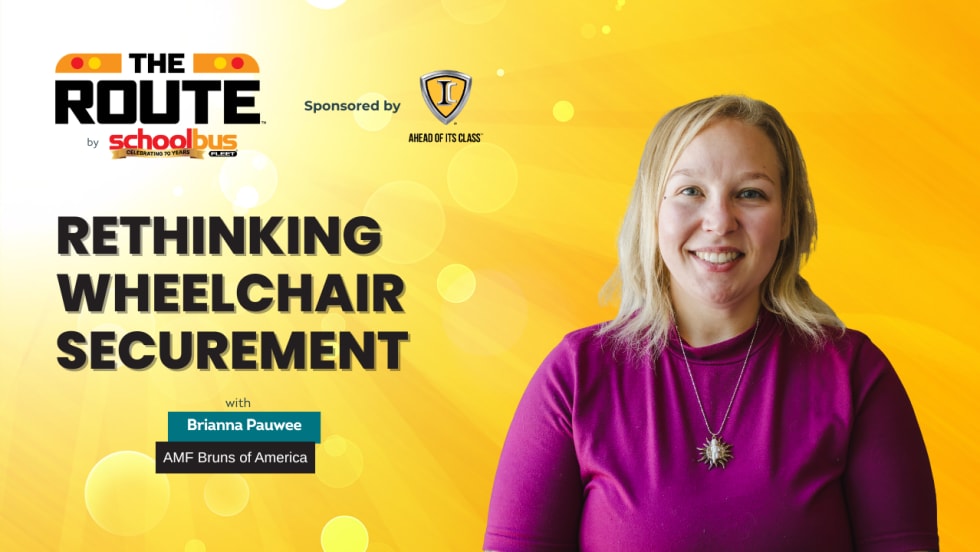
The Lived-Experience Gap in Mobility Tech: An Expert Take on Safe Student Transportation
Brianna Pauwee, a product application specialist at AMF Bruns of America and a wheelchair user, drops in to The Route to share practical securement and training insights, plus the story behind the new “Beyond Mobility” podcast. The Route is sponsored by IC Bus.
Read More →