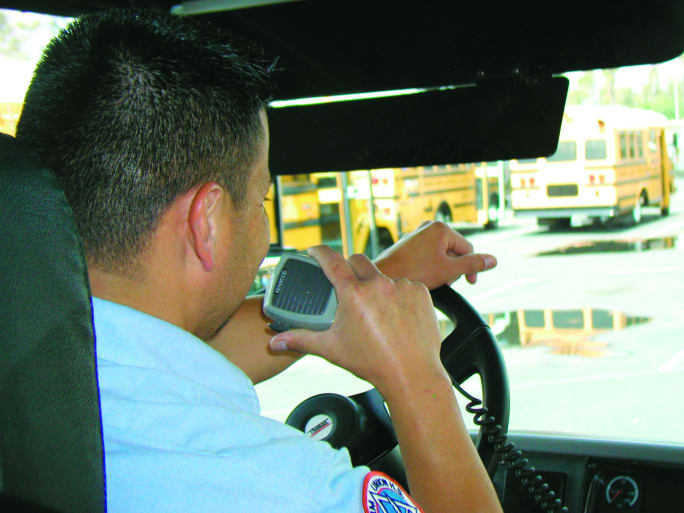
Intervention doesn't have to mean using physical force. Calling dispatch for help, stopping and securing the bus, and giving orders to the students are key steps in responding.
by Jesus Villahermosa Jr.
November 5, 2013
The one question most new drivers ask is always, “Do I have to physically intervene if someone is fighting on my bus?”
Credit:
This image was created in whole or part using GenAI
10 min to read
On July 9, 2013, John Moody did not know that his name and the bus he was driving would become the focus of this nation on the issue of whether a school bus driver has to break up a fight on the bus.
I have taught thousands of bus drivers around the U.S., and whenever I train on the issue of defensible use of force on the bus, it’s amazing to me that every single driver in the audience stays engaged in the training.
Ad Loading...
The longtime drivers ask questions that have been on their minds for years. The new drivers ask questions that they are afraid to ask their supervisors in fear that they will be told not to worry about it — or the infamous “You can’t lay a hand on a child on your bus” response.
In my more than 32 years in the law enforcement field and more than 27 years of private consulting, I have found that the training bus drivers receive is definitely not “reality based” for crisis response situations.
One example I can offer to make this point was when I provided some training for a client and the client’s 91 bus drivers. I decided to take all of the drivers who received my initial training out on the road on three different buses, where each driver was going to have to demonstrate the proper procedures for what to do if a fight broke out on their bus.
Even though during the training every bus driver was able to speak the steps out correctly, we discovered that when it came time for them to actually perform these procedures while I was on their bus with a stopwatch yelling out “Fight!”, every driver failed to complete all of the required steps under that simulated stress situation while the bus was in motion.
You see, there is training, and then there is reality training. Unfortunately, the aforementioned Gulfport, Fla., incident — and, earlier this year, the Alabama hostage situation in which school bus driver Charles Poland was killed by a gunman who took a 5-year-old student hostage — has given national pupil transportation supervisors and drivers what I refer to as a “reality awakening.”
Ad Loading...
Let me be clear that this is no fault of transportation organizations. We live in a reactive society where, if you bring up crisis before it occurs, you are considered paranoid or overthinking situations. In many cases, no training was ever considered in this arena for bus drivers even though the drivers themselves would tell you that they have been dealing with progressively more serious violent incidents on their buses for many years now.
I have always believed that if you want to know about how someone feels about their safety in their job, you should ask them and not the people they work for. Performing a climate survey of your drivers is very important.
What I will shed light on in this article is the infamous question all bus drivers ask when they start: “Do I have to physically intervene if someone is fighting on my bus?”
In the event of a school bus fight, one of the key steps in intervening is to immediately notify dispatch of the situation.
Get physical?
To answer that question, you first have to understand that there is no such thing as a “Good Samaritan” physical intervention law (aka a “Duty to Rescue” law) in any state in this country.
Let me make it clear that I am no lawyer, and I have no desire to be one. But I have testified as a use-of-force expert numerous times in superior courts in Washington state in various types of trials, so I do have some knowledge of when you are allowed to use force and when you are not required, legally, to do so.
Ad Loading...
No law can require citizens to put themselves or others in harm’s way in order to rescue someone else. This is the main issue to focus on when there is a fight on the bus.
Most states say you can use force, when reasonable and necessary, in the following circumstances:
Self defense
Defense of others
Self-inflicted injury
Property damage
In other words, it doesn’t matter whom you work for; no employers can take away these rights from you simply because you work for them.
Defending yourself
While teaching a group of certified staff at a high school in Washington state, I spoke to a teacher who was assaulted by a student. She told me that as the student was assaulting her, she curled up into a fetal position on the ground as he punched and kicked her repeatedly.
Ad Loading...
This shocked me, so I asked her why she didn’t defend herself, and her answer shocked me even more. She told me that when she got hired, it was made very clear to her that under no circumstances was she to lay her hands on any student. She said she was told, “Don’t ever touch the student.”
I am sure many of you were told the same thing when you were hired. What the administrator who told her this should have said was, “Don’t ever touch a student if you don’t have to.” That would be a clearer statement of what they wanted her to consider, but in no way does someone have the right to tell you that you can’t defend yourself if you are being attacked.
Some of you may be thinking, “Aha! I knew I could use force if I wanted to!” That may be true, but then comes the bad news. If you do use force as a driver to separate two kids fighting on a bus, you are opening the door for not only consideration for criminal charges if the force used is excessive, but also for civil liability if the force used is considered to be excessive, negligent, or grossly negligent.
That means the child’s parents can sue you and the school district for your actions, and if you acted outside of the scope of your training, a judge could rule that you alone will be responsible for any monetary amount that is awarded to the plaintiff. Your personal assets could be attached to by the plaintiff if you lose the tort action filed against you, which is something that most drivers would never even think about.
Don’t do nothing
The second question most drivers then ask me during the training is, “Can I also be sued if I do nothing to break up the fight?” The answer to the question exactly stated that way is, “Of course you can!”
Ad Loading...
If you actually had a fight start on your bus and you didn’t notify the dispatcher but just kept driving down the road, doing nothing about the fight, then, in my opinion, you should be sued and you need to consider another occupation, because it is obvious from your lack of action that you don’t care about your students.
But let’s take a look to see if John Moody in Gulfport, Fla., just stood by and did nothing, as the media initially reported. As I stated earlier, I have taught thousands of bus drivers around the country, and every agency or district I have trained for has a basic protocol that their drivers must follow that is similar to the following:
Immediately notify dispatch that there is a fight on your bus.
Provide your bus location.
Pull off to a safe area if possible.
Stop and secure the bus.
Provide directives to the students near the combatants to distance themselves from the combatants.
Order the combatants to stop fighting, but do not leave your driver’s seat area nor go back to the location of the fight.
So let’s take a look at what John Moody did. The following is an excerpt of an article published by WFLA.com describing Mr. Moody’s reaction to the fight on his bus, which was recorded by a surveillance camera:
“The bus driver, John Moody, can be heard yelling for somebody to try to stop them and calls dispatch for help, “I got a fight. I need help in a hurry. I got a fight. I need help in a hurry.”
Ad Loading...
The punches and kicks continue, and the victim falls between the seats. At one point you can hear his screams on the video. The bus driver yells at the attackers, “Leave that boy alone,” but doesn’t try to intervene physically.
Then he again calls dispatch to verify the address. “Get somebody out here quick, quick, quick. They’re about to beat this boy to death. There’s nothing I can do … please send somebody,” said Moody.
According to Pinellas school bus driver policy, the driver’s first duty is to call dispatch, and only has to step in if they think it’s safe. They’re not required to intervene.”
And there’s the point of this article: Any bus driver facing similar circumstances does not have to physically intervene, but, in my opinion, you are required to provide some type of intervention. Intervention includes calling dispatch to advise them of the fight on your bus and requesting assistance, bringing the bus to a safe stop, securing the bus and ordering the combatants to stop fighting — all of which Mr. Moody did.
Let’s not forget that Mr. Moody was a 64-year-old bus driver, and three extremely violent and aggressive suspects could just as easily have turned on Mr. Moody had he tried to physically intervene.
Ad Loading...
In fact, given the level of force the three suspects were using on the 13-year-old victim, I could see where if Mr. Moody had used force to stop the suspects, he would have been scrutinized for using too much physical force. Then the media would have asked what physical force training he had received to qualify him to use that level of force!
Jesus M. Villahermosa Jr. is president of Crisis Reality Training Inc. He has been a deputy sheriff with the Pierce County (Wash.) Sheriff’s Department since 1981.
Driver not charged
can understand why bus drivers in America today feel like it is a no-win situation either way, but take heart in knowing that the final decision by prosecutors reviewing Mr. Moody’s actions was to not file charges of child neglect against him.
Mr. Moody did take action and intervened to help as much as he could have given the limitations of his age, experience and training. I commend Pinellas County Schools for supporting their driver and for having a written policy that actually instructs their bus drivers to do exactly what Mr. Moody did. Take action to seek help, protect the other students on the bus, but don’t physically intervene in the fight.
We need to educate the public by making this incident with Mr. Moody more personal to them. Would the public have been just as enraged if the 64-year-old driver had been their mother or father? Would the prosecutor expect his older father or mother to engage these extremely violent youths that were perpetrating this act of violence? Of course not!
When you speak to someone about this incident, try to get them to empathize with you about the many challenges you face and the fact that almost every violent incident on your bus will probably involve someone younger, faster and stronger than you who is not required to act within a code of ethics or professionalism. When we can start doing that, I believe that the public, and the media, will be more empathetic to the risks that bus drivers are exposed to every day in this country.
Ad Loading...
Train for reality
It is time that bus drivers started to receive more reality-based training to prepare them for situations exactly like this and the Alabama hostage situation. We as a society are seeing acts of violence being carried out against schools, universities and bus drivers that we would have never fathomed 20 years ago.
Our “reality awakening” is occurring every day in this country, and if the public really wants for us to protect their children as best we can, we need to change the training for our education staff across America.
God bless our school bus drivers for serving in one of the most dangerous jobs in the field of education and for having the best statistics in the country for all modes of transportation. You should be proud of what you do and how you are doing it. Thank you for choosing to be a school bus driver.
Drive safely, stay aware and always protect yourselves and your students as best you can.
About the Author: Jesus M. Villahermosa Jr. is president of Crisis Reality Training Inc. He has been a deputy sheriff with the Pierce County (Wash.) Sheriff’s Department since 1981. In his consulting business, he has primarily focused on school-related and workplace violence. He has spoken to thousands of pupil transporters around the country on issues related to use of force, breaking up fights and responding to crises on the bus.
Is it time to strengthen your driver training? Here’s how to pick the right talent and improve recruitment, retention, and safety. This video is brought to you by IC Bus.
Four school bus crashes in Florida, Illinois, and Georgia highlight risks in transportation lots, at bus stops, and during student loading and unloading.
School bus fires are rare but can be devastating. Learn how advances in fire suppression and asset protection help fleets detect fires earlier, reduce damage, and improve safety.
Geotab Investigations combines telematics data, video, documents, and other evidence to help fleets reconstruct incidents, resolve claims, and determine what happened.
Sai Darshana Yekolu of Moseley Middle School in Prosper, Texas, was named the newest winner for her artwork, bringing the theme of “Safe Rides, Everyday Heroes” to life.
With diesel prices soaring and nearly one-third of transportation directors expecting budget cuts, maintaining student safety has never been more challenging. Download this guide to learn how leading districts are prioritizing risk, funding critical safety technology, and building stronger budget cases with data.
As thefts and overnight security threats continue, school transportation leaders are combining stronger operational practices with AI-enabled surveillance to better protect buses, facilities, and staff.
Steve Dowling is set to lead the federal agency's efforts to advance commercial motor vehicle safety and reduce crashes, fatalities, and injuries on the nation's roadways.