




Q&A: Industry Outlook Not All Gloomy
From a financial perspective, the current state of the pupil transportation industry can seem a bit bleak. Soaring diesel prices and other econ...

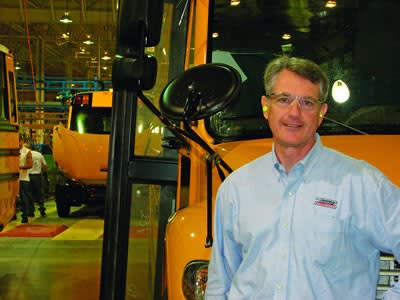
John O'Leary, president and CEO of Thomas Built Buses, says that plant improvements have enabled the company to build higher quality buses in a safer and more productive environment.
From a financial perspective, the current state of the pupil transportation industry can seem a bit bleak.
Soaring diesel prices and other economic factors have taken a sizeable toll on school bus operations’ budgets, and bus sales were down almost 15 percent last year.
Still, John O’Leary, president and CEO of Thomas Built Buses, points out reasons to be optimistic. The company recently renovated one of its manufacturing facilities, resulting in gains in efficiency, quality and safety.
Another boost, O’Leary says, has been the global purchasing strength of parent company Daimler.
He also notes that as alternative-fuel technologies advance, significant savings are in store.
O’Leary discussed these issues in a recent interview with SBF Executive Editor Thomas McMahon.
SBF: What would you say is one of the top concerns for school bus operators right now, and how does it affect their purchasing decisions?
JOHN O’LEARY: World oil prices are putting enormous inflationary pressure on budgets, both directly, in the price of diesel fuel, and indirectly, in just about everything else. The slump in the housing market has not yet fully impacted operators, but it will eventually as lower home valuations drive lower property tax receipts and, ultimately, shrink budgets.
What is the top challenge for school bus manufacturers right now?
For Thomas Built Buses the challenge really isn’t too different than what our customers face: how to continue providing a high quality and affordable product in the face of inflationary pressure and economic uncertainty.
Thomas Built’s 1408 Courtesy Road plant underwent a significant renovation process last year. What kind of results have you seen from that?
After we discontinued FS-65 production in Plant 1, we took the opportunity to optimize the main production line for our Type D products. We had also outgrown our Type A plant, and we were able to close it and move that product into a new optimized line in Plant 1 as well.
After investing $10 million in Plant 1, the Type A and D products now have highly efficient lines with new paint booths, concrete floors, lighting, conveyors and tooling. Most visitors are stunned by the transformation, which is nice. But more importantly, these changes enable us to build a higher quality bus in a safer and more productive environment for our employees.
Our research found that overall school bus sales were down almost 15 percent last year. How are sales this year?
Sales this year have definitely been off. Our dealer sales channel has performed strongly, but our state and direct sales channels have struggled, and these are traditionally areas of strength for us. However, with the investments in efficiency made in recent years, the leveraging of Daimler’s global purchasing strength, and the outstanding efforts made by our employees and dealers, we will still post solid results again in 2008.
This is important, as Thomas continues to make significant investments in its plants and products for the future.
In 2006, there was a sharp rise in sales, apparently due to school bus operators wanting to buy in advance of the EPA’s 2007 engine emission requirements. Do you expect a similar occurrence next year, in advance of the 2010 requirements?
Normally we would expect to see some customers with discretionary purchasing ability buying buses ahead of a significant price increase. However, if the current economic issues do not improve significantly in the next six months, we anticipate continued lower order activity instead of a sales bounce heading into 2010.
What’s the latest with the hybrid bus that Thomas Built is working on?
The Thomas Built C2 hybrid bus is continuing its testing program, and the next step is to engineer the hybrid drive system with the EPA 2010 engine. We will be displaying the hybrid prototype at a number of upcoming shows and industry events.
When do you expect it to be available for purchase?
We have said all along that we will market a hybrid when there is demand for it. We could undoubtedly sell 25 to 50 this year, but with the current technology price premium combined with pressure on budgets, we don’t see many customers who are actually in a position to purchase one. If suddenly demand exploded due to $6-per-gallon diesel or a large government grant program, we could bring the hybrid to market very quickly.
Do you think that, in general, hybrids will become a large part of the school bus market?
I think eventually hybrids will play a larger role in the school bus market, but just how large remains to be seen. In theory, the school bus is a perfect hybrid application. However, we have spoken to a number of operators who have been unimpressed by the minimal fuel economy improvements they have seen in real-world use of hybrid buses. There is still a lot of work to be done to reach the potential savings with this technology.
I do know that operators are paying much more attention to fuel economy than ever before and that it is being given much more consideration in the buying decision. This is good news for Thomas Built Buses, since we continue to hear from the field that the Mercedes engine is best-in-class for fuel economy.
Are there newer alternative-fuel technologies that you think may enter the school bus picture in the next decade or two?
Certainly on the far end of that time range, I would expect to see some hydrogen fuel cell technology employed. Our parent company, Daimler, currently has over 100 hydrogen-powered vehicles, including many city transit buses, in operation around the world. As hydrogen technology becomes more mature, costs will decrease. By way of comparison, a hydrogen- powered city transit bus today costs more than $1 million.
We also continue to see breakthroughs in battery technology, so it wouldn’t surprise me to see a purely electric bus in that time frame that could be recharged between runs, either using a significantly smaller diesel engine than today or perhaps going completely plugged in. If you really want to stretch your imagination, you can envision school buses in sunny states utilizing their large roof areas to collect solar energy, which is then converted to electricity to recharge the batteries. But that is probably outside the 20-year window you specified.
What are your thoughts on the rulemaking that the National Highway Traffic Safety Administration (NHTSA) has in the works on school bus occupant protection?
I think anything NHTSA does to firm up its rules on occupant protection is a good thing for us as a manufacturer.
Last year, Texas became the latest state to mandate seat belts, lap-shoulder belts specifically, on school buses. Do you expect more states to follow suit?
I do expect to see more states gradually heading in the direction of seat belts, as some of the operator objections to the additional equipment have been eliminated by lap-shoulder belts. Thomas Built Buses understands this is a complex issue, and we will continue to offer our customers a choice.
More Management

How to Build a Better Driver Training Program
Ready to boost up your school bus instructor training? Here’s how to pick the right talent and improve recruitment, retention, and safety.
Read More →
CALSTART and Forth Combine to Form Catalyst Mobility
The new name represents a renewed vision for the nonprofit focused on advancing clean, equitable, and affordable transportation solutions that move people and goods.
Read More →
What Makes a Great School Bus Driver Trainer?
Choosing the right school bus driver trainer takes more than experience. Learn six keys to selecting and developing trainers and evaluating program effectiveness.
Read More →

School Bus Contractors Expand Through New Deals, Acquisitions & Partnerships
STA's Canadian division acquires Ontario-based G&L Stevenson Transport while Durham School Services adds a new district contract in California, First Student adds a New Jersey contract, and Minnesota Coaches acquires Halo Transportation.
Read More →
Logan Bus Company Rolls Out AI Phone System for NYC School Bus Families
A summer pilot found that AI agents could handle most routine calls, freeing up time for customer service staff to focus on emergencies and complex family concerns.
Read More →
From Intent to Impact: What I Learned About Leadership from TAPT
A Texas transportation supervisor shares lessons on self-awareness, accountability, managing stress and building trust — and why investing in leadership development matters at every stage of your career.
Read More →
NAPT Names 2026 Award Recipients, Hall of Fame Inductee
Who earned national recognition for their work in student transportation? This year, NAPT named five recipients of its 2026 awards for service, safety, and leadership, plus its newest Hall of Famer.
Read More →
2026 State of Student Transportation Report
Driver shortages. Rising costs. Growing safety expectations. More data, but not enough time to act on it. The 2026 State of Student Transportation Report reveals what transportation leaders say is putting the most pressure on their operations—and where they’re investing next. See how your priorities compare.
Read More →
How to De-Escalate an Angry Person: 5 Steps for Handling Workplace Conflict
What makes emotions run high, and how should you handle an angry colleague or parent? Follow these steps for staying calm, listening, showing empathy, and resolving conflict.
Read More →
What Readiness Looks Like This School Year
Learn about the challenges shaping the 2026–2027 school year, from persistent driver shortages and budget pressure to technology and readiness gaps. See how school districts are responding and adapting in Zonar’s 2026 Back-to-School Readiness Report.
Read More →