




How to Keep Your Fleet Healthy in Cold Weather
To proof your buses against frigid temperatures, pay attention to tires, fuel, belts and hoses. And don't ignore driver training.
It’s never too early to start on your winter maintenance plan, but it can be too late. In fact, if you haven’t winterized your fleet by the time you read this, you’re running a little behind schedule. But don’t despair. Many of the following strategies on winter planning can be put into place year-round. And many of them also can be implemented in the next few weeks without much fanfare. To find out how various fleets handle winter preparation, we talked to transportation supervisors and fleet managers in relatively harsh climates like the Northeast, Midwest and Alaska. Their strategies vary according to climate, road conditions, age of fleet and size of garage staff, but most fleets try to prepare early or to stay prepared year-round.
Weaknesses revealed
"Cold weather will bring out the worst in your fleet," warns Fred Krueger, garage manager at Livonia Public Schools in Michigan. "If a battery’s weak, it’s going to show up in the cold. If a belt’s bad, it will show up." The best strategy, he says, is to set up a program that doesn’t need much modification for the weather. "We try to stay on top of the charging system and belts and hoses of the cooling system all year long, because in Michigan, winter seems like it’s never far away," Krueger says. He adds, however, that Livonia, a suburb of Detroit, has four distinct seasons. "There’s no sense in trying to tailor the program for any one season, because three months later it will be over." To avoid having to modify the fuel blend for each season, Krueger burns a winter-blended diesel all year. "It’s a Grade 1 fuel, so I don’t have to put any additives in it," he says. Nor does Krueger flush the antifreeze on a regular basis. He says the antifreeze typically lasts as long as the radiator, about five years. His motor oil of choice — a standard 15W-40 — is also good for year-round use. Krueger does make one concession to the weather, however. On extremely cold mornings, he’ll have his mechanics warm up all the buses for the drivers. "If it’s five degrees or below, then we’ll come in and fire them all up," he says, adding that six mechanics can start all 130 buses in 45 minutes or so. In addition, Krueger keeps a supply of ether handy to help start the stubborn, older buses.
Tires need inspection
In Horseheads, N.Y., the weather can turn nasty in the winter. Harry Schulz, a bus mechanic at Horseheads Central School District, says temperatures can reach 30 degrees below zero. On rare occasions, the wind chill factor dips so low that classes are canceled because administrators fear the children could suffer frostbite on their way to school or waiting at the bus stop. Despite the potential for bitter cold, the transportation department doesn’t modify its regular preventive maintenance program for its 75 buses. It does, however, ensure that snow tires, which are run on all buses year round, are matched to the routes. The buses that have to travel into rural, hilly areas will be fitted with the snow tires with the deepest tread. Schulz says the formula of the diesel fuel is modified to include anti-gel additives. Occasionally, ether is used to help start the older engines. He says the engines with glow plugs have not been a problem to start.
Drivers take a spin
Wayne Johnston, transportation director at the School District of Springfield Township in Oreland, Pa., runs a 41-bus operation. He doesn’t wait until the weather turns cold before using a diesel fuel additive. "The fuel has to be treated all year," he says. In the summer, warm fuel is put into cool underground tanks. That leads to condensation, which the additives can help to eliminate. Although he doesn’t have a special maintenance program for winter, Johnston makes sure that drivers are aware that inclement weather can make their jobs difficult and dangerous. He discusses winter-driving precautions during monthly driver meetings at the beginning of the school year and publishes tips in the department newsletter. When the snow finally arrives, Johnston goes a step further with his driver training. "The first time it snows, we ask our drivers to take a bus into our high school parking lot, spin it around in the snow and get used to what happens when you lose control," he says. "That way, when it happens on the road, they’ll know what to do to get the bus back under control."
Don’t shock the drivers
In Milwaukee, Laidlaw Transit keeps a close eye on its 70-bus fleet during the winter months. According to Dennis Brown, shop manager, that means ensuring that the buses are inspected regularly and that support equipment, such as block heaters, is operational. "We also check to make sure that the outside outlets are working," he says. "We don’t want the drivers to get shocked." With cold weather approaching, Brown makes it a practice to inspect heater ducts, heater filters and defroster motors. "Just because it’s winter, it may take more power to operate all of the mechanical things on the bus, like blower motors," he says. It’s also important to encourage drivers to be meticulous about their pre-trip inspections. "They need to make sure that there’s nothing leaking underneath and that the bus has been plugged in for the night," he says. Drivers also need to be sure that their fuel tanks are at least three-quarters full in the winter. "When they run the fuel down, condensation can collect around the fuel filter and freeze, which cuts off the fuel."
No surprises in Alaska
In Anchorage, Alaska, harsh winters are the norm. From December through March, residents can expect 35 days of snow and average high temperatures around 27 degrees. Steve Kalmes, transportation director at Anchorage School District, says all 114 buses are equipped with automatic chains as well as a set of manual chains. In addition, the buses run on siped tires all year. "We did a test 20 years ago in comparing siped tires with studded tires, and we found that siped tires were more effective," Kalmes says. To pre-heat engines and to keep them warm during layovers, Anchorage’s buses are equipped with auxiliary diesel-fired engine heaters. "These heaters run on timers, and the drivers can set them so they fire up about an hour before they actually come on duty," Kalmes says. The auxiliary heaters also have the benefit of reducing tailpipe emissions. A warmed-up engine doesn’t need to idle as long as a cold engine, and drivers don’t need to keep engines running during layovers. "In the winter months, emissions are a problem, so we do what we can to minimize that," Kalmes says. Jay Adams, supervisor of vehicle maintenance, says the buses have been using synthetic motor oils for the past seven or eight years because they help in cold starts. "We have very few problems, compared to when we used petroleum-based oil," he says. District buses are spec’d to relieve some of the difficulties of cold-weather driving. In addition to automatic snow chains, buses are equipped with heated mirrors, winter wiper blades and thermopane windows in the first couple of seating rows (for improved visibility for the driver). Drivers are prepped for winter driving as part of the back-to-school sessions. "They need to be sure that they know how to apply chains and that the chains actually fit their bus," Adams says.
Cold-weather maintenance checklist
Regular preventive maintenance is essential year round, but special considerations need to be taken when temperatures dip below freezing. Navistar International provides the following recommendations for cold-weather maintenance of school buses:
Check all rubber parts (hoses, fan belts, etc.) on a weekly basis.
Check all electrical wiring and connections for any frays or damaged insulation.
Try to keep batteries fully charged and warm.
Keep tanks as full as possible to prevent condensation on exposed tank walls.
Fill fuel tank when engine will be shut off for eight hours or more.
Check air cleaners and air inlet daily, or as necessary, when working in snow.
An underhood air valve can also be used to ensure that snow and ice will not block air inlet.
Diesel engines require different grades of fuel during extremely cold weather. In temperatures below 20 degrees, use diesel 1-D or winterized 2-D fuel. Either fuel should have a minimum cetane rating of 45. [When confronted with severe arctic cold weather conditions where the pour point of fuel requires low cetane, additives are required to supplement the fuel.]
More Maintenance
The Essential Guide to School Bus Maintenance and Student Safety
Your district's buses carry students to school every day. This guide shows how predictive maintenance powered by fleet data helps keep buses reliable, drivers accountable and students safer from the first bell to the last stop.
Read More →
Kerry Brothers Grows Michigan School Bus Repair Network
The acquisition of Downriver Truck and Bus expands Kerry Brothers’ school bus maintenance footprint across southeast Michigan, adding repair capacity, diagnostic resources, and state inspection support.
Read More →
Noregon Introduces CAN Bus Diagnostic Tool, Expands JPRO Features
CAN Mentor and the latest JPRO update aim to simplify vehicle network diagnostics and improve repair efficiency for technicians of all experience levels.
Read More →
Cummins on Smarter, Simpler Engine Innovation
Cummins discusses its first-ever gasoline engine for school buses, EPA 2027, and why bus fleets still want durable, simpler internal combustion options.
Read More →
Report: 72% of Diesel School Buses Now Use Advanced Low-Emission Engines
New data shows advanced low-emission diesel technology continues expanding across school bus fleets, even as electric bus adoption gains momentum.
Read More →
Vampire Tools' CAIMAN 7.5-Inch Multi-Purpose Screw Extractor Long-Nose Pliers with Crimper
Vampire Tools introduced the VAMPLIERS Caiman 7.5-inch multi-purpose pliers, combining screw extraction, cutting, crimping, and gripping functions into a single tool designed for fleet maintenance professionals.
Read More →
How Advanced Diagnostics Helps Bus Fleets Stay Ahead of Repairs
Chat with Noregon’s Kevin Smallhorn at ACT Expo about bus diagnostic tools, telematics integration, CNG maintenance support, and strategies to help reduce downtime and improve uptime.
Read More →
How School Bus Fleets are Getting Ahead of Breakdowns
Don’t let bus downtime wear you down. Here’s how bus operators are shifting from manual processes to AI-powered, data-driven maintenance systems for improved reliability and safety.
Read More →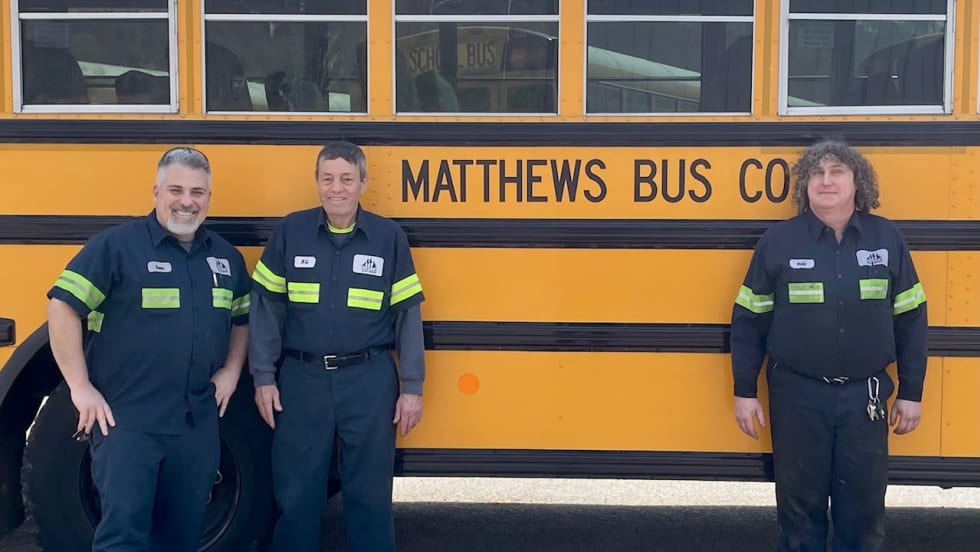
Pennsylvania School Bus Maintenance Team Praised for Dedication to Safety
Matthews Bus Company’s West Jefferson received a letter of commendation from the Pennsylvania State Police for their fleet inspections.
Read More →
From Chaos to Clarity: How School Districts Are Running Leaner Transportation Operations
Covering 38 routes on a Friday afternoon. Buses idling while routes overlap. Parents calling nonstop about late arrivals. Sound familiar? This whitepaper explores how district transportation leaders solved these exact problems — and what measurable results followed.
Read More →